
ᐅ Is it sensible to speed up the drying of screed with underfloor heating?
Created on: 5 Apr 2018 16:59
M
McEgg
Hello,
On April 3rd, the screed was installed in the house. The original plan was to start the underfloor heating after one week, using the screed drying program. Since the schedule has been delayed, the builder now wants to gain time by increasing the underfloor heating to full power after just one week (however that may work).
The site manager mentioned that this could cause cracks in the screed. If that happens, they would seal the cracks with a special resin.
My question is whether this is a good idea and if there might be any problems later on. On one hand, I want everything to be done properly. On the other hand, it would be helpful to make up for lost time since the rental apartment has already been terminated.
What do you think about this?
On April 3rd, the screed was installed in the house. The original plan was to start the underfloor heating after one week, using the screed drying program. Since the schedule has been delayed, the builder now wants to gain time by increasing the underfloor heating to full power after just one week (however that may work).
The site manager mentioned that this could cause cracks in the screed. If that happens, they would seal the cracks with a special resin.
My question is whether this is a good idea and if there might be any problems later on. On one hand, I want everything to be done properly. On the other hand, it would be helpful to make up for lost time since the rental apartment has already been terminated.
What do you think about this?

Expert Guide: Heating Protocols for Different Types of Screed
What is a heating protocol? How is it used during the heating of the screed? Where can it be obtained and who is responsible for maintaining the protocol? What exactly is recorded in it?
The heating protocol is a regulation for the controlled functional testing, readiness for covering, and cooling down of screed with underfloor heating. It serves as documentation of the work steps, has the status of an official document, and must be provided to the contractor no later than before the final floor covering is installed.
Regulations for Installing Screed with Underfloor Heating
Underfloor heating essentially forms the heating layer in the systematically and, in this sense, layered structure of the floor. The floor heated in this way must be planned so that all components, starting from the subfloor through the insulation, the underfloor heating system itself, up to the surface covering, are optimally coordinated to create a permanently functional unit that meets all energy efficiency requirements.
The materials and installation techniques used must comply with both the current state of the art, as well as the relevant technical datasheets and installation guidelines of the respective system providers and manufacturers. Regarding the professional heating of screed, the following standards are important:
For underfloor heating, a heating protocol must be maintained and submitted to the floor layer in accordance with VOB DIN 18365 Floor Covering Works. Guidance on coordinating all parties involved in planning and execution can be found in "Interface Coordination for Heated Floor Constructions" by the Federal Association of Surface Heating Systems (BVF).
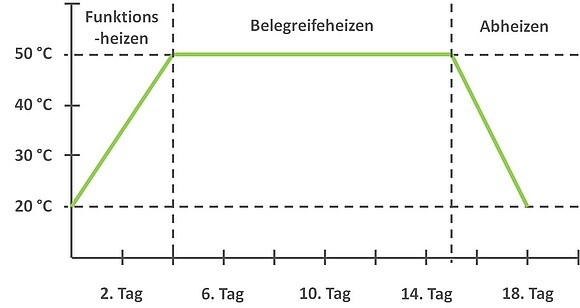
Schematic representation of the recorded flow temperature profile in underfloor heating during the heating, readiness for covering, and cooling phases of screed. (Graphic: Energie-Experten.org)
Expert Knowledge: When installing underfloor heating, a special type of screed called heated screed is used instead of conventional screed. Among other differences, the guidelines for acceptable residual moisture in heated screed differ from those of conventional screed without underfloor heating.
Process of Screed Drying According to Protocol
For commissioning underfloor heating beneath the screed, there are regulations that precisely define the procedure. Strictly following the prescribed steps is crucial because only then the heated screed will dry professionally and without damage and can be covered with the final floor finish. This is also referred to as the readiness of the screed for covering, which is achieved through the regulated heating process.
After the screed is applied and has sufficiently rested, as well as after the functional test—that is, the leak test of the underfloor heating pipes—the readiness of the screed for covering must be ensured through controlled heating of the structure according to the so-called heating protocol (also called the action protocol) for the preparation and installation of elastic, textile coverings as well as parquet and wooden floors.[/B]
What is a heating protocol? How is it used during the heating of the screed? Where can it be obtained and who is responsible for maintaining the protocol? What exactly is recorded in it?
The heating protocol is a regulation for the controlled functional testing, readiness for covering, and cooling down of screed with underfloor heating. It serves as documentation of the work steps, has the status of an official document, and must be provided to the contractor no later than before the final floor covering is installed.
Regulations for Installing Screed with Underfloor Heating
Underfloor heating essentially forms the heating layer in the systematically and, in this sense, layered structure of the floor. The floor heated in this way must be planned so that all components, starting from the subfloor through the insulation, the underfloor heating system itself, up to the surface covering, are optimally coordinated to create a permanently functional unit that meets all energy efficiency requirements.
The materials and installation techniques used must comply with both the current state of the art, as well as the relevant technical datasheets and installation guidelines of the respective system providers and manufacturers. Regarding the professional heating of screed, the following standards are important:
- DIN 18353, edition 2016-09: German Construction Contract Procedures (VOB) - Part C: General Technical Specifications for Construction Services (ATV) - Screed Works
- DIN 18560-2, edition 2009-09: Screeds in Building Construction - Part 2: Screeds and Heated Screeds on Insulation Layers (Floating Screeds)
- DIN 18365:2015-08: German Construction Contract Procedures (VOB) - Part C: General Technical Specifications for Construction Services (ATV) - Floor Covering Works
- DIN EN 1264-4:2009-11: Floor Heating and Cooling Systems with Water Flow - Part 4: Installation; German version EN 1264-4:2009
For underfloor heating, a heating protocol must be maintained and submitted to the floor layer in accordance with VOB DIN 18365 Floor Covering Works. Guidance on coordinating all parties involved in planning and execution can be found in "Interface Coordination for Heated Floor Constructions" by the Federal Association of Surface Heating Systems (BVF).
Schematic representation of the recorded flow temperature profile in underfloor heating during the heating, readiness for covering, and cooling phases of screed. (Graphic: Energie-Experten.org)
Expert Knowledge: When installing underfloor heating, a special type of screed called heated screed is used instead of conventional screed. Among other differences, the guidelines for acceptable residual moisture in heated screed differ from those of conventional screed without underfloor heating.
Process of Screed Drying According to Protocol
For commissioning underfloor heating beneath the screed, there are regulations that precisely define the procedure. Strictly following the prescribed steps is crucial because only then the heated screed will dry professionally and without damage and can be covered with the final floor finish. This is also referred to as the readiness of the screed for covering, which is achieved through the regulated heating process.
After the screed is applied and has sufficiently rested, as well as after the functional test—that is, the leak test of the underfloor heating pipes—the readiness of the screed for covering must be ensured through controlled heating of the structure according to the so-called heating protocol (also called the action protocol) for the preparation and installation of elastic, textile coverings as well as parquet and wooden floors.[/B]
Similar topics