
ᐅ House construction, KfW 70 standard, approximately 150 m² – which heating system? Gas boiler or air-to-water heat pump?
Created on: 14 Apr 2015 12:58
L
LittleWulfL
LittleWulf14 Apr 2015 12:58Hello, we plan to start building our own home this year. For various reasons, we want to work with a provider that offers a complete service package. Currently, we are deciding between Fischer Bau and Helma.
About our house:
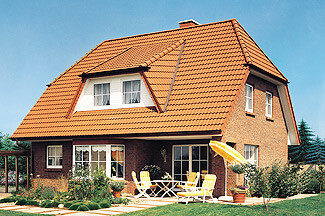
We are about 95% sure that it will be the house shown in the attachment (attachment: image from the provider Fischer Bau).
We aim to achieve KFW70 standard. No basement, underfloor heating throughout the house, blinds all around, additional towel radiator in the bathroom, brick facade, and a hip roof with a dormer.
The plot is located in a village; the roof area (with dormer) probably faces south-southeast.
I have been researching and reading about all aspects of building a house for some time now. So far, I have been quite interested in the air-to-water heat pump. It seems to be a good and reliable heating system that is somewhat future-proof. However, the more I have looked into air-to-water heat pumps, the more negatives I have found.
Both providers initially proposed a gas heating system with solar panels in their basic offers. However, upon my inquiries, both also offered an air-to-water heat pump with ventilation and exhaust air heat recovery as an alternative.
At the moment, I am quite unsure what the best heating system for our house is. Many statements about air-to-water heat pumps, such as them being very noisy and inefficient, come from the years 2010–2012. I am not sure if that is still accurate. Gas is basically not bad either, a solid heating medium with mature technology.
I hope to receive some comments and suggestions here on how best to approach this. I think ventilation and exhaust ventilation are important today since houses are very airtight, and one cannot or does not ventilate as often as needed.
But gas? Solar? Air-to-water heat pump?
I am somewhat overwhelmed by the information, and I really can’t find any independent or unbiased advice.
---------------------------------
Hello,
I have edited your post regarding the link; please observe the forum rules. Thank you!
Best regards, Bauexperte
Bauexperte
About our house:
We are about 95% sure that it will be the house shown in the attachment (attachment: image from the provider Fischer Bau).
We aim to achieve KFW70 standard. No basement, underfloor heating throughout the house, blinds all around, additional towel radiator in the bathroom, brick facade, and a hip roof with a dormer.
The plot is located in a village; the roof area (with dormer) probably faces south-southeast.
I have been researching and reading about all aspects of building a house for some time now. So far, I have been quite interested in the air-to-water heat pump. It seems to be a good and reliable heating system that is somewhat future-proof. However, the more I have looked into air-to-water heat pumps, the more negatives I have found.
Both providers initially proposed a gas heating system with solar panels in their basic offers. However, upon my inquiries, both also offered an air-to-water heat pump with ventilation and exhaust air heat recovery as an alternative.
At the moment, I am quite unsure what the best heating system for our house is. Many statements about air-to-water heat pumps, such as them being very noisy and inefficient, come from the years 2010–2012. I am not sure if that is still accurate. Gas is basically not bad either, a solid heating medium with mature technology.
I hope to receive some comments and suggestions here on how best to approach this. I think ventilation and exhaust ventilation are important today since houses are very airtight, and one cannot or does not ventilate as often as needed.
But gas? Solar? Air-to-water heat pump?
I am somewhat overwhelmed by the information, and I really can’t find any independent or unbiased advice.
---------------------------------
Hello,
I have edited your post regarding the link; please observe the forum rules. Thank you!
Best regards, Bauexperte
Bauexperte
L
LittleWulf14 Apr 2015 14:54Unfortunately, I was unable to find the button to edit my post.
Here is an update on the heating system we were offered by one of the suppliers. We will receive the second offer on Saturday.
Vaillant solar gas compact unit with condensing technology, auroCOMPACT VSC S 206/4-5 150 with a 150-liter (40-gallon) stratified storage tank and 2 flat-plate collectors with a gross collector area of 5.02m² (54 sq ft) VFK 145V, including complete accessories for the solar station and the solar controller Auromatic 560/2.
Here is an update on the heating system we were offered by one of the suppliers. We will receive the second offer on Saturday.
Vaillant solar gas compact unit with condensing technology, auroCOMPACT VSC S 206/4-5 150 with a 150-liter (40-gallon) stratified storage tank and 2 flat-plate collectors with a gross collector area of 5.02m² (54 sq ft) VFK 145V, including complete accessories for the solar station and the solar controller Auromatic 560/2.
Before choosing a system, a heating load calculation should be available (although it can be roughly estimated—especially for model homes). There is initially little against gas and solar—KFW70 standards can also be achieved with them (provided the rest is right).
When comparing the heating costs of an air-to-water heat pump with gas, you may find that gas is actually cheaper, as well as in terms of investment costs. The advantage of an air-to-water heat pump is independence from gas and no need for a gas line—but even with a gas line, gas heating is often still cheaper than an air-to-water heat pump.
By the way, air-to-water heat pumps are not really more ecological—unless you generate the electricity yourself or the system is very efficient.
Furthermore, air-to-water heat pumps are significantly more prone to planning mistakes—if it is incorrectly sized, or the underfloor heating is installed incorrectly (e.g., spaced too far apart), costs can quickly rise (I will explain soon).
If the KFW70 house only reaches KFW70 with the air-to-water heat pump (and the insulation is not adequate), I would advise against it based on experience. The heating system relies partly on heating very little or operating with very low flow temperatures (every degree reduces efficiency). If some rooms have high heat loss, for example, if the living room has 6 meters (20 feet) of windows with a Ug of 0.9 and a Uf of 1.3, and the underfloor heating is installed with a 20cm (8 inches) spacing, the air-to-water heat pump will struggle and switch on the electric backup heater during deep winter, which wastes money.
What I have read recently is that frequency-controlled air-to-water heat pumps perform very well—I recommend researching this as well.
Check the pink forum, where heating systems are discussed daily. There is no such thing as the wrong heating system—it always depends on the building you are constructing, its location, its use, the quality of planning, and personal preferences.
When comparing the heating costs of an air-to-water heat pump with gas, you may find that gas is actually cheaper, as well as in terms of investment costs. The advantage of an air-to-water heat pump is independence from gas and no need for a gas line—but even with a gas line, gas heating is often still cheaper than an air-to-water heat pump.
By the way, air-to-water heat pumps are not really more ecological—unless you generate the electricity yourself or the system is very efficient.
Furthermore, air-to-water heat pumps are significantly more prone to planning mistakes—if it is incorrectly sized, or the underfloor heating is installed incorrectly (e.g., spaced too far apart), costs can quickly rise (I will explain soon).
If the KFW70 house only reaches KFW70 with the air-to-water heat pump (and the insulation is not adequate), I would advise against it based on experience. The heating system relies partly on heating very little or operating with very low flow temperatures (every degree reduces efficiency). If some rooms have high heat loss, for example, if the living room has 6 meters (20 feet) of windows with a Ug of 0.9 and a Uf of 1.3, and the underfloor heating is installed with a 20cm (8 inches) spacing, the air-to-water heat pump will struggle and switch on the electric backup heater during deep winter, which wastes money.
What I have read recently is that frequency-controlled air-to-water heat pumps perform very well—I recommend researching this as well.
Check the pink forum, where heating systems are discussed daily. There is no such thing as the wrong heating system—it always depends on the building you are constructing, its location, its use, the quality of planning, and personal preferences.
B
Bieber081514 Apr 2015 22:15Solar? Solar thermal for hot water or photovoltaic for electricity? Most likely solar thermal...
UG? Uf? Pink? (feel free to private message, I only know a green (?) forum, ah, the vastness of the web...)
Going by instinct:
- Central ventilation with heat recovery (for a comfortable indoor climate)
- Underfloor heating with gas condensing boiler
- Solar thermal supporting hot water production
Get a price quote for this. Also, get a comparative price for an air-to-water heat pump. Then report back here.
UG? Uf? Pink? (feel free to private message, I only know a green (?) forum, ah, the vastness of the web...)
Going by instinct:
- Central ventilation with heat recovery (for a comfortable indoor climate)
- Underfloor heating with gas condensing boiler
- Solar thermal supporting hot water production
Get a price quote for this. Also, get a comparative price for an air-to-water heat pump. Then report back here.
L
LittleWulf15 Apr 2015 08:39I can say quite clearly that an air-to-water heat pump is always more expensive than the gas/solar thermal options. But your brief summary, Bieber, is actually what has been more appealing to me since this week. A classic, well-established gas system with solar-assisted hot water, and then additionally (which unfortunately nobody offers as a standard) ventilation with heat recovery.
Regarding the ventilation, there is one option with "holes in the wall" and a proper system from Vaillant.
Which would you recommend?
Regarding the ventilation, there is one option with "holes in the wall" and a proper system from Vaillant.
Which would you recommend?
It’s not entirely clear. There are also air-to-water heat pump units available for just over 3,000 euros – but these are usually not offered to you. In general, that’s true, of course.
A matter of opinion. You will probably be advised to go for a central system – quieter, more aesthetically pleasing, generally better heat recovery, possibly more energy-efficient, etc. – but then you have concealed pipes inside the house where rats, spiders, and martens can nest.
A matter of opinion. You will probably be advised to go for a central system – quieter, more aesthetically pleasing, generally better heat recovery, possibly more energy-efficient, etc. – but then you have concealed pipes inside the house where rats, spiders, and martens can nest.
Similar topics