
ᐅ House construction, KfW 70 standard, approximately 150 m² – which heating system? Gas boiler or air-to-water heat pump?
Created on: 14 Apr 2015 12:58
L
LittleWulf
Hello, we plan to start building our own home this year. For various reasons, we want to work with a provider that offers a complete service package. Currently, we are deciding between Fischer Bau and Helma.
About our house:
We are about 95% sure that it will be the house shown in the attachment (attachment: image from the provider Fischer Bau).
We aim to achieve KFW70 standard. No basement, underfloor heating throughout the house, blinds all around, additional towel radiator in the bathroom, brick facade, and a hip roof with a dormer.
The plot is located in a village; the roof area (with dormer) probably faces south-southeast.
I have been researching and reading about all aspects of building a house for some time now. So far, I have been quite interested in the air-to-water heat pump. It seems to be a good and reliable heating system that is somewhat future-proof. However, the more I have looked into air-to-water heat pumps, the more negatives I have found.
Both providers initially proposed a gas heating system with solar panels in their basic offers. However, upon my inquiries, both also offered an air-to-water heat pump with ventilation and exhaust air heat recovery as an alternative.
At the moment, I am quite unsure what the best heating system for our house is. Many statements about air-to-water heat pumps, such as them being very noisy and inefficient, come from the years 2010–2012. I am not sure if that is still accurate. Gas is basically not bad either, a solid heating medium with mature technology.
I hope to receive some comments and suggestions here on how best to approach this. I think ventilation and exhaust ventilation are important today since houses are very airtight, and one cannot or does not ventilate as often as needed.
But gas? Solar? Air-to-water heat pump?
I am somewhat overwhelmed by the information, and I really can’t find any independent or unbiased advice.
---------------------------------
Hello,
I have edited your post regarding the link; please observe the forum rules. Thank you!
Best regards, Bauexperte
Bauexperte
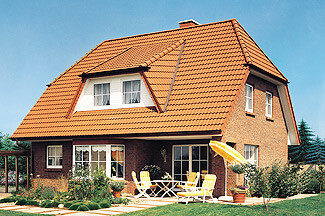
About our house:
We are about 95% sure that it will be the house shown in the attachment (attachment: image from the provider Fischer Bau).
We aim to achieve KFW70 standard. No basement, underfloor heating throughout the house, blinds all around, additional towel radiator in the bathroom, brick facade, and a hip roof with a dormer.
The plot is located in a village; the roof area (with dormer) probably faces south-southeast.
I have been researching and reading about all aspects of building a house for some time now. So far, I have been quite interested in the air-to-water heat pump. It seems to be a good and reliable heating system that is somewhat future-proof. However, the more I have looked into air-to-water heat pumps, the more negatives I have found.
Both providers initially proposed a gas heating system with solar panels in their basic offers. However, upon my inquiries, both also offered an air-to-water heat pump with ventilation and exhaust air heat recovery as an alternative.
At the moment, I am quite unsure what the best heating system for our house is. Many statements about air-to-water heat pumps, such as them being very noisy and inefficient, come from the years 2010–2012. I am not sure if that is still accurate. Gas is basically not bad either, a solid heating medium with mature technology.
I hope to receive some comments and suggestions here on how best to approach this. I think ventilation and exhaust ventilation are important today since houses are very airtight, and one cannot or does not ventilate as often as needed.
But gas? Solar? Air-to-water heat pump?
I am somewhat overwhelmed by the information, and I really can’t find any independent or unbiased advice.
---------------------------------
Hello,
I have edited your post regarding the link; please observe the forum rules. Thank you!
Best regards, Bauexperte
Bauexperte
L
LittleWulf15 Apr 2015 19:50A decentralized system is probably cheaper.
However, since we started looking at houses, I’ve never liked the idea of having those holes in the wall – and those ugly covers.
The centralized system is likely more expensive, but right now, our provider is offering the Vaillant recoVair for negotiation.
Regarding efficiency or performance, I haven’t seen any discussion in the other forum about whether the “hole-in-the-wall decentralized” system differs from the “machine in the utility room with pipes running through the house to each room centralized” system.
By the way, here are my questions about the wall structure and insulation:
https://www.hausbau-forum.de/threads/wir-wollen-bauen-ist-das-was-uns-angeboten-wird-so-i-o.12269/
However, since we started looking at houses, I’ve never liked the idea of having those holes in the wall – and those ugly covers.
The centralized system is likely more expensive, but right now, our provider is offering the Vaillant recoVair for negotiation.
Regarding efficiency or performance, I haven’t seen any discussion in the other forum about whether the “hole-in-the-wall decentralized” system differs from the “machine in the utility room with pipes running through the house to each room centralized” system.
By the way, here are my questions about the wall structure and insulation:
https://www.hausbau-forum.de/threads/wir-wollen-bauen-ist-das-was-uns-angeboten-wird-so-i-o.12269/
 EveundGerd17 Apr 2015 01:14
As with the type of heating system, ventilation also depends on your budget and, beyond that, is a matter of personal preference.
The important thing is to gather good information. In the end, your gut feeling will probably make the final decision.
The important thing is to gather good information. In the end, your gut feeling will probably make the final decision.

BeHaElJa schrieb:
a) Do you live in a noisy or quiet environment? -> noisy: centralized, quiet: centralized/decentralized
b) Is the budget very tight? -> no: centralized, yes: decentralized (generally somewhat cheaper)
c) Are you worried about the risk of pipe leaks? -> no: centralized/decentralized, yes: decentralized
d) Do you plan to rent out a floor at some point? -> no: centralized/decentralized, yes: rather decentralized (otherwise there might be conflicts about drafts – although outlets could possibly be reduced?!
e) Do you care about aesthetics? -> yes: centralized, no: centralized/decentralized
f) Are you very sensitive to noise? -> yes: centralized, no: decentralized/centralized
g) Is your building inspector/planning authority pushing you toward a specific solution? -> take the one they prefer; others might not be approved or accepted -> This nice little list could almost be pinned as a decision guide for ventilation systems in a separate thread at the top? I think it sums it up quite well!
Bauexperte schrieb:
Clean ... but what about the extraction of the gas?If you follow that logic, you'd have to build a passive house. Electricity is not exactly ecological either, and the production of heating systems is definitely not environmentally friendly... But sure, topics like fracking are not great and argue against using gas.
However, from an economic perspective, the initial investment for gas (or sometimes even for an air-source heat pump) is the most affordable. And even if you have, for example, 300 euros more in heating costs per year, that amounts to only around 6,000 euros additional over 20 years. I would say that a ground-source heat pump with trench collectors easily costs more than 6,000 euros extra compared to a gas boiler.

BeHaElJa schrieb:
a) Do you live in a noisy or quiet environment? -> noisy: central system, quiet: central/decentralized
b) Is your budget very limited? -> no: central system, yes: decentralized system (generally somewhat cheaper)
c) Are you worried about potential pipe noise? -> no: central/decentralized, yes: decentralized
d) Do you plan to rent out a floor at some point? -> no: central/decentralized, yes: rather decentralized (otherwise you might argue about drafts – although you could possibly reduce vents?!
e) Do you care about the appearance? -> yes: central, no: central/decentralized
f) Are you very sensitive to noise? -> yes: central, no: decentralized/central
g) Is your builder or project manager pushing you toward a certain solution? -> choose that one, the others are not accepted or liked Regarding e), I would add that visible piping inside rooms would also be visually unappealing to me (I know there are systems where pipes are routed differently).
WildThing schrieb:
-> This nice little list could almost be pinned as a separate post at the top as a decision aid for ventilation systems? I think it fits quite well! I like this suggestion. Perhaps the moderators could set something up.
WildThing schrieb:
But economically speaking, the purchase costs for gas (or sometimes still for an air source heat pump) are the cheapest. And even if, for example, you have 300 euros more heating costs per year, over 20 years that is still “only” 6,000 euros in additional expenses. And I’d say that, for example, a ground source heat pump with trench collectors easily costs more than 6,000 euros more than a gas boiler. Well – we paid about 14,000 to 15,000 euros all in for the geothermal system.
With gas, you also have to budget for connection fees and an annual chimney sweep. Furthermore, future gas prices are really hard to predict – but the same applies to electricity prices as well.
EveundGerd17 Apr 2015 10:06f-pNo schrieb:
Well – we paid around 14,000 to 15,000 EUR in total for the ground source heat pump.
With gas, you also have to consider connection fees and the annual chimney sweep. Additionally, the development of gas prices is hard to predict – but this also applies to electricity prices. That is low.
Ground source heat pump would have been our next choice after gas. However, the costs would have been significantly higher: drilling about 10,000 EUR plus the heating system around 12,000 EUR, plus the suitable building envelope: additional costs nearly 13,000 EUR.
Our gas heating system with solar support and a 210 l (55 gallons) hot water storage tank, including a 60 m (200 feet) supply trench and house connection, cost just under 6,000 EUR.
Our considerations: for 29,000 EUR we can heat for a long time and pay the chimney sweep once a year with 45 EUR.
If our gas heating needs to be replaced in 8–10 years, we could switch to another system. The prerequisites for this have already been created through the close spacing of the underfloor heating.
Similar topics