
Hello,
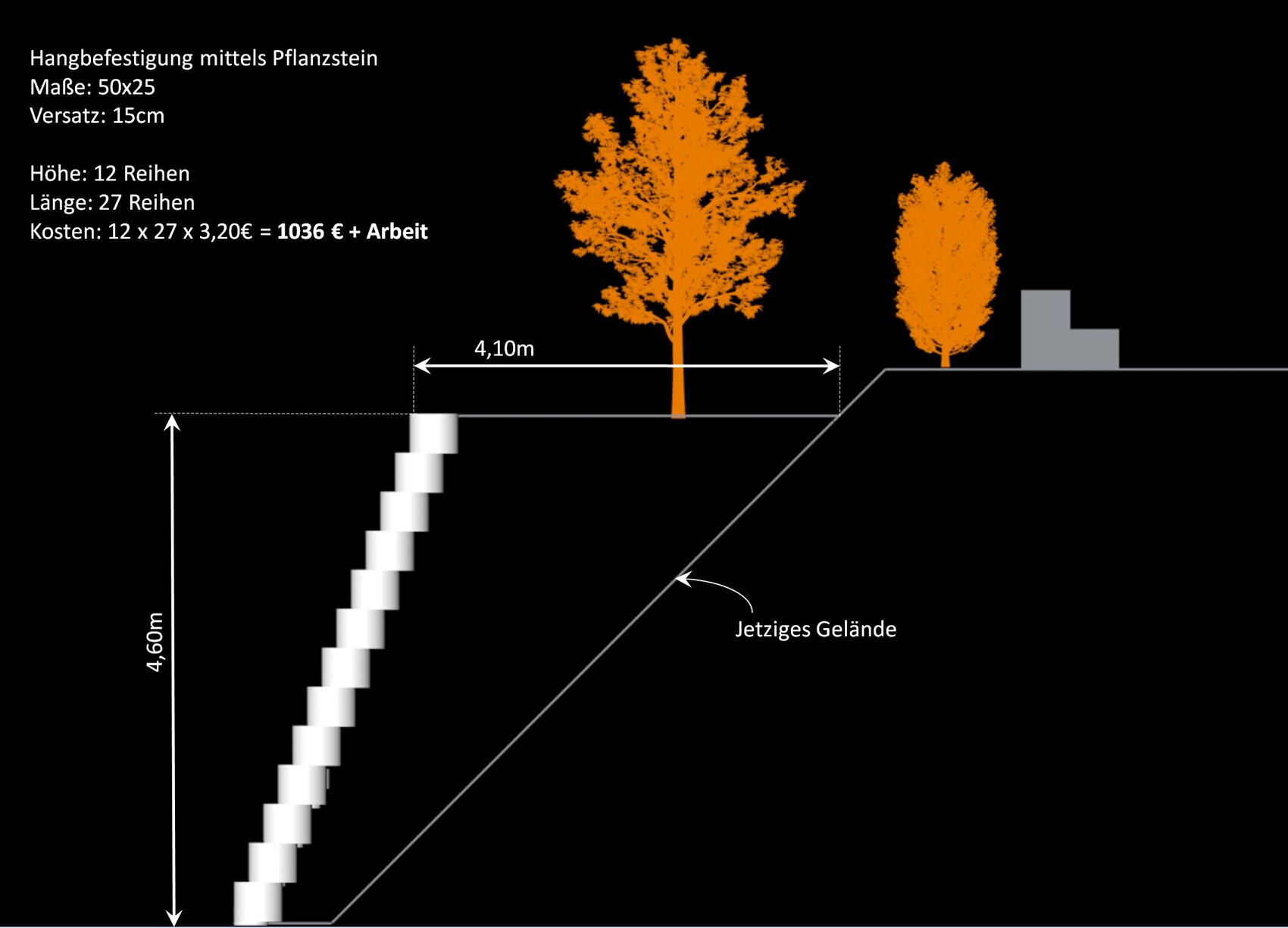
I want to stabilize the slope on my property (27m long) to create a usable, additional level.
My current plan is to stabilize only about 10m of it, since that area is the most important to have level.
This would give me a nice flat area about 4.1m long (13.5 feet).
I am looking for the most cost-effective solution for a steep embankment.
See the picture:
Someone told me that using old tires is the cheapest option and then planting ground cover on top.
But somehow I find that a bit odd.
What do you think?
Thanks!
I want to stabilize the slope on my property (27m long) to create a usable, additional level.
My current plan is to stabilize only about 10m of it, since that area is the most important to have level.
This would give me a nice flat area about 4.1m long (13.5 feet).
I am looking for the most cost-effective solution for a steep embankment.
See the picture:
Someone told me that using old tires is the cheapest option and then planting ground cover on top.
But somehow I find that a bit odd.
What do you think?
Thanks!
B
borderpuschl22 Feb 2021 11:40Such slope landscaping will never be cheap. First, check whether it is even permitted. Then you can discuss possible solutions. Depending on the overall situation (extended slope or just a filled plot), it might be possible to use only gravel and geogrid.
N
Nice-Nofret22 Feb 2021 11:52The height and steepness definitely require a professional to plan and obtain approval, if necessary...
Car tires? Seriously? I’m not sure you’ll get permission for a special waste disposal site in a residential area.
Car tires? Seriously? I’m not sure you’ll get permission for a special waste disposal site in a residential area.
 Schimi179122 Feb 2021 11:59
haydee schrieb:
...
They contain toxic substances that should not be released into the environment.Which ones?N
nordanney22 Feb 2021 12:15Schimi1791 schrieb:
Which ones?Limited polycyclic aromatic hydrocarbons (PAHs), along with zinc and sulfur. But overall, nothing extreme or that would lead to soil contamination.About 10% of a tire consists of chemical additives such as plasticizers, vulcanizing agents, zinc oxide, butadiene, thiuram, polycyclic aromatic hydrocarbons (PAHs), 1-octanethiol,
The shoulder material is tested for pollutants, among other things due to tire wear, and must be disposed of if necessary.
For a wall like this, quite a lot adds up. Maybe current limit values are being met, but what about in 3 or 4 years? Where is the line between upcycling (reusing as a planter ring) and illegal dumping?
The shoulder material is tested for pollutants, among other things due to tire wear, and must be disposed of if necessary.
For a wall like this, quite a lot adds up. Maybe current limit values are being met, but what about in 3 or 4 years? Where is the line between upcycling (reusing as a planter ring) and illegal dumping?
Schimi179122 Feb 2021 13:44As long as there is no abrasion, I see only a low risk of any disintegration or leaching caused by water.
However, if there are small children in the house, I am a bit more cautious, since they tend to touch and even lick everything. That is why there are increasing warnings against making toys for children from used car tires. Overall, I would also prefer not to have old tires in the garden.
But that is not necessarily the topic here... 🙂
However, if there are small children in the house, I am a bit more cautious, since they tend to touch and even lick everything. That is why there are increasing warnings against making toys for children from used car tires. Overall, I would also prefer not to have old tires in the garden.
But that is not necessarily the topic here... 🙂