
Hi everyone,
I have the following question: I bought a house from the 1950s. In the basement, two rooms have wooden floorboards. Beneath them, there is rubble and slag, all dry. I would like to apply a self-leveling screed over the wooden floorboards to create a solid, even surface. After that, I plan to install something like vinyl flooring.
My question now is: could I potentially have a moisture problem if I “seal” everything with the self-leveling screed?
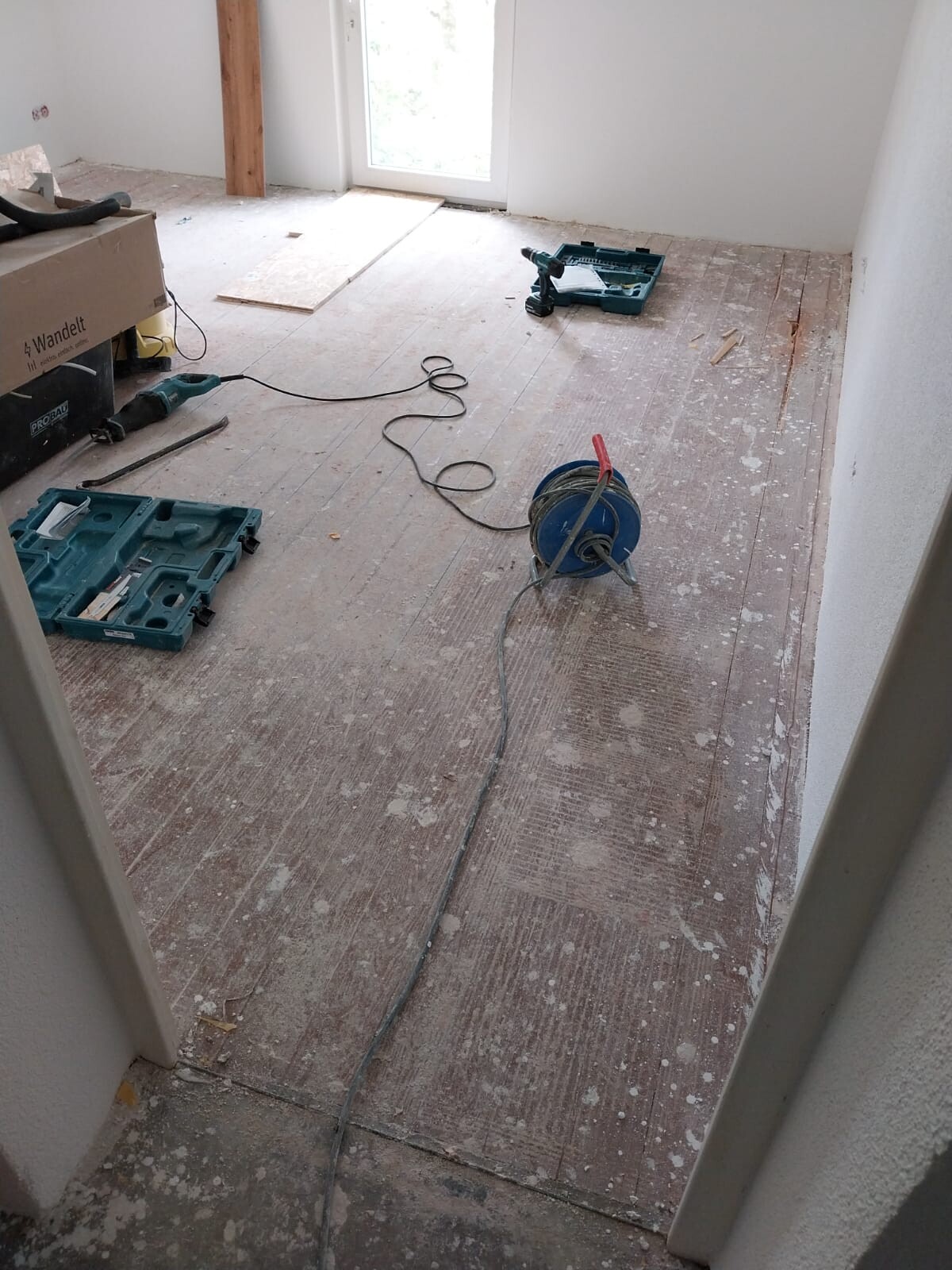
Thank you all for your help!
I have the following question: I bought a house from the 1950s. In the basement, two rooms have wooden floorboards. Beneath them, there is rubble and slag, all dry. I would like to apply a self-leveling screed over the wooden floorboards to create a solid, even surface. After that, I plan to install something like vinyl flooring.
My question now is: could I potentially have a moisture problem if I “seal” everything with the self-leveling screed?
Thank you all for your help!

Peter7919 schrieb:
I would like to apply a flowing screed over the wooden floorboards to create a solid, level surface. Afterwards, for example, to install vinyl flooring. Hello Peter,
The text you mentioned describes your initial situation: wooden floorboards with the possibility to install a flexible floor covering on top. This is exactly the basis I responded to. Originally, there was no mention of renovating and continuing to use the wooden floorboards.
The leveling compound will be applied uniformly with a thickness of about 5mm (0.2 inches), as I wrote. This has nothing to do with visible joints! They will not remain visible even if the parquet surface is renovated, meaning sanded and refinished, because before the final sanding, the joints are filled with a mixture of wood dust and glue.
In summary:
A precise description of the starting condition and the desired goal simplifies the analysis and helps to specify the renovation plan.
-------------------------------------
Regards, KlaRa