
ᐅ Experience with centralized exhaust ventilation systems without heat recovery
Created on: 13 Jan 2018 19:26
Z
zizzi
Hello everyone,
Does anyone have experience with a central exhaust ventilation system without heat recovery in a new build, KfW 70 standard, with underfloor heating and no radiators? (This is important because you cannot place wall or window vents above radiators to immediately mix the cold air with warm air.)
Is it recommended? If yes, what should you pay attention to? Do you notice air drafts coming from wall or window vents during the cold seasons?
I am attaching a photo from the page I read about this. The system is explained there in more detail.
Thanks in advance
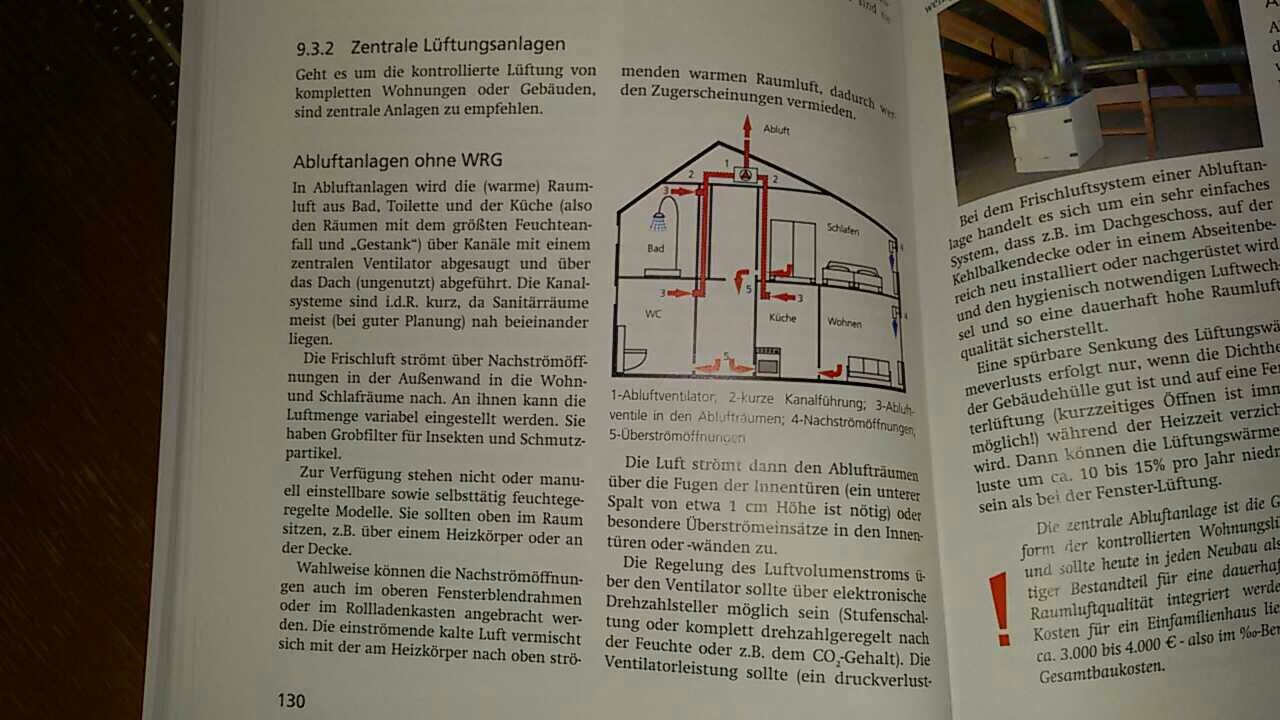
Does anyone have experience with a central exhaust ventilation system without heat recovery in a new build, KfW 70 standard, with underfloor heating and no radiators? (This is important because you cannot place wall or window vents above radiators to immediately mix the cold air with warm air.)
Is it recommended? If yes, what should you pay attention to? Do you notice air drafts coming from wall or window vents during the cold seasons?
I am attaching a photo from the page I read about this. The system is explained there in more detail.
Thanks in advance
I’ll respond to zizzi’s questions. Yes, we have underfloor heating. No, there was no option to choose, as this system is the standard with my general contractor. Controlled mechanical ventilation was an additional cost. Without any ventilation system, he would only install it upon explicit request and with protest. Karsten

We are also facing a similar decision and have sought support from an energy consultant (KFW application/calculation).
According to them: Underfloor heating provides long-wave radiant heat, which is designed to warm the building structure and objects to ensure comfortable living.
Heat recovery from air that does not contain much energy is not always effective. A cost-benefit analysis justifying the higher expenses of a central system with heat recovery may not necessarily be valid when aiming for the KFW55 standard.
For various reasons, we have now opted for a central exhaust system combined with decentralized fresh air inlets at the windows.
There should be no issue with drafts.
This is just our experience so far, which is planned for implementation this year.
According to them: Underfloor heating provides long-wave radiant heat, which is designed to warm the building structure and objects to ensure comfortable living.
Heat recovery from air that does not contain much energy is not always effective. A cost-benefit analysis justifying the higher expenses of a central system with heat recovery may not necessarily be valid when aiming for the KFW55 standard.
For various reasons, we have now opted for a central exhaust system combined with decentralized fresh air inlets at the windows.
There should be no issue with drafts.
This is just our experience so far, which is planned for implementation this year.
steija1 schrieb:
We are also facing the same decision and have consulted an energy advisor (KfW application/calculation).
Exact quote: Underfloor heating provides long-wave radiant heat designed to warm building components and objects to ensure comfortable living.
Heat recovery from air with low energy content is not always advisable. A cost-benefit calculation justifying the additional expense of a central system with heat recovery is not necessarily given when aiming for the KfW 55 standard.
For various reasons, we have now decided on a central exhaust system with decentralized supply air through the windows.
There should be no drafts.
This is just our experience so far, which we expect to implement this year.We probably consulted the same person [emoji6] I received the same information from our contact person (architect) who has worked for many years as an energy advisor. We want to build to KfW 70 standard with underfloor heating. He said that with simple natural ventilation we will not have mold problems. I think a central exhaust system plus decentralized supply air (ADL) is a solution that offers some comfort and fresh air for little money. My only concern is possible drafts caused by the ADL, but Nordlys reassured me with his experience.
S
Swan&Weasel13 Sep 2020 09:03Hello Zizzi and Steija1,
we are currently considering the same issues you faced two years ago, and I would be very grateful to hear about your experiences with the central exhaust ventilation system. When we were initially exploring prefabricated houses, we decided against controlled mechanical ventilation (To everyone itching to debate this: we don’t need to discuss that here anymore ). We are building now with Ytong/concrete blocks, mineral wool insulation, brick veneer, and underfloor heating. According to our builder, there have never been mold problems even without ventilation (??). We are also achieving KfW55 standards without controlled mechanical ventilation (due in part to a combined heat and power plant). The house is already energy certified based on this, and construction has started.
A friend of ours, who is a dedicated installer (and wouldn’t receive a contract for this site anyway, so there is no conflict of interest), advised us that some form of automatic ventilation is absolutely necessary and suggested this solution. The central exhaust system seems like a feasible alternative to us. At least the costs are significantly lower, and it eliminates concerns sometimes raised about contamination and cleaning of supply air ducts. It seems important to me that the outdoor vents can be completely closed if needed (e.g., in case of warnings about toxic gases or if the possible drafts become uncomfortable), that the sound insulation is good, and ideally that a filter can be installed.
Unfortunately, it is really difficult to find reliable information and user experiences with this type of ventilation. Therefore, it would be incredibly valuable to hear from you. Has this system proven reliable for you? What are the practical downsides? Cold drafts, airflow noise, noise disturbance from outside through the window vents? How high above the floor do the doors need to be to ensure proper air exchange?
If I understand correctly, the energy standard calculated with the central exhaust system is not worse than it is currently with conventional window ventilation, right? We wouldn’t want to risk our KfW loan and funding.
we are currently considering the same issues you faced two years ago, and I would be very grateful to hear about your experiences with the central exhaust ventilation system. When we were initially exploring prefabricated houses, we decided against controlled mechanical ventilation (To everyone itching to debate this: we don’t need to discuss that here anymore ). We are building now with Ytong/concrete blocks, mineral wool insulation, brick veneer, and underfloor heating. According to our builder, there have never been mold problems even without ventilation (??). We are also achieving KfW55 standards without controlled mechanical ventilation (due in part to a combined heat and power plant). The house is already energy certified based on this, and construction has started.
A friend of ours, who is a dedicated installer (and wouldn’t receive a contract for this site anyway, so there is no conflict of interest), advised us that some form of automatic ventilation is absolutely necessary and suggested this solution. The central exhaust system seems like a feasible alternative to us. At least the costs are significantly lower, and it eliminates concerns sometimes raised about contamination and cleaning of supply air ducts. It seems important to me that the outdoor vents can be completely closed if needed (e.g., in case of warnings about toxic gases or if the possible drafts become uncomfortable), that the sound insulation is good, and ideally that a filter can be installed.
Unfortunately, it is really difficult to find reliable information and user experiences with this type of ventilation. Therefore, it would be incredibly valuable to hear from you. Has this system proven reliable for you? What are the practical downsides? Cold drafts, airflow noise, noise disturbance from outside through the window vents? How high above the floor do the doors need to be to ensure proper air exchange?
If I understand correctly, the energy standard calculated with the central exhaust system is not worse than it is currently with conventional window ventilation, right? We wouldn’t want to risk our KfW loan and funding.
Hi, we have now been living in the house for 1½ years and I can only share my experience, which has probably been discussed extensively here before, but since your question wasn’t about the fundamental issue of controlled ventilation vs...
We have a central exhaust system in all the wet rooms and the kitchen. This was very important at the beginning because the house quickly had very high humidity levels due to moisture from construction. Of course, this decreases over time and is no longer a factor you notice directly. Still, I would say that without the system, it becomes very difficult over time due to the airtight construction, even if you are away for a few days.
The exhaust is controlled via my KNX system, so it doesn’t run continuously, but on warm days it operates at full capacity, especially at night, to bring cooler air into the house. In winter, it runs more moderately to provide the necessary air exchange. There’s no major hassle with opening windows, etc. And yes, we decided to leave out a controlled ventilation system during construction for cost reasons (about 5000€ ($) more), and looking back I think that decision was okay. Of course, the efficiency is lower, but you have to earn back that extra cost first, and the calculation only makes sense over decades (if at all).
What this means for your KfW loan should be something your energy consultant can advise on, as they calculate everything from all components relevant under the energy savings regulations.
Good luck,
Jan
We have a central exhaust system in all the wet rooms and the kitchen. This was very important at the beginning because the house quickly had very high humidity levels due to moisture from construction. Of course, this decreases over time and is no longer a factor you notice directly. Still, I would say that without the system, it becomes very difficult over time due to the airtight construction, even if you are away for a few days.
The exhaust is controlled via my KNX system, so it doesn’t run continuously, but on warm days it operates at full capacity, especially at night, to bring cooler air into the house. In winter, it runs more moderately to provide the necessary air exchange. There’s no major hassle with opening windows, etc. And yes, we decided to leave out a controlled ventilation system during construction for cost reasons (about 5000€ ($) more), and looking back I think that decision was okay. Of course, the efficiency is lower, but you have to earn back that extra cost first, and the calculation only makes sense over decades (if at all).
What this means for your KfW loan should be something your energy consultant can advise on, as they calculate everything from all components relevant under the energy savings regulations.
Good luck,
Jan
Similar topics