
Hello,
following up on the post a bit further below, after careful consideration I have decided to implement an independent second reception concept for radio/TV in the new build (target completion Q1/19), in addition to streaming and internet.
Here is my rough concept:
From the utility room, cables will run to the individual living spaces with the following requirements:
Now my specific questions:
I was inspired by the following—slightly modified—diagram from Axing.
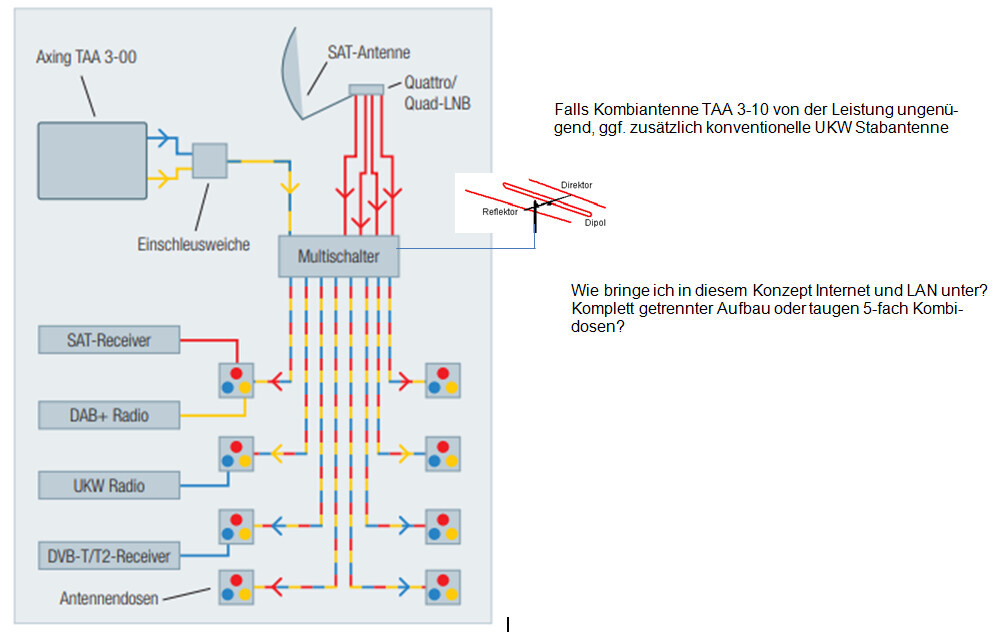
Unfortunately, LAN/internet is not considered here, as there probably are not many homebuilders who choose a dual system anymore. However, what is a good and affordable concept if this dual approach is desired?
Thank you for any tips and advice!
following up on the post a bit further below, after careful consideration I have decided to implement an independent second reception concept for radio/TV in the new build (target completion Q1/19), in addition to streaming and internet.
Here is my rough concept:
- Outdoor antenna (stable mast) to accommodate (1) satellite dish, (2) FM antenna, and (3) DVB-T2 antenna, with the option to include an additional DAB+ reception module in (2) or (3).
- All antenna signals will be routed to splitters in the utility room and amplified there if necessary.
- The telephone line from the provider will also enter the utility room, where the router will be installed.
From the utility room, cables will run to the individual living spaces with the following requirements:
- Antenna outlets (radio/TV) in 5 living rooms
- Ethernet/LAN outlets in 8 rooms, with 5 of these also having antenna outlets as described above
Now my specific questions:
- Do I need to keep the 3 antenna cables separate? What are the advantages and disadvantages of separate cable routing?
- Is it sufficient to use one TV cable per outlet that carries both DVB-T2 and satellite frequencies? The tuner would then select the frequencies it can use.
- Can conventional FM bands and DAB+ frequencies be transmitted simultaneously over the radio cable?
- Is it possible to transmit the radio signal over the TV cable as well?
- Do I need an antenna amplifier? What are the pros and cons of using an amplifier?
- Which type of antenna outlet is ideal for my purposes?
- There are now combined outlets (up to 5-way) that include both TV and LAN connections. Are these recommended, or are they unsuitable due to limited space and bending radius issues?
I was inspired by the following—slightly modified—diagram from Axing.
Unfortunately, LAN/internet is not considered here, as there probably are not many homebuilders who choose a dual system anymore. However, what is a good and affordable concept if this dual approach is desired?
Thank you for any tips and advice!
Hi, that’s misleading. There are plenty of providers. I’m currently installing a 7-family house where I have a fiber optic LNB on the roof, a 7-way fiber optic distribution in the attic, and a fiber optic to coax converter for each apartment, 7-way. This way, I effectively have 49 lines, which is quite practical. For a single-family house, this is certainly oversized, but the costs remain reasonable. You only need to run one cable. Also, this setup prevents voltage surges from the roof entering the house. If lightning strikes, it will only damage the system in the attic, while the distributions inside the house stay unaffected because fiber optics provide perfect galvanic isolation. That’s why I installed it this way in my own house as well.
Tom1607 schrieb:
Hi, that is misleading. There are many providers. I’m currently installing a 7-family house where I have a fiber optic LNB on the roof, a 7-way fiber optic distribution in the attic, and a 7-way fiber optic to coax converter in each apartment. This effectively gives me 49 lines, which is quite practical. For a single-family home, this is definitely oversized, but the costs remain reasonable, and you only need to install one cable. Additionally, this setup prevents voltage from being carried from the roof into the house—if lightning strikes, only the system in the attic is affected; the distributions in the rest of the house remain untouched because fiber optic provides perfect galvanic isolation. That’s why I implemented the same system in my own house. Could you list the components that were installed?
How is the power supply on the roof galvanically isolated from the rest of the house?
@Leo: The power supply for the LNB is supplied through the main electricity meter. Each apartment has its own meter, and in each apartment, a surge protector is installed at the entry point to the distribution box. The fiber optic cables have no metal reinforcement, so nothing can pass through the cable. The installed system is an Invacom, but you could also use Triax. There isn’t much difference. There is also a surge protector installed before the meters.
Similar topics