
Hello everyone,
Since the construction of the roof frame for my extension is in its final phase, I need to consider insulation and material ordering.
Because this topic is quite complex, I would appreciate your help. It is a 45° (45-degree) pitched roof with a bedroom and an unheated attic. The energy consultant suggested the following setup.
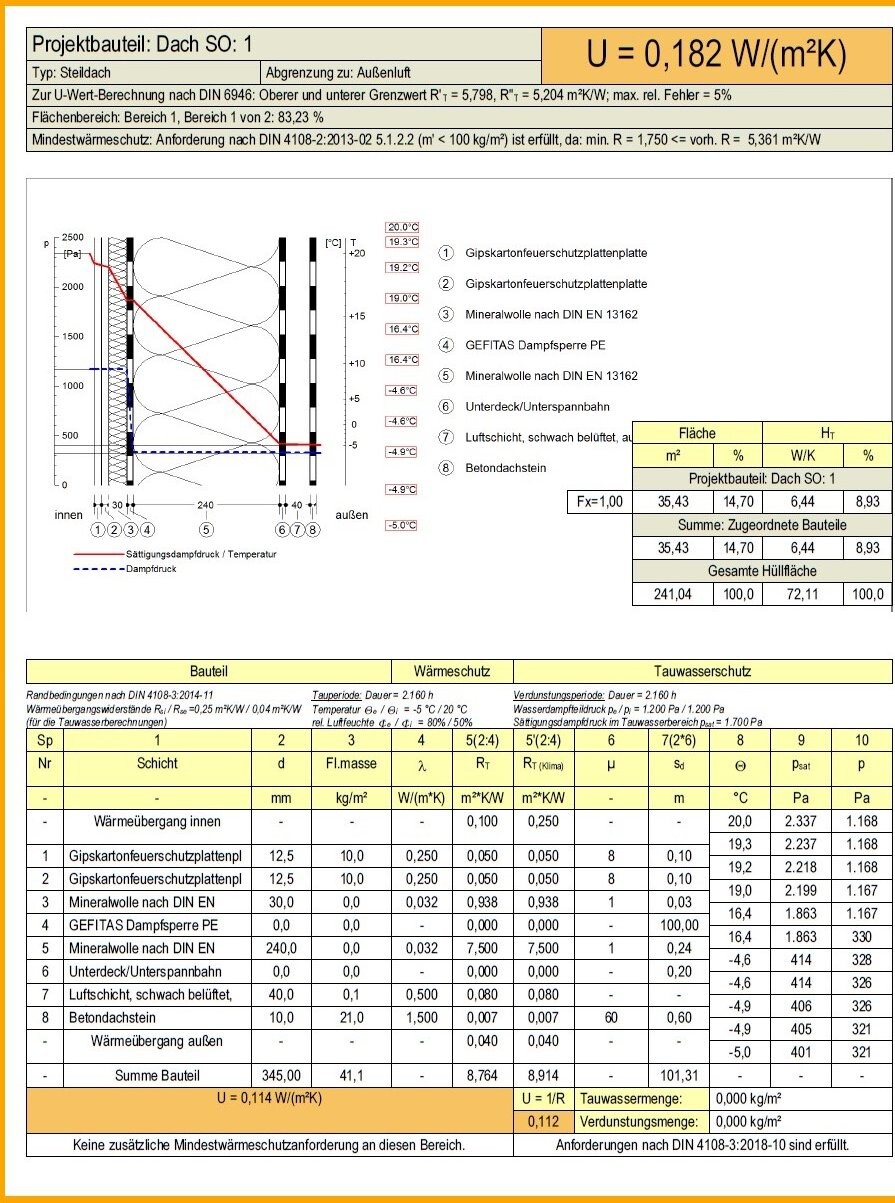
I would like to improve this a bit with a 60mm (2.4 inches) exterior insulation using wood fiber boards for better summer performance.
Since I’m not exactly sure how the ventilation space (counter-batten layer) should be installed and I often read about ventilated insulation, I hope to benefit from your combined knowledge.
The planned layers are:
- Clay roof tiles
- Counter-batten
- Battens
- Underlay membrane
- 60mm (2.4 inches) wood fiber board
- 240mm (9.4 inches) mineral wool insulation
- Vapor barrier / vapor retarder
- 30mm (1.2 inches) mineral wool with battens
- 25mm (1 inch) double-layer drywall
1. Question: Is a true vapor barrier really necessary between the layers of mineral wool?
2. Question: Which type of vapor retarder or barrier should be used (which specifications or values)?
3. Question: Which kind of mineral wool insulation is best (which specifications or values)?
4. Question: Is the construction setup correct as planned, or can it be improved?
Thank you very much for your help. I’m looking forward to lots of input.
Since the construction of the roof frame for my extension is in its final phase, I need to consider insulation and material ordering.
Because this topic is quite complex, I would appreciate your help. It is a 45° (45-degree) pitched roof with a bedroom and an unheated attic. The energy consultant suggested the following setup.
I would like to improve this a bit with a 60mm (2.4 inches) exterior insulation using wood fiber boards for better summer performance.
Since I’m not exactly sure how the ventilation space (counter-batten layer) should be installed and I often read about ventilated insulation, I hope to benefit from your combined knowledge.
The planned layers are:
- Clay roof tiles
- Counter-batten
- Battens
- Underlay membrane
- 60mm (2.4 inches) wood fiber board
- 240mm (9.4 inches) mineral wool insulation
- Vapor barrier / vapor retarder
- 30mm (1.2 inches) mineral wool with battens
- 25mm (1 inch) double-layer drywall
1. Question: Is a true vapor barrier really necessary between the layers of mineral wool?
2. Question: Which type of vapor retarder or barrier should be used (which specifications or values)?
3. Question: Which kind of mineral wool insulation is best (which specifications or values)?
4. Question: Is the construction setup correct as planned, or can it be improved?
Thank you very much for your help. I’m looking forward to lots of input.

In der Ruine schrieb:
The counter battens are directly screwed through the roof insulation on top of the rafters. See the picture in the PM.Yes, exactly, that can work: just the additional insulation as insulation on top of the rafters, and the planned insulation installed between the rafters. Then the battens are supported by the rafters (only fixed with nails through the upper insulation).https://www.instagram.com/11antgmxde/
https://www.linkedin.com/company/bauen-jetzt/
 In der Ruine13 Sep 2023 21:55
11ant schrieb:
Yes, exactly, that can work: just the additional insulation as external roof rafter insulation, and the planned insulation as insulation between the rafters. Then the battens are supported by the rafters (only nailed through the upper insulation). I still don’t understand what bothers you about this or how it could be done better.
In der Ruine schrieb:
I still don’t understand what bothers you about it or how it could be done better. All good. Nothing bothered me, I was just confused because you mentioned “insulation above rafters.” But you have now clarified that you were referring to “insulation above rafters” only as an addition, meaning in the context of the diagram it corresponds to layer 5a. That approach is certainly possible. Whether it is “better” than the energy consultant’s suggestion, I’m not sure. To me, it looks more like “more is better,” which I would question. I tend to be skeptical about combining different types of insulation in sequence, although I am not an expert in this specific area.
https://www.instagram.com/11antgmxde/
https://www.linkedin.com/company/bauen-jetzt/
In der Ruine15 Sep 2023 06:53In der Ruine schrieb:
Thank you very much for your help, and I am looking forward to a lot of input. I would like to revisit this topic.
In der Ruine schrieb:
I would like to bring up this topic again.Has it really not been buried in the endless meantime since yesterday yet???https://www.instagram.com/11antgmxde/
https://www.linkedin.com/company/bauen-jetzt/
Instead of the effort involved in adding insulation above the roof deck, the rafters could simply be doubled by 6cm (2.4 inches).
30cm (12 inches) of mineral wool with a thermal conductivity of 0.035 W/(m·K) is more than sufficient and may also be supported by the BEG (BAFA) program.
This mineral wool can also ventilate adequately through the counter-battens. Therefore, the 3cm (1.2 inches) interior insulation is not necessary, which also prevents any material from resting on the potentially damp side of the vapor retarder.
30cm (12 inches) of mineral wool with a thermal conductivity of 0.035 W/(m·K) is more than sufficient and may also be supported by the BEG (BAFA) program.
This mineral wool can also ventilate adequately through the counter-battens. Therefore, the 3cm (1.2 inches) interior insulation is not necessary, which also prevents any material from resting on the potentially damp side of the vapor retarder.