
Hello,
for years I have been thinking about how to design the problem area of my house.
I have a long narrow strip along the public pathway that I would like to plant. The strip is about 75 cm (30 inches) wide and 10.5 meters (34.5 feet) long. It faces south and gets full sun. Two gardens away, the neighbor has cut down all the tall and old trees, which means that since this year, our house is fully exposed to the sun. Therefore, we really want some sort of protection to prevent the ground from heating up excessively and possibly something that will protect at least the lower part of our facade from the direct sun in the future.
Trees probably won’t work due to the limited space available.
I like plants that are useful to wildlife throughout the year.
The fence must stay because otherwise the area would become a dog toilet, even now with just the stones. The privacy screen on the fence is more of a splash guard since the whole area is on an unpaved path, which is officially a dead end but apparently many people have a key to lower the bollards, and the footpath is frequently used by vehicles, often at high speed. It’s a disaster when it rains.
So, I’m looking forward to your suggestions.
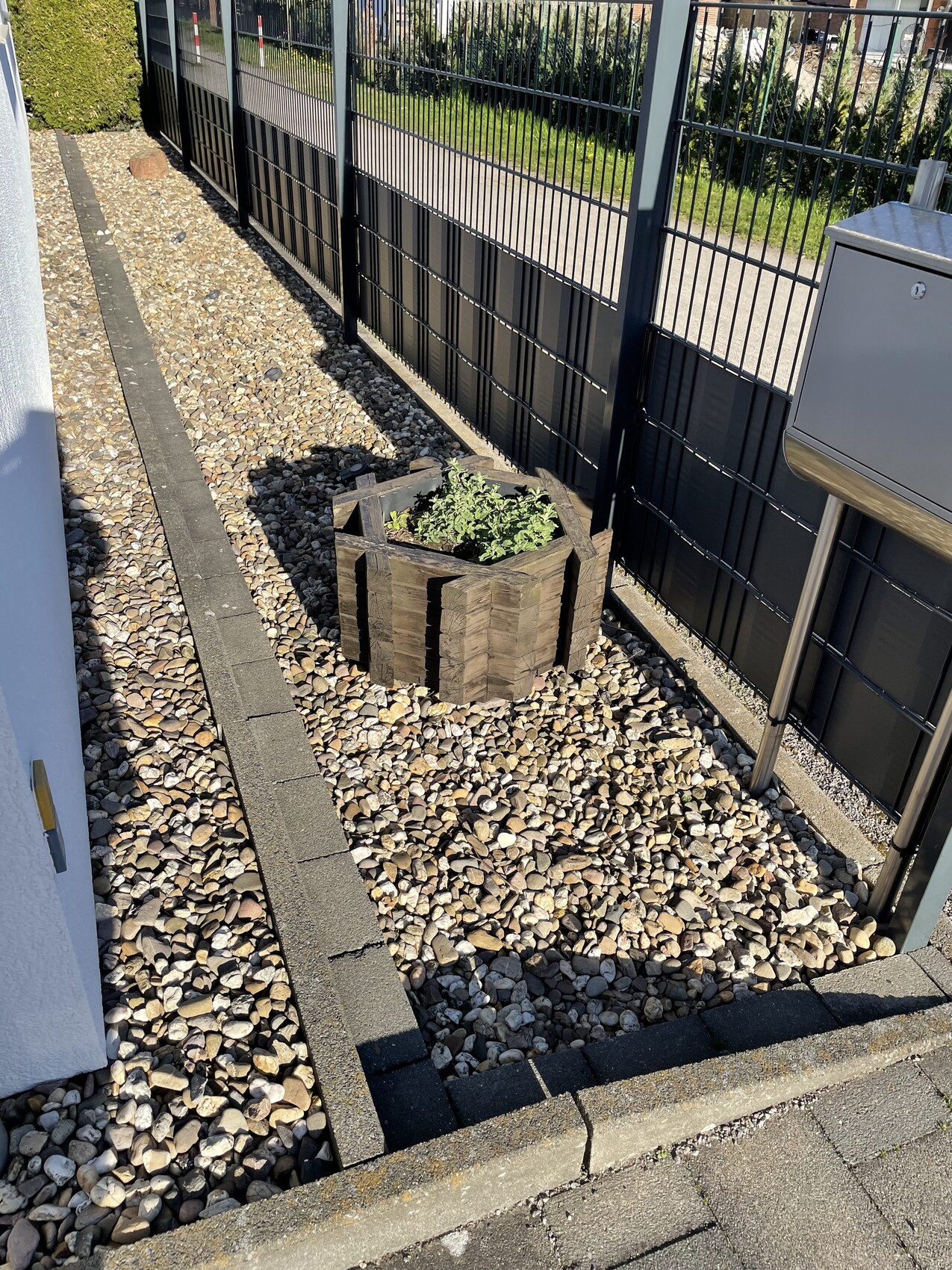

for years I have been thinking about how to design the problem area of my house.
I have a long narrow strip along the public pathway that I would like to plant. The strip is about 75 cm (30 inches) wide and 10.5 meters (34.5 feet) long. It faces south and gets full sun. Two gardens away, the neighbor has cut down all the tall and old trees, which means that since this year, our house is fully exposed to the sun. Therefore, we really want some sort of protection to prevent the ground from heating up excessively and possibly something that will protect at least the lower part of our facade from the direct sun in the future.
Trees probably won’t work due to the limited space available.
I like plants that are useful to wildlife throughout the year.
The fence must stay because otherwise the area would become a dog toilet, even now with just the stones. The privacy screen on the fence is more of a splash guard since the whole area is on an unpaved path, which is officially a dead end but apparently many people have a key to lower the bollards, and the footpath is frequently used by vehicles, often at high speed. It’s a disaster when it rains.
So, I’m looking forward to your suggestions.
shenja schrieb:
Also an idea. Although lavender outside of its blooming season doesn't look very attractive.Yes, it unfortunately thins out quickly. But pork tenderloin in lavender sauce is a delight.The question about what = perennials was already answered, just for completeness:
Hibiscus requires a lot of water during flowering, so it is also demanding if you don’t want to install irrigation.
Yellow and pink? Ilex produces red berries. By the way, it’s not suitable for a heated south-facing wall; it is actually a forest tree and prefers slightly moist, shaded conditions and acidic soil. If left alone, it will grow into a huge, beautiful tree...
Gartenfreund schrieb:
How about hibiscus?
Hibiscus requires a lot of water during flowering, so it is also demanding if you don’t want to install irrigation.
Pinkiponk schrieb:
- Holly (Ilex)
Both are (supposedly) evergreen, attract birds, insects, etc., and come in many sizes and widths. I want to plant these in my garden, preferably in yellow and pink colors
Yellow and pink? Ilex produces red berries. By the way, it’s not suitable for a heated south-facing wall; it is actually a forest tree and prefers slightly moist, shaded conditions and acidic soil. If left alone, it will grow into a huge, beautiful tree...
P
Pinkiponk19 Apr 2022 08:04Müllerin schrieb:
Yellow and pink? Ilex usually has red berries. By the way, it’s not suitable for a heated south-facing wall; it’s actually a forest tree that prefers a somewhat moist, shaded environment and acidic soil. If left undisturbed, it will grow into a huge, beautiful tree... Ilex also comes with yellow and orange berries, but there may be good reasons why we mostly see Ilex with red berries here.
Yellow and pink also refers to the honeysuckle. I will try it with yellow Ilex and pink honeysuckle if the suitable varieties are available for my locations.
 Holzhäuschen19 Apr 2022 08:53
I would suggest working with seeds, preferably a wildflower mix along with some shrubs.
When choosing wildflower mixes, make sure they contain truly native wild plants. I’m not sure where you are in Germany, but there are several suppliers. You might want to check with Naturgarten e.V. These mixes typically need to be mowed once or twice a year, and they will come back for several years. The appearance changes every year.
I’m a big fan of Witt and would recommend “Natur für jeden Garten” by Witt to anyone interested in gardening that supports insects and wildlife. I’ve read at least 20 gardening books, and this one is simply the best for me.
If you decide on a hedge, it could also be a wildlife or bird protection hedge, where you can sow a margin alongside it.
I have done a lot of research and written on this topic, but I don’t want to get banned. Rumor has it that my profile picture could be used to find me.
Best regards! This could turn into something really great.
When choosing wildflower mixes, make sure they contain truly native wild plants. I’m not sure where you are in Germany, but there are several suppliers. You might want to check with Naturgarten e.V. These mixes typically need to be mowed once or twice a year, and they will come back for several years. The appearance changes every year.
I’m a big fan of Witt and would recommend “Natur für jeden Garten” by Witt to anyone interested in gardening that supports insects and wildlife. I’ve read at least 20 gardening books, and this one is simply the best for me.
If you decide on a hedge, it could also be a wildlife or bird protection hedge, where you can sow a margin alongside it.
I have done a lot of research and written on this topic, but I don’t want to get banned. Rumor has it that my profile picture could be used to find me.
Best regards! This could turn into something really great.
shenja schrieb:
It will probably come down to perennials. But keep in mind that after the blooming season, nothing remains of the plants since they either die back or need to be cut down. That’s not very attractive either.