
ᐅ Glass panes fogging up on the inside during cold outdoor temperatures – troubleshooting the causes
Created on: 10 Jan 2022 20:45
N
Nanopixel
As soon as the outdoor temperature approaches 0°C (32°F), we notice the following situation in our living room (see attachment). The glass panels of the sliding door fog up heavily overnight from the inside, causing water to run down the glass and form puddles at the bottom.
It should be mentioned that the windows on the left side of the picture have already been replaced with triple-glazed units, while the mentioned door has not been renewed yet (age unknown). The water always forms behind the closed pleated blinds overnight, when the room temperature drops.
Now I’m wondering if this effect is due to the age of the sliding door, meaning that its surface is colder and condensation forms there, unlike on the newer windows. Or does the condensation appear only there instead of on the newer windows because there is a radiator below the latter, which prevents it?
Or could there be completely different issues causing this?
Thanks in advance for your opinions.
Regards
N
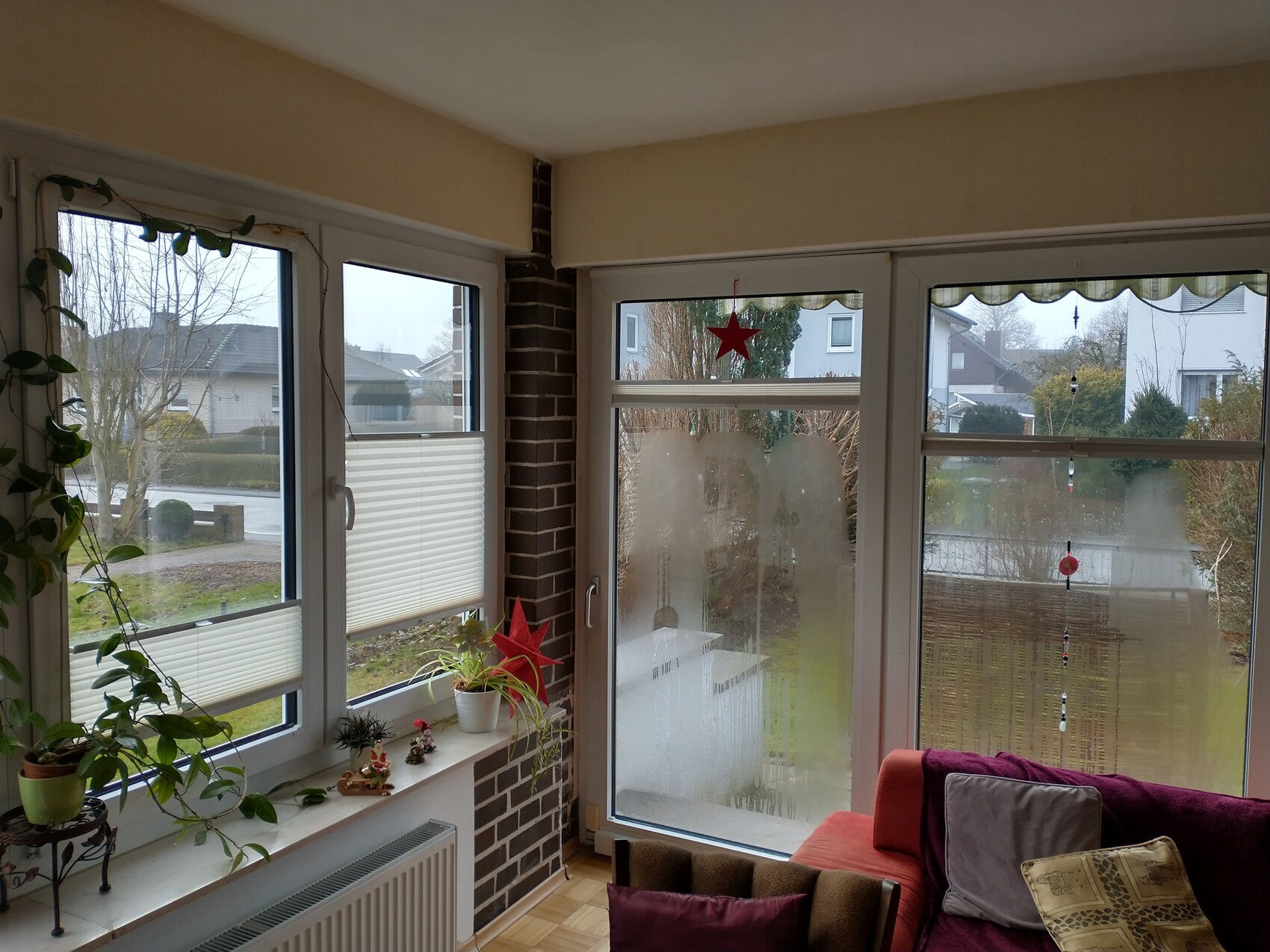
It should be mentioned that the windows on the left side of the picture have already been replaced with triple-glazed units, while the mentioned door has not been renewed yet (age unknown). The water always forms behind the closed pleated blinds overnight, when the room temperature drops.
Now I’m wondering if this effect is due to the age of the sliding door, meaning that its surface is colder and condensation forms there, unlike on the newer windows. Or does the condensation appear only there instead of on the newer windows because there is a radiator below the latter, which prevents it?
Or could there be completely different issues causing this?
Thanks in advance for your opinions.
Regards
N
Moisture condenses on the coldest surface when it is below the dew point. In this case, that's the door. Check between the panes; the manufacturing date might be there.
Solutions have already been discussed here. Adjust the heating, ventilate to remove moisture, etc.
Replacing the door also makes sense from an energy efficiency standpoint. Just make sure the walls do not fall below the dew point. Otherwise, mold can develop.
In other words: adjust heating and ventilation.
Solutions have already been discussed here. Adjust the heating, ventilate to remove moisture, etc.
Replacing the door also makes sense from an energy efficiency standpoint. Just make sure the walls do not fall below the dew point. Otherwise, mold can develop.
In other words: adjust heating and ventilation.
You have an uninsulated "cabin" from the 1970s. Be careful with triple glazing in this case. (see also mold in the kitchen behind the fridge).
As already suggested here: heat/ventilate/heat/ventilate/heat/ventilate…
Be glad there is still this old window; otherwise, a wall/corner would be damp/wet!
As already suggested here: heat/ventilate/heat/ventilate/heat/ventilate…
Be glad there is still this old window; otherwise, a wall/corner would be damp/wet!
W
WilderSueden11 Jan 2022 08:34This is what happens when windows are reasonably airtight, but the glazing still lets in cold air. I experience this too (apartment building, around 1980). It can’t really be fully resolved without construction work, only mitigated.
Heating and ventilation have already been mentioned. In general, you can try to minimize indoor humidity by not drying clothes inside and by consistently airing out rooms after cooking and showering. Avoid placing anything in front of the windows that restricts air exchange. However, this only helps to a limited extent. Here is a photo of my bedroom just now. Despite free air circulation, the balcony door is damp, while the window next to it is damp where the radiator is. On the right, between the radiator and the wall, the window is also damp again. Our problem is probably worsened by protruding concrete elements on the balcony that draw in the cold.
As an immediate measure, you can always wipe this off daily and remove the moisture to the outside.

Heating and ventilation have already been mentioned. In general, you can try to minimize indoor humidity by not drying clothes inside and by consistently airing out rooms after cooking and showering. Avoid placing anything in front of the windows that restricts air exchange. However, this only helps to a limited extent. Here is a photo of my bedroom just now. Despite free air circulation, the balcony door is damp, while the window next to it is damp where the radiator is. On the right, between the radiator and the wall, the window is also damp again. Our problem is probably worsened by protruding concrete elements on the balcony that draw in the cold.
As an immediate measure, you can always wipe this off daily and remove the moisture to the outside.
N
Nanopixel14 Jan 2022 12:13driver55 schrieb:
You have an uninsulated "cabin" from the 1970s. Be careful with triple glazing there. (see also mold in the kitchen behind the refrigerator). The other windows, which have already been replaced, were made of WOOD and some had condensation between the panes. When replacing them, the window installer only offered triple glazing. Are there still options with lower specifications, or is that advisable?
The mold behind the refrigerator was probably caused by the heat emitted from the appliance, which in winter hit directly against the cold northwest exterior corner of the room. The wall there was as damp as the sliding door window in the picture above. I will post soon in the original thread how I solved the problem.
driver55 schrieb:
Be glad that there is still this old window; otherwise, the wall/corner would be damp or wet! The corner above the sliding door already showed early signs of mold. No matter how much you heat the room, this corner is extremely cold in winter. Currently 8°C (46°F) measured with an infrared thermometer, while the room is at 20°C (68°F).
Between the panes of this old sliding door it says "INTERPANE 1/92" – could this be the construction year?

Similar topics