
ᐅ Glass panes fogging up on the inside during cold outdoor temperatures – troubleshooting the causes
Created on: 10 Jan 2022 20:45
N
Nanopixel
As soon as the outdoor temperature approaches 0°C (32°F), we notice the following situation in our living room (see attachment). The glass panels of the sliding door fog up heavily overnight from the inside, causing water to run down the glass and form puddles at the bottom.
It should be mentioned that the windows on the left side of the picture have already been replaced with triple-glazed units, while the mentioned door has not been renewed yet (age unknown). The water always forms behind the closed pleated blinds overnight, when the room temperature drops.
Now I’m wondering if this effect is due to the age of the sliding door, meaning that its surface is colder and condensation forms there, unlike on the newer windows. Or does the condensation appear only there instead of on the newer windows because there is a radiator below the latter, which prevents it?
Or could there be completely different issues causing this?
Thanks in advance for your opinions.
Regards
N
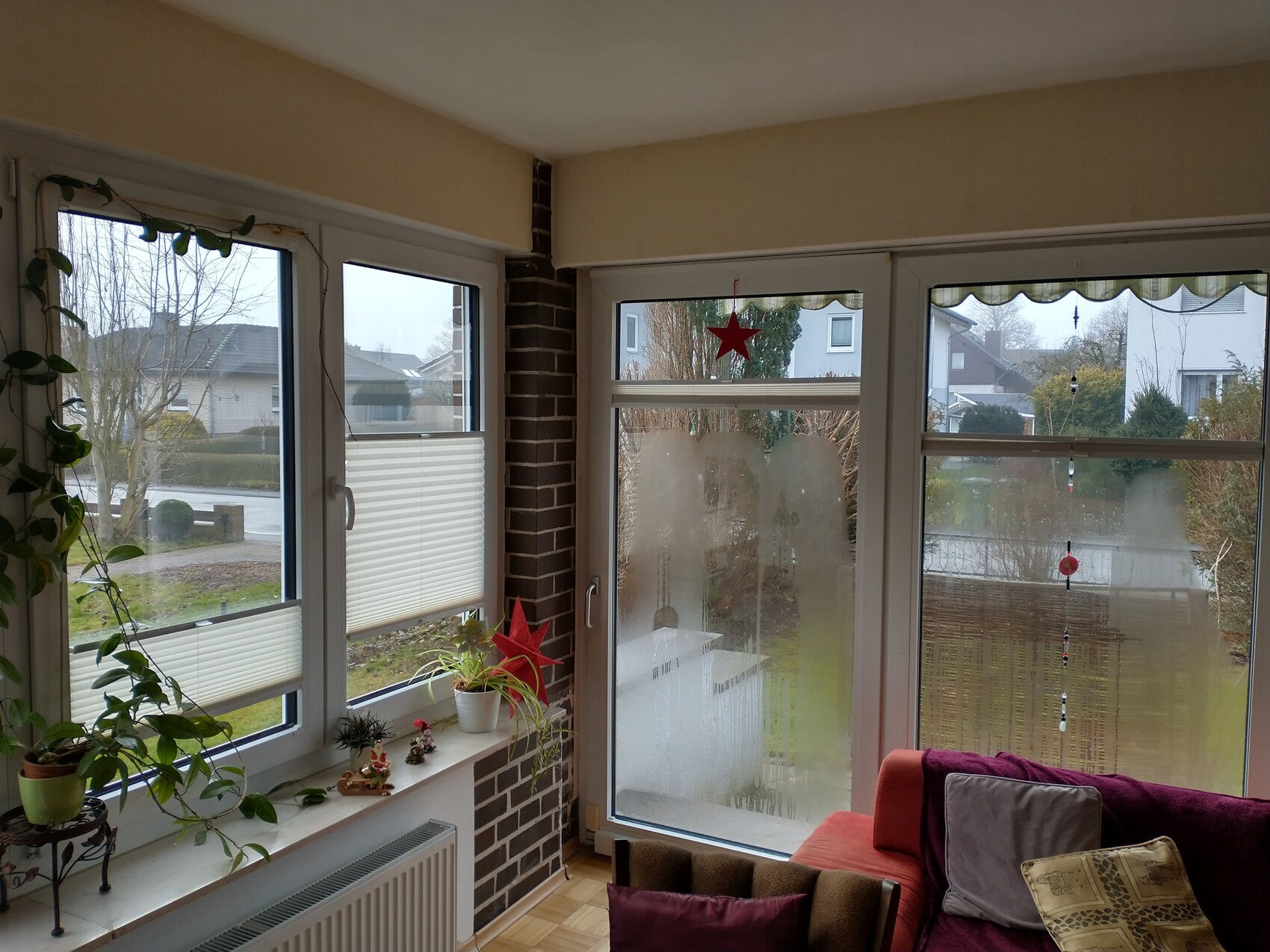
It should be mentioned that the windows on the left side of the picture have already been replaced with triple-glazed units, while the mentioned door has not been renewed yet (age unknown). The water always forms behind the closed pleated blinds overnight, when the room temperature drops.
Now I’m wondering if this effect is due to the age of the sliding door, meaning that its surface is colder and condensation forms there, unlike on the newer windows. Or does the condensation appear only there instead of on the newer windows because there is a radiator below the latter, which prevents it?
Or could there be completely different issues causing this?
Thanks in advance for your opinions.
Regards
N
Nanopixel schrieb:
While the room is at 20°C (68°F).
Between the panes of this old sliding door it says "INTERPANE 1/92" – could that be the manufacturing date? 20 degrees Celsius (68°F) in an older building is actually quite cold because the walls are even colder.
Turn up the heating and ventilate several times; otherwise, it won’t work.
Dry the glass and don’t leave the cloth next to the window!
Yes, that is likely the date or year of manufacture.
N
Nanopixel14 Jan 2022 15:35We never heat above 20-21°C (68-70°F) here, but of course that’s a matter of personal preference; this temperature is enough for us. Turning up the heat and sitting in an uncomfortably overheated room just to prevent mold doesn’t seem like a reasonable solution—especially with energy prices as high as they are.
Of course, I wipe the window every day (using a squeegee like the ones used in showers) to remove the moisture.
Regarding the moldy corner, what is the general opinion on using this kind of anti-mold paint from hardware stores?
Of course, I wipe the window every day (using a squeegee like the ones used in showers) to remove the moisture.
Regarding the moldy corner, what is the general opinion on using this kind of anti-mold paint from hardware stores?
N
Nanopixel14 Jan 2022 15:49... of course, the room is also ventilated, that goes without saying.
N
Nice-Nofret14 Jan 2022 16:42You have the following options:
- Increase the temperature of the windows, for example with new windows, and if the walls are affected, they will also need additional insulation.
- Raise the room temperature so that the indoor air can hold more moisture.
- Dehumidify the air inside the house—either with a dehumidifier or by ventilating much more.
- Increase the temperature of the windows, for example with new windows, and if the walls are affected, they will also need additional insulation.
- Raise the room temperature so that the indoor air can hold more moisture.
- Dehumidify the air inside the house—either with a dehumidifier or by ventilating much more.
N
Nanopixel14 Jan 2022 17:22But isn’t it true – correct me if I’m wrong – that no matter how much I heat the room, the mentioned corner remains the coldest spot in the room, maybe no longer 8°C (46°F) but 10°C (50°F) or even 12°C (54°F). Yet it is still the coldest spot. (For now, leaving aside the glass of the door on the outside.) And water will continue to condense there..?

Nanopixel schrieb:
And will the water continue to condense there..? No, because there is the dew point, which shifts with increasing temperature.
At an indoor temperature of 18°C (64°F) and a relative humidity of 40%, the dew point is about 4°C (39°F). If the indoor temperature is 22°C (72°F) and the humidity is 70%, the dew point is approximately 16°C (61°F). An average surface temperature of interior building components of 10–12°C (50–54°F) over 24 hours is assumed in living spaces, which are usually heated by radiators and warm air convection. Especially when the room temperature is lowered at night (night setback), moisture can develop in the interior walls because the wall temperature drops below the dew point of the indoor air. The moisture caused by the resulting condensation must dry out during the day; otherwise, mold damage may occur. Conventional radiators, convectors, or heating strips transfer most of their thermal energy to the surrounding air, which then distributes the heat in the room through natural convection. Corners and areas behind furniture placed close to interior walls are poorly reached by this warm air flow and therefore remain cooler. These poorly ventilated spots are particularly susceptible to mold growth. An alternative is underfloor and wall heating systems, as well as ceiling radiant panels, which emit heat over large surface areas from walls, floors, or ceiling panels.
On windows with temperatures below the dew point of the indoor air, the air cools down below the dew point and moisture condenses on the glass, because window glass is not vapor-permeable and acts like a vapor barrier. On windows with temperatures below the frost point, frost forms on the glass. When well-insulated glazing and exterior doors are installed, often the vapor-tight window frames and door casings are the coldest spots in the room. To prevent condensation and mold formation there in winter, the surface temperature must, as everywhere else, not drop below the dew point of the indoor air or sufficient ventilation with warm indoor air must be ensured. This is one reason why radiators are usually installed below windows, which are typically the coldest surfaces inside a room.
Similar topics