
ᐅ Inside the house is 10°C warmer than outside – how is that possible?
Created on: 5 Jun 2021 17:44
K
kati1337
Hello!
We are beginners at living in a newly built house, and this first spring is raising some questions.
Our heating system (Tecalor THZ 504) has already decided, based on the outside temperature—which is currently around 20°C (68°F)—that it is in summer mode. In other words, the heating is turned off.
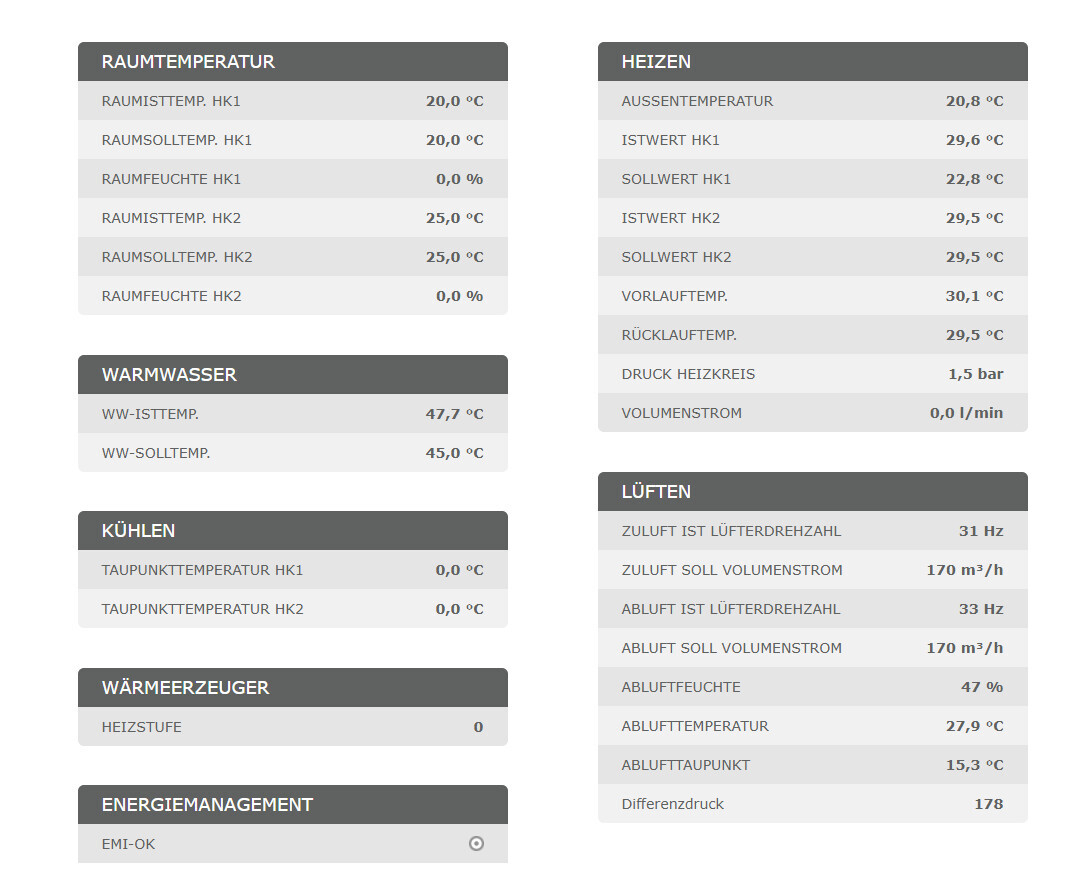
The system information still shows the flow temperature at just under 30°C (86°F), but the flow rate has dropped to zero.
The ventilation is still running, and I suspect our heat recovery unit is causing the issue—because what’s the point of exchanging indoor air with outside air if it blows the air back inside at almost the same warm temperature as it took out?
We only have an outdoor temperature sensor. The device doesn’t handle the indoor temperature very well. It claims the current indoor temperature is 20°C (68°F), but it seems to detect (through measuring) that the exhaust air temperature is about 28°C (82°F). This matches what our various thermometers around the house show.
The question remains: why do we have 28°C (82°F) inside at all? Where is the heat coming from?
Could it be caused solely by sunlight coming through the windows?
We have air conditioning, but I’d rather not run it yet when it’s only about 20°C (68°F) outside and raining.
How do you other new build owners handle this issue? Do you use shading? Something else? Or do you not have this problem at all and maybe there is something wrong with our building services?
We are beginners at living in a newly built house, and this first spring is raising some questions.
Our heating system (Tecalor THZ 504) has already decided, based on the outside temperature—which is currently around 20°C (68°F)—that it is in summer mode. In other words, the heating is turned off.
The system information still shows the flow temperature at just under 30°C (86°F), but the flow rate has dropped to zero.
The ventilation is still running, and I suspect our heat recovery unit is causing the issue—because what’s the point of exchanging indoor air with outside air if it blows the air back inside at almost the same warm temperature as it took out?
We only have an outdoor temperature sensor. The device doesn’t handle the indoor temperature very well. It claims the current indoor temperature is 20°C (68°F), but it seems to detect (through measuring) that the exhaust air temperature is about 28°C (82°F). This matches what our various thermometers around the house show.
The question remains: why do we have 28°C (82°F) inside at all? Where is the heat coming from?
Could it be caused solely by sunlight coming through the windows?
We have air conditioning, but I’d rather not run it yet when it’s only about 20°C (68°F) outside and raining.
How do you other new build owners handle this issue? Do you use shading? Something else? Or do you not have this problem at all and maybe there is something wrong with our building services?
T
T_im_Norden5 Jun 2021 18:35The 20°C (68°F) room temperature display on the heating system is not a measured value. It is an assumed value used for the heating curve.
The bypass is supposed to normally prevent cooler outside air from being warmed through the heat exchanger. This should work automatically with a modern device.
The bypass is supposed to normally prevent cooler outside air from being warmed through the heat exchanger. This should work automatically with a modern device.
Shading is essential. But the supply temperature of the heating system shouldn’t be as high as 30 degrees Celsius (86°F). What for?? Something isn’t right there.
Otherwise, 28 degrees Celsius (82°F) is extreme. Without shading, we experience a maximum of 25 degrees Celsius (77°F) in spring, usually around 23 degrees Celsius (73°F).
Otherwise, 28 degrees Celsius (82°F) is extreme. Without shading, we experience a maximum of 25 degrees Celsius (77°F) in spring, usually around 23 degrees Celsius (73°F).
T
T_im_Norden5 Jun 2021 19:07The heating engineer measured the floor temperature.

guckuck2 schrieb:
That makes a huge difference, and without it, you’ll either be overheated or have to cool against it. Okay, then I guess we’ll have to get used to it. I’m just surprised it’s this bad today. It’s been pouring all day and outside it’s a maximum of 20°C (68°F).
T_im_Norden schrieb:
The bypass is normally designed to prevent cooler outside air from being warmed by the heat exchanger.
This should work automatically on a modern unit. I have the option to turn the "bypass" on. Should I do that?
Currently, it’s set to "exhaust ventilation." Otherwise, I can choose: "Off, Supply air, Bypass," or "summer cassette" (but we don’t have one of those).
T_im_Norden schrieb:
The heating circuit recorded the floor temperature. I don’t understand that—what does it mean?
haydee schrieb:
You can replace the summer cassette yourself. It’s as easy as changing a light bulb.
In our system, the summer cassette is set so that the ventilation turns off as soon as the outside temperature is higher than the inside temperature. I’ve read something similar. A summer cassette would cost around 100€ (about $110) as far as I know. But how does your system know the current indoor temperature? Ours only has an outdoor sensor and consistently maintains 24°C (75°F) inside when it’s actually 20°C (68°F), so that doesn’t match up.
Aren’t you worried that the heat exchanger might get damaged if you have to store it outside the unit for six months every year? How much would a replacement cost if it broke during the swap?
Similar topics