
ᐅ Installation of an Air-to-Water Heat Pump – Is This Setup Correct?
Created on: 6 Jun 2020 13:58
M
Mertha257
Hello dear forum members,
We have been considering the installation location for our planned air-to-water heat pump for several days now. It is intended to be placed on the east side of the house, specifically in the gap between the bay window wall and the back wall of the garage (see image).
The discharge direction would be toward the east, away from the house, but after about 3 meters (10 feet) there is the neighbor’s garage/garden shed.
After researching various manufacturers, the heat pump fits in this space, as the minimum clearances from walls at the back and sides range between 15–40 cm (6–16 inches), which we can achieve.
However, I have two concerns:
1.) Possible thermal short-circuit: Given the enclosure by the bay window, our own garage rear wall, and the neighboring building, will the air-to-water heat pump be able to discharge the used, cooler air effectively enough and far enough so that sufficient fresh, warm air can flow to the intake? I do not want to compromise the efficiency of the heat pump due to the installation location. Unfortunately, there is no other feasible place to install it...
2.) Noise impact: It is often advised that air-to-water heat pumps should not be placed in wall niches or corners to avoid sound amplification/reflection. Although I plan to decouple the heat pump as much as possible and build a proper foundation, our bedroom is located on the first floor directly above this spot.
What are your thoughts on these two points? Do you have any experience regarding this? Point #1 is especially important to me, as I have found some good approaches to avoid or reduce noise.
Thank you very much for your advice!
Have a great weekend everyone!
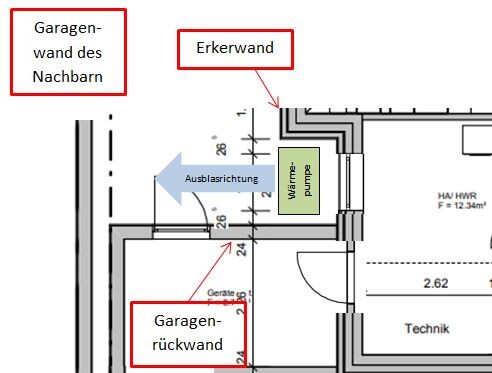
We have been considering the installation location for our planned air-to-water heat pump for several days now. It is intended to be placed on the east side of the house, specifically in the gap between the bay window wall and the back wall of the garage (see image).
The discharge direction would be toward the east, away from the house, but after about 3 meters (10 feet) there is the neighbor’s garage/garden shed.
After researching various manufacturers, the heat pump fits in this space, as the minimum clearances from walls at the back and sides range between 15–40 cm (6–16 inches), which we can achieve.
However, I have two concerns:
1.) Possible thermal short-circuit: Given the enclosure by the bay window, our own garage rear wall, and the neighboring building, will the air-to-water heat pump be able to discharge the used, cooler air effectively enough and far enough so that sufficient fresh, warm air can flow to the intake? I do not want to compromise the efficiency of the heat pump due to the installation location. Unfortunately, there is no other feasible place to install it...
2.) Noise impact: It is often advised that air-to-water heat pumps should not be placed in wall niches or corners to avoid sound amplification/reflection. Although I plan to decouple the heat pump as much as possible and build a proper foundation, our bedroom is located on the first floor directly above this spot.
What are your thoughts on these two points? Do you have any experience regarding this? Point #1 is especially important to me, as I have found some good approaches to avoid or reduce noise.
Thank you very much for your advice!
Have a great weekend everyone!
 hausnrplus256 Jun 2020 22:29
Mertha257 schrieb:
Point #1 is especially important to me because I have read some good approaches to prevent or reduce noise generation.What approaches do you have?
Snowy36 schrieb:
We installed ours on the opposite side of the house, away from the bedroom ... it’s freestanding, inverter-controlled, and a particularly quiet model ... but you can still hear it turn on in the living room ... I don’t want that near the bedroom ...How many meters (feet) away and what orientation is the other side?
We are still uncertain, as the consultation with the builder/heating company has not yet taken place. In your location, noise would definitely be a major concern for me as well.
hausnrplus25 schrieb:
What are your approaches there?
How many meters / what orientation is the other side?
We are still unsure as well, but so far the consultation with the construction company / heating company has not taken place. At your location, noise would also be my biggest concern.Unfortunately, I don’t understand the question?
hausnrplus256 Jun 2020 23:00@Snowy36
How many meters (feet) away from the living room is the air-to-water heat pump where you can still hear it, and how many meters (feet) from the bedroom where, luckily, you can no longer hear it?
How many meters (feet) away from the living room is the air-to-water heat pump where you can still hear it, and how many meters (feet) from the bedroom where, luckily, you can no longer hear it?
M
Mertha2576 Jun 2020 23:18Snowy36 schrieb:
We installed ours on the side of the house away from the bedroom... it’s a standalone unit with inverter control and is an extra quiet model... but you can still hear it when it turns on in the living room... I don’t want that near the bedroom...Wow, I really didn’t expect that.Two questions:
- Do you hear it running inside the house or only when it starts up?
- If you don’t mind me asking, which model do you have?
Thank you.
M
Mertha2576 Jun 2020 23:23hausnrplus25 schrieb:
What are your approaches here?
How many meters (feet) / what orientation is the other side?
We are still uncertain as well; so far, we have not had consultations with the construction or heating company. Noise would also be my main concern at your location.I have read that a solid foundation/isolation, sound-optimized model, enclosure, and noise-reducing roofing should be sufficient. The answers here, however, make me seriously doubt that...N
nordanney6 Jun 2020 23:36Mertha257 schrieb:
I have read that a solid foundation/decoupling, sound-optimized design, enclosure, and sound-reducing roofing are sufficient.A quiet model is the most important choice. Then you stand next to it and barely hear more than the noise of a loud PC fan.Don’t get stressed, just listen for yourself. Many installers will take you to customer reference sites.