
ᐅ Backfilling Building Excavations – What Is the Best Approach?
Created on: 12 Aug 2012 12:39
S
SchicolinaS
Schicolina12 Aug 2012 12:39Hello everyone,
our house construction is still in the early stages, but we are already in what might be the most challenging phase: the excavation pit. Don’t laugh, but we have already had quite a bit of fun with it.
Our plot is located in the "Munich gravel plain," and the basement will be partially below the groundwater level. Since our construction company is already struggling quite a bit with this issue in advance, it would be really helpful if we knew a bit more about it…
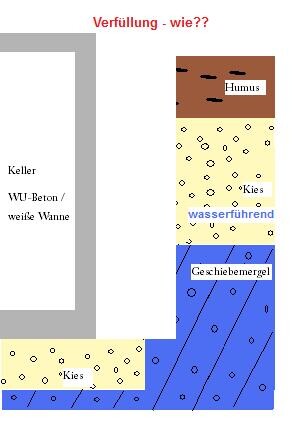
I have attached a drawing to help make it easier to understand.
From top to bottom, the soil layers are as follows:
1. Topsoil = humus
2. Gravel layer (gravelly sand with stones and silts according to the report)
3. Glacial till (boulder clay)
The concrete slab will be placed in the glacial till layer, which will be almost impermeable to water (at least the deeper you go). The gravel layer carries groundwater.

Below the concrete slab, a clean gravel layer will be installed — this will permanently hold water later.
Now the question is: what is the best way to build up the backfill?
Using gravel would allow for the best compaction, but it would also cause water to remain permanently at the transitions between the concrete slab and the basement walls, as more water will flow from the groundwater-bearing gravel layer than the till layer can drain away — if at all (I don’t expect it to). In theory, a waterproof basement shell ("white tank") should be able to handle this, BUT…
Or should the layers be rebuilt according to the surrounding soil layers?
Or would it even be better to go further and fill entirely with glacial till (as far as the excavation allows) to keep as little water around the building as possible — accepting the disadvantage of poorer compaction?
It would be great if someone has experience with this.
Best regards, Schicolina
our house construction is still in the early stages, but we are already in what might be the most challenging phase: the excavation pit. Don’t laugh, but we have already had quite a bit of fun with it.
Our plot is located in the "Munich gravel plain," and the basement will be partially below the groundwater level. Since our construction company is already struggling quite a bit with this issue in advance, it would be really helpful if we knew a bit more about it…
I have attached a drawing to help make it easier to understand.
From top to bottom, the soil layers are as follows:
1. Topsoil = humus
2. Gravel layer (gravelly sand with stones and silts according to the report)
3. Glacial till (boulder clay)
The concrete slab will be placed in the glacial till layer, which will be almost impermeable to water (at least the deeper you go). The gravel layer carries groundwater.
Below the concrete slab, a clean gravel layer will be installed — this will permanently hold water later.
Now the question is: what is the best way to build up the backfill?
Using gravel would allow for the best compaction, but it would also cause water to remain permanently at the transitions between the concrete slab and the basement walls, as more water will flow from the groundwater-bearing gravel layer than the till layer can drain away — if at all (I don’t expect it to). In theory, a waterproof basement shell ("white tank") should be able to handle this, BUT…
Or should the layers be rebuilt according to the surrounding soil layers?
Or would it even be better to go further and fill entirely with glacial till (as far as the excavation allows) to keep as little water around the building as possible — accepting the disadvantage of poorer compaction?
It would be great if someone has experience with this.
Best regards, Schicolina
B
Bauexperte13 Aug 2012 11:40Hello,
The geotechnical engineer (geotechnical report) will certainly be happy to answer all your questions if your builder does not feel capable of doing so.
Kind regards
Schicolina schrieb:Why is your builder “overwhelmed”? All the necessary measures are clearly outlined in the geotechnical report; surely they can read it.
Since our construction company is already quite overwhelmed with this issue in advance, it would be really helpful if we were a bit more knowledgeable...
Schicolina schrieb:I hope no one responds to this here; such matters should be handled by experts, and any well-meaning advice may not apply to your specific situation and could end up costing you a lot of money!
It would be great if someone had experience with this.
The geotechnical engineer (geotechnical report) will certainly be happy to answer all your questions if your builder does not feel capable of doing so.
Kind regards
S
Schicolina16 Aug 2012 08:26Hello construction expert, thank you for your response.
My question actually combines two issues, one of which the geotechnical engineer probably won’t answer: is it better to have constant hydrostatic pressure against the waterproof concrete shell, or should one try to avoid that at all costs, even if it means accepting some settlement? Perhaps certain components of the glacial till could also attack the concrete, meaning direct contact might not be ideal, or maybe there is another factor altogether...
Of course, we will follow up on this, but a second expert opinion wouldn’t have hurt. By the way, I would also have appreciated some feedback from homeowners (has compaction according to soil layers ever been done before?), although how to "utilize" that is ultimately up to each person—that’s true, but not just in construction topics.
The geotechnical engineer’s statement is: The moisture-sensitive clayey soils encountered during excavation are suitable for backfilling/filling; however, they are difficult to install and compact when saturated.
I’m curious to see if he will provide more specific answers when asked—based on my experience with geologists, probably not—or it will become expensive...
Best regards, Schicolina
My question actually combines two issues, one of which the geotechnical engineer probably won’t answer: is it better to have constant hydrostatic pressure against the waterproof concrete shell, or should one try to avoid that at all costs, even if it means accepting some settlement? Perhaps certain components of the glacial till could also attack the concrete, meaning direct contact might not be ideal, or maybe there is another factor altogether...
Of course, we will follow up on this, but a second expert opinion wouldn’t have hurt. By the way, I would also have appreciated some feedback from homeowners (has compaction according to soil layers ever been done before?), although how to "utilize" that is ultimately up to each person—that’s true, but not just in construction topics.
The geotechnical engineer’s statement is: The moisture-sensitive clayey soils encountered during excavation are suitable for backfilling/filling; however, they are difficult to install and compact when saturated.
I’m curious to see if he will provide more specific answers when asked—based on my experience with geologists, probably not—or it will become expensive...
Best regards, Schicolina
Similar topics