
ᐅ Sealing at the junction between the foundation slab and the wall against ground moisture
Created on: 1 Aug 2022 22:28
K
Kili1987
Hello team,
we are currently starting the exterior groundwork and have the following setup so far. Our entire house is covered on the outside with an ETICS (External Thermal Insulation Composite System). The concrete slab is coated with a waterproof slurry, and the transition from the slab to the insulation below is additionally sealed with a fillet (cove). We will be adding about 50cm (20 inches) of soil on top and will therefore extend at least the terrace up to the window sill.
My question: Is it sufficient here to install a standard dimpled membrane from the top edge of the terrace down to the insulation (forming an L shape) and then place the soil against it?
I have read that with ETICS or bitumen waterproofing, the dimples are usually faced outward and that a geotextile fabric is placed over the dimpled membrane?
Any opinions or recommendations specifically regarding the dimpled membrane?
Regards,
Kili1987
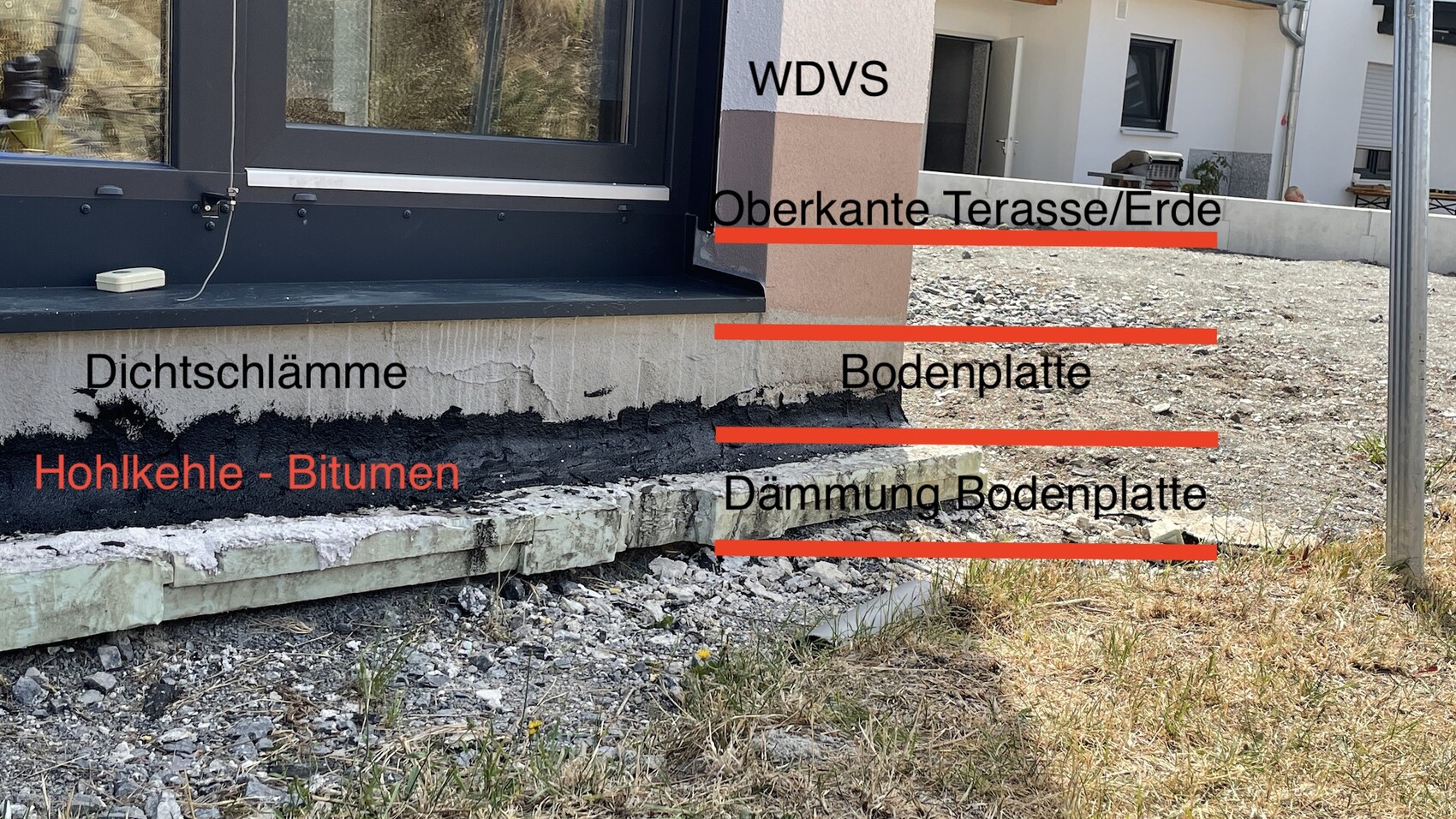
we are currently starting the exterior groundwork and have the following setup so far. Our entire house is covered on the outside with an ETICS (External Thermal Insulation Composite System). The concrete slab is coated with a waterproof slurry, and the transition from the slab to the insulation below is additionally sealed with a fillet (cove). We will be adding about 50cm (20 inches) of soil on top and will therefore extend at least the terrace up to the window sill.
My question: Is it sufficient here to install a standard dimpled membrane from the top edge of the terrace down to the insulation (forming an L shape) and then place the soil against it?
I have read that with ETICS or bitumen waterproofing, the dimples are usually faced outward and that a geotextile fabric is placed over the dimpled membrane?
Any opinions or recommendations specifically regarding the dimpled membrane?
Regards,
Kili1987
ThomasH. schrieb:
The site manager now thinks that installing a drainage system might be disadvantageous because it could cause a water gradient. He also says that waterproof concrete in the wet clay soil is not a problem.
I would like to get at least a second opinion because, naturally, I want to ensure the most stable foundation possible in the long term.
Can drainage in clay soil also be detrimental? Or am I not making a mistake by installing drainage all around the slab foundation? In general, I don’t see how a drainage system could negatively affect the construction. The question is rather whether drainage is permitted, where the water would be discharged, and if the effort and costs are justified in this case.
You have a waterproof (WU) slab foundation (which is usually not necessary in about 95% of non-basement single-family homes), and I assume there is no groundwater. Drainage would therefore only divert rainwater/surface water. As long as water does not flow onto the slab, I do not see a need for drainage.
A site cross-section including the house would also be helpful to better assess the situation.
How was the building founded?
Thank you for your reply.
The terrain profile is easy to describe – no hills or slopes, completely flat.
My main concern is that the clay soil always contains a lot of moisture that does not drain away. There is generally constant dampness here (no waterlogging, as the groundwater is not reached within 80cm (31 inches)). Therefore, I was considering ventilation using a breathable membrane and a drainage pipe (to divert moisture).
The terrain profile is easy to describe – no hills or slopes, completely flat.
My main concern is that the clay soil always contains a lot of moisture that does not drain away. There is generally constant dampness here (no waterlogging, as the groundwater is not reached within 80cm (31 inches)). Therefore, I was considering ventilation using a breathable membrane and a drainage pipe (to divert moisture).

We have a similar floor and a drainage system installed under the base plate in the gravel bed (done by the concrete contractors). Additionally, we have a perimeter drainage system (installed by ourselves). Usually, this drains into a soakaway because discharging surface water from your own property into the sewer system is prohibited (here).
This moisture in the clay soil is actually quite normal.
As the site manager has already mentioned, you have a slab foundation designed to resist constantly pressing water. If you only had a slab foundation against ground moisture, then gravel layers or drainage would have been needed to keep the water away from the slab. Drainage would also only help to drain rainwater more quickly. It won't eliminate ground moisture. Air circulation is not really possible there.
But as already stated, I don’t see any disadvantages (aside from the additional costs and effort).
As the site manager has already mentioned, you have a slab foundation designed to resist constantly pressing water. If you only had a slab foundation against ground moisture, then gravel layers or drainage would have been needed to keep the water away from the slab. Drainage would also only help to drain rainwater more quickly. It won't eliminate ground moisture. Air circulation is not really possible there.
But as already stated, I don’t see any disadvantages (aside from the additional costs and effort).
Similar topics