
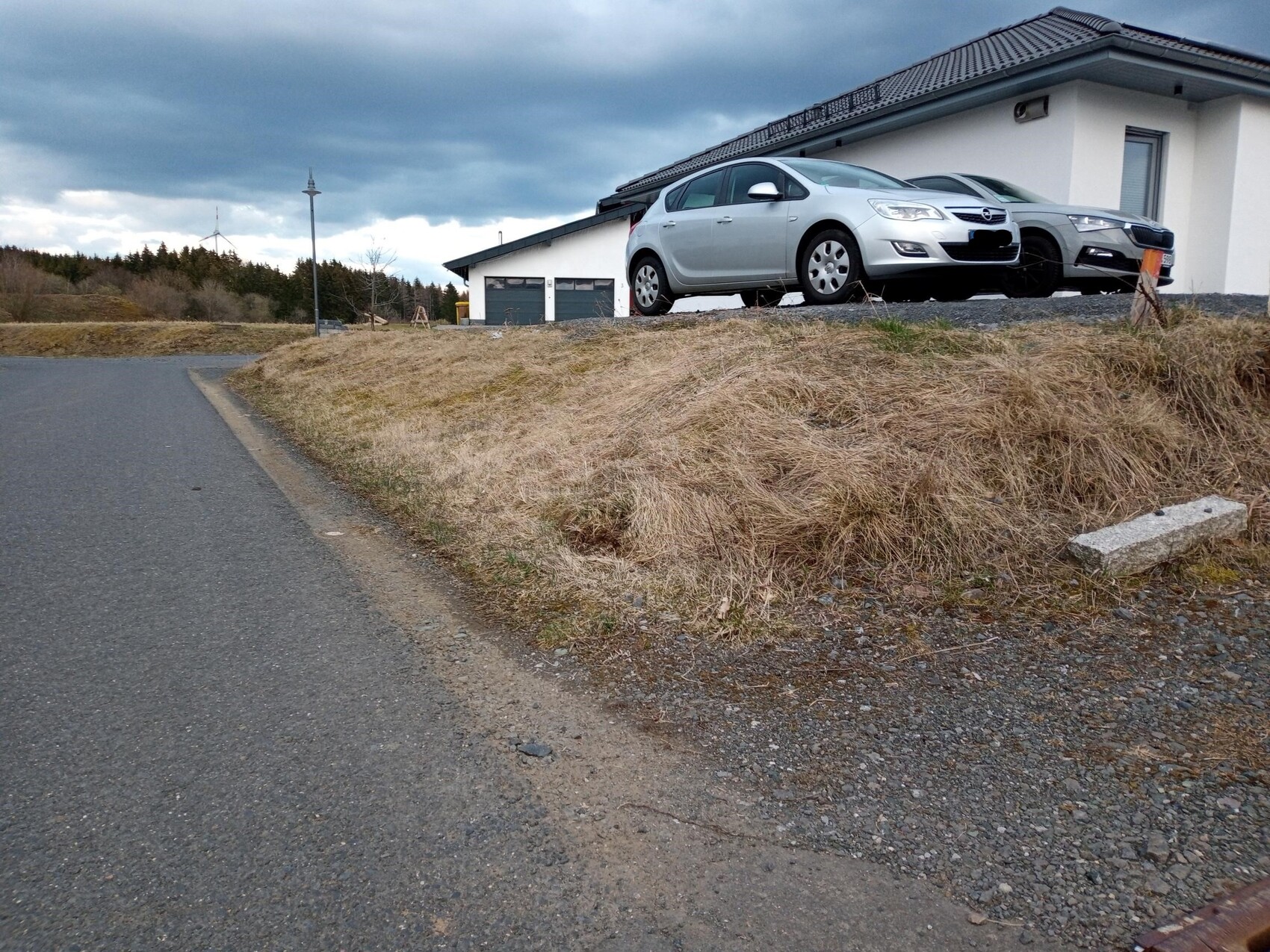
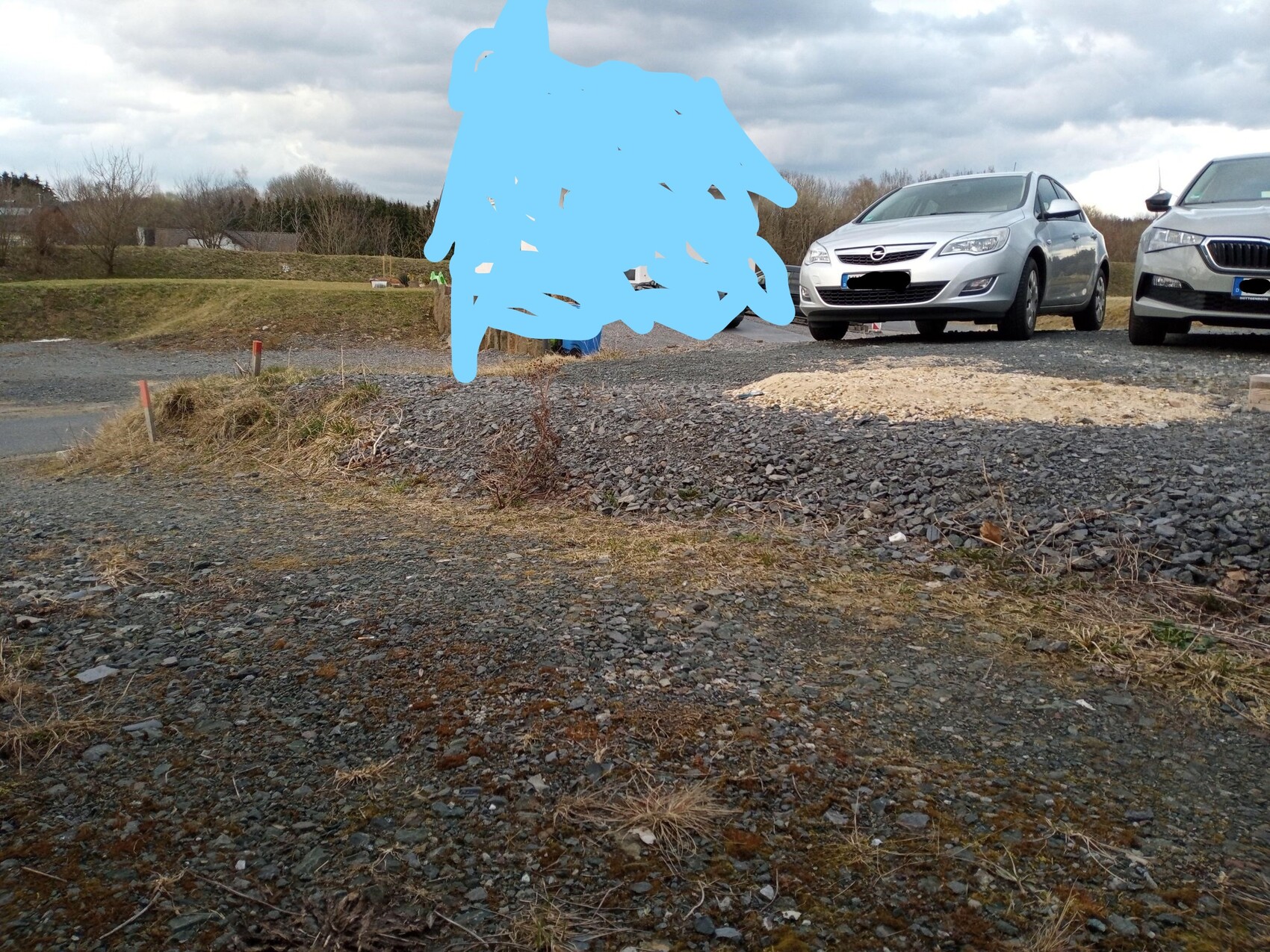
Tomorrow I have another appointment with the landscaping contractor and I’m still looking for alternatives for slope stabilization... Mainly, I’m concerned about the area shown in the second picture, where the section next to the neighbor with their garage needs to be supported. On our side, we will be adding about 10-15 cm (4-6 inches) on top, basically raising the level, while the neighbor has dug down from their garage door towards the street.
What is the simplest and most effective way to handle this? So far, onsite contractors have suggested either L-shaped concrete blocks or a wall made of formwork blocks along the neighbor’s driveway and around the corner near the boat. Where the two cars are parked now, we plan to build a double carport in the future.
Something else that comes to mind are planter blocks or gabions filled with gravel?
Appearance is secondary at this point; the main priority is just to secure the area.
The section of the slope along the street will be edged with curbstones, and then planted with a fast-growing ground cover to stabilize the soil.

What is the simplest and most effective way to handle this? So far, onsite contractors have suggested either L-shaped concrete blocks or a wall made of formwork blocks along the neighbor’s driveway and around the corner near the boat. Where the two cars are parked now, we plan to build a double carport in the future.
Something else that comes to mind are planter blocks or gabions filled with gravel?
Appearance is secondary at this point; the main priority is just to secure the area.
The section of the slope along the street will be edged with curbstones, and then planted with a fast-growing ground cover to stabilize the soil.
The fact is that the future carport will have a paved interior, so I will need at least an edge stone or curb stone, or lawn edging stone, to frame the paved area.
Now I came across angle edge stones / angled concrete curbs, basically a small L-shaped block, dimensions H: 22cm (9 inches) x W: 50cm (20 inches) x D: 27cm (11 inches). These can be moved without an excavator, and I would also get an angle so that the concrete wedge basically ends at the property boundary. If the neighbor wants later, they can place an edge stone on their side before starting their own paving.
Or I might even stay 20-30cm (8-12 inches) away from the boundary with this option, so I can fill in the potentially visible concrete wedge towards the neighbor and plant it with ground cover greenery. Of course, I will discuss these options with the neighbor, but he will probably say, as usual, "Go ahead, I don’t mind."
Maybe I am overthinking it, and what I call a slope here is not seriously worth mentioning, but up to now, none of the landscaping contractors have suggested anything different. Of course, this limits the profit you can make on laypeople.


Now I came across angle edge stones / angled concrete curbs, basically a small L-shaped block, dimensions H: 22cm (9 inches) x W: 50cm (20 inches) x D: 27cm (11 inches). These can be moved without an excavator, and I would also get an angle so that the concrete wedge basically ends at the property boundary. If the neighbor wants later, they can place an edge stone on their side before starting their own paving.
Or I might even stay 20-30cm (8-12 inches) away from the boundary with this option, so I can fill in the potentially visible concrete wedge towards the neighbor and plant it with ground cover greenery. Of course, I will discuss these options with the neighbor, but he will probably say, as usual, "Go ahead, I don’t mind."
Maybe I am overthinking it, and what I call a slope here is not seriously worth mentioning, but up to now, none of the landscaping contractors have suggested anything different. Of course, this limits the profit you can make on laypeople.