
ᐅ New construction ceiling: painting over fiberglass mesh or spray plaster
Created on: 19 Jun 2020 09:58
N
neutri80
Hello,
In our new build, we have precast concrete ceilings and are now considering how to finish them.
Our options are paintable fleece wallpaper or a very fine textured spray plaster.
My husband thinks the spray plaster is too rough and feels it would look odd if the ceiling and the walls are almost the same. That’s why we are leaning towards using the paintable fleece wallpaper, which would result in a fairly smooth surface.
What do you think?
Are there any pros and cons to these two methods, and what would you choose?
Which option is more high-end?
Regards,
Ivonne
In our new build, we have precast concrete ceilings and are now considering how to finish them.
Our options are paintable fleece wallpaper or a very fine textured spray plaster.
My husband thinks the spray plaster is too rough and feels it would look odd if the ceiling and the walls are almost the same. That’s why we are leaning towards using the paintable fleece wallpaper, which would result in a fairly smooth surface.
What do you think?
Are there any pros and cons to these two methods, and what would you choose?
Which option is more high-end?
Regards,
Ivonne
S
Stefan00113 Jul 2020 12:51@pagoni2020 Do you have any pictures of it?
P
pagoni202013 Jul 2020 12:57Stefan001 schrieb:
@pagoni2020 Do you have any pictures of it?Of what exactly? I still have various pictures from my old house, but I would need to know what you specifically mean. However, photos might not show it very clearly either.
P
pagoni202013 Jul 2020 14:11I just checked, the name has changed at Haering, but it seems to be just a modernized name; it sounds nicer.
It’s probably the "Hawering Fine Decorative Quartz" with 1mm (0.04 inch) grains. The pictures don’t show it very well—I only have older photos where the result of the plaster isn’t really shown, more like everyday life there was photographed.
Basically, it’s a white paint mixed with very fine 1mm (0.04 inch) quartz sand, which is then applied evenly or always in the same way onto the pre-primed plaster surface (using a wide brush). You can tint it to any color you want, resulting in a monochrome wall or ceiling where the brush strokes or application style remain visible. Overall, this creates a calm and uniform look, but it’s not too smooth, so it hides minor surface imperfections.
Back then, Mediterranean styles were popular, so I chose a suitable glaze (for example, Caparol) and applied it consistently with a "cross-stroke" technique. It should be done by one person alone; otherwise, differences become visible later. It creates a peaceful effect and allows for creative use, plus it’s very easy to apply. At the time, we had zero experience; the painter where we bought it explained everything to us.
Without a glaze, it can look as simple and modern as you like.
One time I tried the 2mm (0.08 inch) version on the ceiling, but it didn’t look good because the 2mm grains didn’t spread well (at least not with my application), and it also seemed too coarse for my taste.
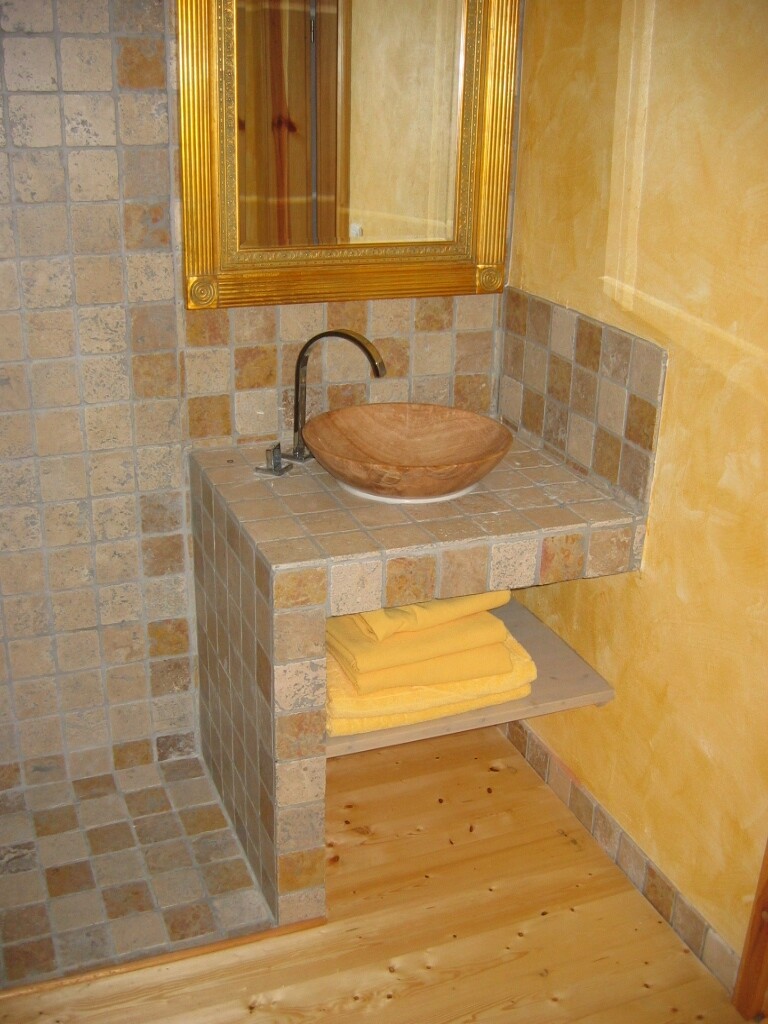
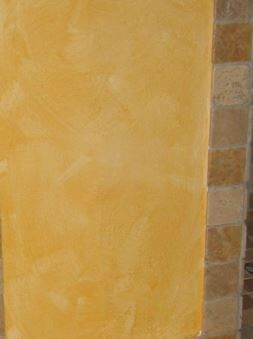
It’s probably the "Hawering Fine Decorative Quartz" with 1mm (0.04 inch) grains. The pictures don’t show it very well—I only have older photos where the result of the plaster isn’t really shown, more like everyday life there was photographed.
Basically, it’s a white paint mixed with very fine 1mm (0.04 inch) quartz sand, which is then applied evenly or always in the same way onto the pre-primed plaster surface (using a wide brush). You can tint it to any color you want, resulting in a monochrome wall or ceiling where the brush strokes or application style remain visible. Overall, this creates a calm and uniform look, but it’s not too smooth, so it hides minor surface imperfections.
Back then, Mediterranean styles were popular, so I chose a suitable glaze (for example, Caparol) and applied it consistently with a "cross-stroke" technique. It should be done by one person alone; otherwise, differences become visible later. It creates a peaceful effect and allows for creative use, plus it’s very easy to apply. At the time, we had zero experience; the painter where we bought it explained everything to us.
Without a glaze, it can look as simple and modern as you like.
One time I tried the 2mm (0.08 inch) version on the ceiling, but it didn’t look good because the 2mm grains didn’t spread well (at least not with my application), and it also seemed too coarse for my taste.
P
pagoni202013 Jul 2020 14:18Hehe, well... the good old days, you just can’t explain it later on.
Basically, you see this more often today in commercial buildings or government offices: white textured plaster (often called by other names), which is basically wall paint mixed with quartz sand. I also know people who mix it themselves, and whether with or without a tinted glaze, it ultimately has nothing to do with textured paint; you could do the same with any wall paint. The only difference is that it contains these 1mm (0.04 inch) grains.
The marbled effect is actually created by the colored glaze; otherwise, it looks like a normally painted wall but with tiny quartz sand grains mixed in.
Basically, you see this more often today in commercial buildings or government offices: white textured plaster (often called by other names), which is basically wall paint mixed with quartz sand. I also know people who mix it themselves, and whether with or without a tinted glaze, it ultimately has nothing to do with textured paint; you could do the same with any wall paint. The only difference is that it contains these 1mm (0.04 inch) grains.
The marbled effect is actually created by the colored glaze; otherwise, it looks like a normally painted wall but with tiny quartz sand grains mixed in.