
ᐅ Inside the house is 10°C warmer than outside – how is that possible?
Created on: 5 Jun 2021 17:44
K
kati1337
Hello!
We are beginners at living in a newly built house, and this first spring is raising some questions.
Our heating system (Tecalor THZ 504) has already decided, based on the outside temperature—which is currently around 20°C (68°F)—that it is in summer mode. In other words, the heating is turned off.
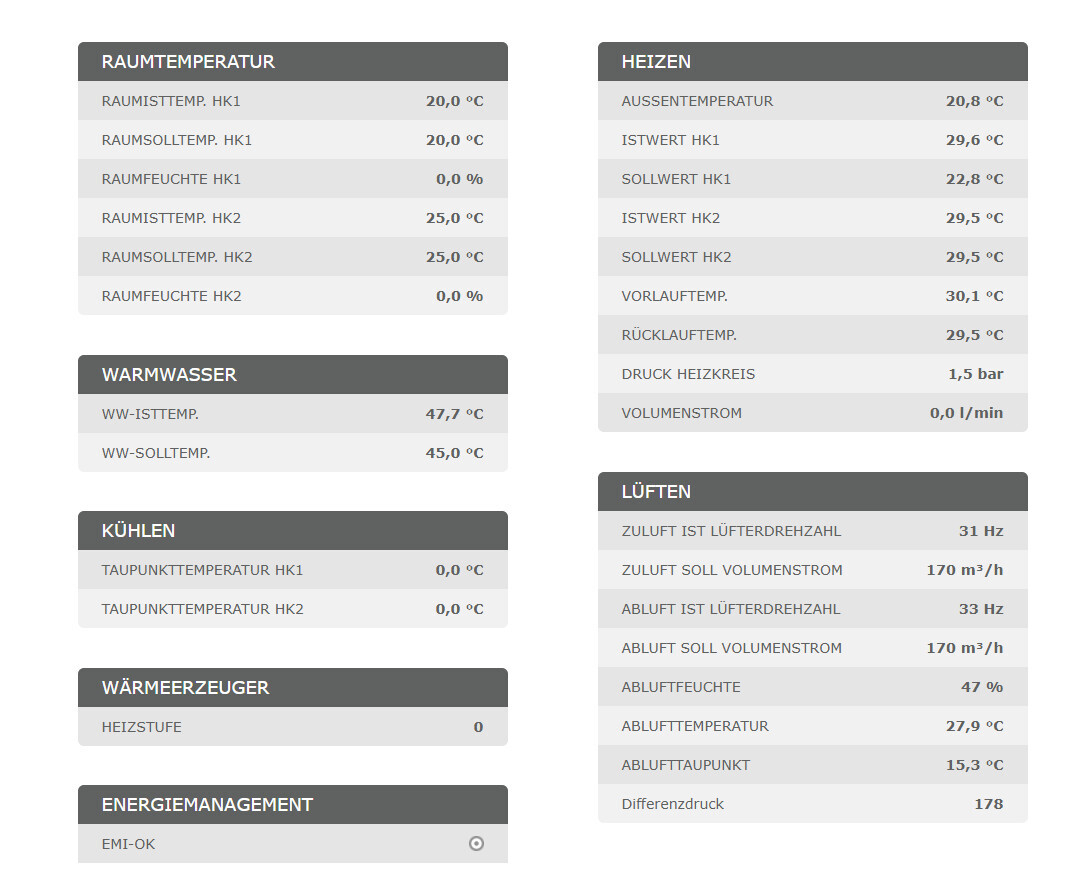
The system information still shows the flow temperature at just under 30°C (86°F), but the flow rate has dropped to zero.
The ventilation is still running, and I suspect our heat recovery unit is causing the issue—because what’s the point of exchanging indoor air with outside air if it blows the air back inside at almost the same warm temperature as it took out?
We only have an outdoor temperature sensor. The device doesn’t handle the indoor temperature very well. It claims the current indoor temperature is 20°C (68°F), but it seems to detect (through measuring) that the exhaust air temperature is about 28°C (82°F). This matches what our various thermometers around the house show.
The question remains: why do we have 28°C (82°F) inside at all? Where is the heat coming from?
Could it be caused solely by sunlight coming through the windows?
We have air conditioning, but I’d rather not run it yet when it’s only about 20°C (68°F) outside and raining.
How do you other new build owners handle this issue? Do you use shading? Something else? Or do you not have this problem at all and maybe there is something wrong with our building services?
We are beginners at living in a newly built house, and this first spring is raising some questions.
Our heating system (Tecalor THZ 504) has already decided, based on the outside temperature—which is currently around 20°C (68°F)—that it is in summer mode. In other words, the heating is turned off.
The system information still shows the flow temperature at just under 30°C (86°F), but the flow rate has dropped to zero.
The ventilation is still running, and I suspect our heat recovery unit is causing the issue—because what’s the point of exchanging indoor air with outside air if it blows the air back inside at almost the same warm temperature as it took out?
We only have an outdoor temperature sensor. The device doesn’t handle the indoor temperature very well. It claims the current indoor temperature is 20°C (68°F), but it seems to detect (through measuring) that the exhaust air temperature is about 28°C (82°F). This matches what our various thermometers around the house show.
The question remains: why do we have 28°C (82°F) inside at all? Where is the heat coming from?
Could it be caused solely by sunlight coming through the windows?
We have air conditioning, but I’d rather not run it yet when it’s only about 20°C (68°F) outside and raining.
How do you other new build owners handle this issue? Do you use shading? Something else? Or do you not have this problem at all and maybe there is something wrong with our building services?
 KingJulien6 Jun 2021 06:06
Regarding actual temperature:
In our case, if there is no room temperature sensor, the heating system assumes the set room temperature as the actual temperature.
If it works the same way for you, you can adjust the settings as you like to match reality.
In our case, if there is no room temperature sensor, the heating system assumes the set room temperature as the actual temperature.
If it works the same way for you, you can adjust the settings as you like to match reality.
T
T_im_Norden6 Jun 2021 08:29The target room temperature is important for the heating curve and should not be adjusted arbitrarily.
KingJulien6 Jun 2021 09:31In summer, the heating curve feels a bit off for me 😉 You can always switch back to a fixed setting for the heating season.
H
hampshire6 Jun 2021 11:04In tennis, you cannot raise the net only for your opponent. With your house, you cannot activate the insulation effect only for winter. Heat that enters the house also stays inside for a longer time. Without shading, the sun heats the materials it reaches through the glass. These then emit heat, which remains inside the house. The same applies on sunny days with hot outdoor air and open windows and doors. Once the warm air is inside the house and heats the interior materials, it takes time for the heat to leave again. So, two principles help:
The stronger the insulation, the slower the system responds. That is the difference compared to your house from 1982.
- Do not let heat into the house. There are three measures for this: avoid direct sunlight through windows = shading, do not let hot air in = keep openings closed, turn off the heating.
- Provide active cooling.
The stronger the insulation, the slower the system responds. That is the difference compared to your house from 1982.
T
T_im_Norden6 Jun 2021 11:17KingJulien schrieb:
In summer, the heating curve is a bit off 😉
You can always reset it to a fixed value for the heating season.But what’s the point of that? You set the target room temperature to the current room temperature of 23°C (73°F), then the sun comes in and the temperature in the living room rises, and you run back to the heat pump to adjust the setting again so that the value matches the current room temperature?
 Schimi17916 Jun 2021 11:24
hampshire schrieb:
..,
Without shading, the sun heats the materials it reaches through the glass. These then emit warmth, which stays inside the house.
…That’s why kudos to electric shutters (or similar) with a sun sensor. They close to 80%. This blocks most of the heat while still letting in enough light.Similar topics