
ᐅ Which Smart Home System to Choose – Special Requirements Present…
Created on: 24 Mar 2021 18:58
Z
zoe_willssmart
Hello,
unfortunately, I only realized towards the end of renovating my old house that smart home systems involve much more than just radiator thermostats and window sensors...
The more I looked into the topic, the more I noticed what I already have or want, and now I’m completely lost about what makes sense and how everything can be combined. So, the question is which wireless standard to use, since running cables is no longer an option.
What do I want to control remotely and make smart?
- Of course, the radiator thermostats, which should automatically turn down when I open a window—or when my partner tilts one open (which he likes to do, grr). I also want to be able to inform the system via an app whether I’m coming home or not, so heating isn’t wasted unnecessarily.
- Window sensors / handles: I want the app to show whether the windows are closed, tilted, or fully open. Maybe even a warning light near the door if I’m about to leave and something is still really open.
- In the hallway, I want lights that automatically turn on when I walk past, but of course only if it’s not bright enough. And at night, I don’t want floodlight intensity—just a comfortable level of light.
- Some switches are in awkward places, and running cables from there would be… well, forget it with these walls. So a few smart modules inside existing switch boxes and sticking a switch somewhere else should be possible with any system, right?
- Smoke detectors: Since my new drywall (plasterboard) walls have become quite soundproof, they need to network together and sound alarms in other rooms. It would be great if you could silence them via app and check which detector triggered first. (Have you ever jumped out of bed half-asleep because of an obvious false alarm, had to fetch a ladder, and pull down that annoying device from 3 meters (10 feet) high just to turn it off? I hate that…)
- Velux roof windows—specifically IO Homecontrol: aside from Somfy, they don’t seem to be controllable by default with other systems. Velux apparently offers an additional device (a hub? bridge? whatever), but can I integrate that anywhere? At least I’d like automatic shading to close when it gets unbearably hot indoors in summer. It would be great to have a network setup that opens my roof windows briefly when the air quality is very poor, instead of just blinking a warning like the Bosch Twinguard does. And, ideally, automatic shading plus opening/closing the windows depending on temperature—so it doesn’t get like a greenhouse during the day or too chilly in my attic at night.
- Outdoor irrigation: I’d like to connect irrigation to keep my flower pots watered on weekends or during holidays. There is a water connection available, and I could run power if needed. I have no clue whether I should go with a standard irrigation controller, something from Gardena, or a Raspberry Pi... At the moment, I’m thinking about setting up a hydroponic system, where a Raspberry Pi monitoring water parameters remotely might be the most practical solution. Do you have any ideas?
- Music: Since some of my stereo systems have broken down, I’m considering what else I could use besides the one tower with a CD player and the annoying music alarm clock. Years or decades ago I might have put my CD collection on a NAS to play in different rooms, but that’s probably not state-of-the-art anymore... Maybe, just maybe, it would make sense to just put a Bluetooth speaker in the bathroom and hobby room, which could be controlled remotely somehow. I actually don’t want Alexa/Siri/whatever listening devices in the house, but I might make an exception for the bathroom. How else do you control something like this if not through a phone? Do you keep an extra tablet there just to select music?
Questions, questions...
And to make things more complicated (otherwise you’d just say Zigbee):
I’m actually leaning toward Bosch—not only because I prefer rechargeable batteries for environmental reasons rather than disposable mini batteries, but also because I want to store my data locally on a device rather than somewhere in the cloud.
I guess integrating that with a Raspberry Pi will be difficult, right?
So if anyone can shed some light on this, I’d be very grateful for any information 🙂
unfortunately, I only realized towards the end of renovating my old house that smart home systems involve much more than just radiator thermostats and window sensors...
The more I looked into the topic, the more I noticed what I already have or want, and now I’m completely lost about what makes sense and how everything can be combined. So, the question is which wireless standard to use, since running cables is no longer an option.
What do I want to control remotely and make smart?
- Of course, the radiator thermostats, which should automatically turn down when I open a window—or when my partner tilts one open (which he likes to do, grr). I also want to be able to inform the system via an app whether I’m coming home or not, so heating isn’t wasted unnecessarily.
- Window sensors / handles: I want the app to show whether the windows are closed, tilted, or fully open. Maybe even a warning light near the door if I’m about to leave and something is still really open.
- In the hallway, I want lights that automatically turn on when I walk past, but of course only if it’s not bright enough. And at night, I don’t want floodlight intensity—just a comfortable level of light.
- Some switches are in awkward places, and running cables from there would be… well, forget it with these walls. So a few smart modules inside existing switch boxes and sticking a switch somewhere else should be possible with any system, right?
- Smoke detectors: Since my new drywall (plasterboard) walls have become quite soundproof, they need to network together and sound alarms in other rooms. It would be great if you could silence them via app and check which detector triggered first. (Have you ever jumped out of bed half-asleep because of an obvious false alarm, had to fetch a ladder, and pull down that annoying device from 3 meters (10 feet) high just to turn it off? I hate that…)
- Velux roof windows—specifically IO Homecontrol: aside from Somfy, they don’t seem to be controllable by default with other systems. Velux apparently offers an additional device (a hub? bridge? whatever), but can I integrate that anywhere? At least I’d like automatic shading to close when it gets unbearably hot indoors in summer. It would be great to have a network setup that opens my roof windows briefly when the air quality is very poor, instead of just blinking a warning like the Bosch Twinguard does. And, ideally, automatic shading plus opening/closing the windows depending on temperature—so it doesn’t get like a greenhouse during the day or too chilly in my attic at night.
- Outdoor irrigation: I’d like to connect irrigation to keep my flower pots watered on weekends or during holidays. There is a water connection available, and I could run power if needed. I have no clue whether I should go with a standard irrigation controller, something from Gardena, or a Raspberry Pi... At the moment, I’m thinking about setting up a hydroponic system, where a Raspberry Pi monitoring water parameters remotely might be the most practical solution. Do you have any ideas?
- Music: Since some of my stereo systems have broken down, I’m considering what else I could use besides the one tower with a CD player and the annoying music alarm clock. Years or decades ago I might have put my CD collection on a NAS to play in different rooms, but that’s probably not state-of-the-art anymore... Maybe, just maybe, it would make sense to just put a Bluetooth speaker in the bathroom and hobby room, which could be controlled remotely somehow. I actually don’t want Alexa/Siri/whatever listening devices in the house, but I might make an exception for the bathroom. How else do you control something like this if not through a phone? Do you keep an extra tablet there just to select music?
Questions, questions...
And to make things more complicated (otherwise you’d just say Zigbee):
I’m actually leaning toward Bosch—not only because I prefer rechargeable batteries for environmental reasons rather than disposable mini batteries, but also because I want to store my data locally on a device rather than somewhere in the cloud.
I guess integrating that with a Raspberry Pi will be difficult, right?
So if anyone can shed some light on this, I’d be very grateful for any information 🙂
Z
zoe_willssmart27 Mar 2021 17:10Don't I need tons of gateways/hubs, etc., since each system initially comes with its own to connect?
 untergasse4327 Mar 2021 20:29
Correct. Although many things already work relatively well together out of the box with the respective wireless standards. The approach is just rubbish, but advertising still suggests that everything can be easily done by yourself. As I said, with the Alexas and Googles of this world, it works reasonably well, but you pay for that with the presence of Alexas and Googles.
If you are somewhat IT-savvy, I strongly recommend taking a look at Home Assistant, OpenHab, or ioBroker, as suggested earlier.
I personally evaluated Edomi (purely KNX), ioBroker, and Home Assistant, created small demos with each, and ultimately chose Home Assistant. It offers many ready-made integrations (to connect your various systems), and if not, Node-RED is included out of the box.
I personally evaluated Edomi (purely KNX), ioBroker, and Home Assistant, created small demos with each, and ultimately chose Home Assistant. It offers many ready-made integrations (to connect your various systems), and if not, Node-RED is included out of the box.
Z
zoe_willssmart29 Mar 2021 20:41I’m a bit concerned about brokers and such turning the process into a hobby that takes up a lot of time, instead of having a home that operates smartly in the background.
I use ioBroker along with a large number of Shelly devices. You do need to invest some time to get familiar with it. Here is an example of how I visualized it in our hallway. The entire visualization runs on the Mediola system, while all the actual logic is handled by ioBroker.
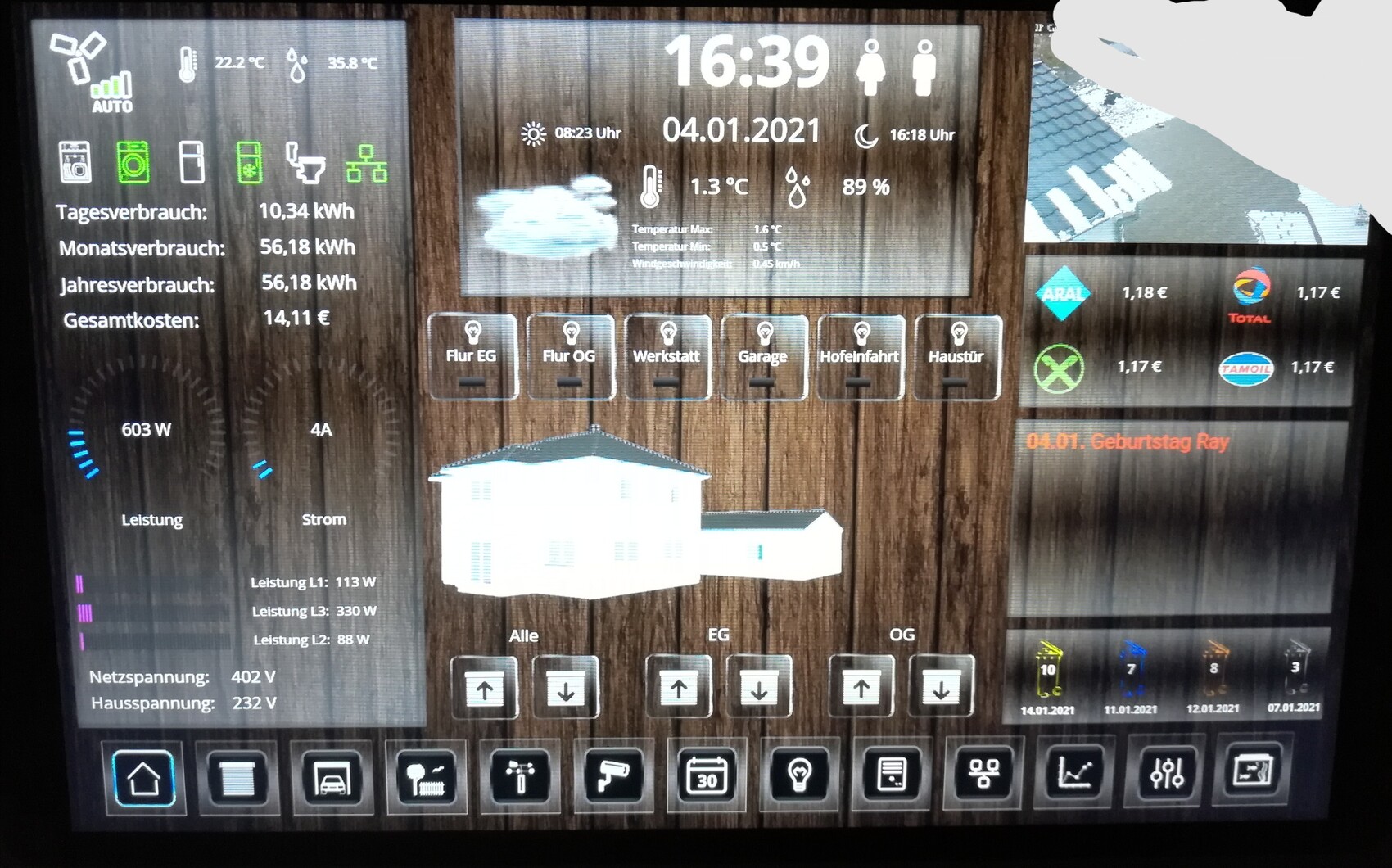
The system is basically intended as an information center. Roller shutter control, lighting, and so on all run independently in the background.
The system is basically intended as an information center. Roller shutter control, lighting, and so on all run independently in the background.
Z
zoe_willssmart29 Mar 2021 22:18why use both iobroker and mediola? why isn’t one enough?