
ᐅ The situation in the real estate market... unbelievable
Created on: 12 Nov 2019 18:29
R
Reinhard84.2
Hello everyone,
We are currently looking for a property in the Lower Rhine region, which is not a particularly sought-after area, but unfortunately, the prices are not any better than in eastern Germany. When calling several real estate agents, they mentioned up to 50 viewings scheduled for one property. This was for a standard semi-detached house with a somewhat larger plot. I get the impression that as soon as a house has a garden bigger than a chicken coop, the interest is incredible.
Of course, the municipalities are not designating any new building land, as that would spoil the surroundings… (to what extent that is still possible is left to their imagination). This naturally has the convenient side effect that existing building plots and older properties are insanely expensive.
You can probably wait half a lifetime for the supposed recession, falling prices, and available properties. It’s all frustrating and a real pity.
Thanks for listening.
We are currently looking for a property in the Lower Rhine region, which is not a particularly sought-after area, but unfortunately, the prices are not any better than in eastern Germany. When calling several real estate agents, they mentioned up to 50 viewings scheduled for one property. This was for a standard semi-detached house with a somewhat larger plot. I get the impression that as soon as a house has a garden bigger than a chicken coop, the interest is incredible.
Of course, the municipalities are not designating any new building land, as that would spoil the surroundings… (to what extent that is still possible is left to their imagination). This naturally has the convenient side effect that existing building plots and older properties are insanely expensive.
You can probably wait half a lifetime for the supposed recession, falling prices, and available properties. It’s all frustrating and a real pity.
Thanks for listening.
I can’t deny my personal passion for cars, nor that I spend quite a bit of money on them. But I truly enjoy driving and maintaining all these vehicles every day.
However, when it comes to a car, functionality is key, especially space. The cars listed are not suitable as a first vehicle simply because they lack adequate cargo space.
If you don’t make large shopping trips or go on vacation by car, models like the Corsa, Twingo, and similar can be sufficient.
But looking around my neighborhood, most people drive SUVs, Tourans, VW buses, or station wagons. And those typically cost more than 300 euros per month.
But that’s enough of the car discussion, it’s getting off-topic.
However, when it comes to a car, functionality is key, especially space. The cars listed are not suitable as a first vehicle simply because they lack adequate cargo space.
If you don’t make large shopping trips or go on vacation by car, models like the Corsa, Twingo, and similar can be sufficient.
But looking around my neighborhood, most people drive SUVs, Tourans, VW buses, or station wagons. And those typically cost more than 300 euros per month.
But that’s enough of the car discussion, it’s getting off-topic.
Rough estimate:
New car / dealer registration / nearly new car
Compact class small car, gasoline engine €20,000 (Polo, Focus, C4, etc.)
Purchase planned for 100,000 km (62,000 miles) over 5 years (annual mileage 20,000 km (12,400 miles) for commuting plus private use)
Estimated residual value after 5 years €5,000
=>
€15,000 / 5 years
€3,000 / 1 year
€250 / month investment cost
Fuel (20,000 km / 12 months), maintenance, winter tires, insurance, and road tax rounded €250
=> Flat rate of €500 / month total car costs
New car / dealer registration / nearly new car
Compact class small car, gasoline engine €20,000 (Polo, Focus, C4, etc.)
Purchase planned for 100,000 km (62,000 miles) over 5 years (annual mileage 20,000 km (12,400 miles) for commuting plus private use)
Estimated residual value after 5 years €5,000
=>
€15,000 / 5 years
€3,000 / 1 year
€250 / month investment cost
Fuel (20,000 km / 12 months), maintenance, winter tires, insurance, and road tax rounded €250
=> Flat rate of €500 / month total car costs
An annual mileage of 20,000€ roughly equals 175€ (rounded) spent on fuel. Those who commute a lot naturally pay more for fuel. That’s clear.
Regarding the investment: You can get a brand-new Polo for 12,500€. After 5 years, it’s still worth around 5,000€, so that’s half the initial cost.
If you don’t buy a new car every 5 years but every 10 years, the numbers look even better—12,500€ over 10 years compared to 15,000€ over 5 years. Even with 20,000€ over 10 years, it still looks more reasonable. Those who need a new car every five years just pay extra. It’s a luxury you can choose to have or not. That’s clear.
Regarding the investment: You can get a brand-new Polo for 12,500€. After 5 years, it’s still worth around 5,000€, so that’s half the initial cost.
If you don’t buy a new car every 5 years but every 10 years, the numbers look even better—12,500€ over 10 years compared to 15,000€ over 5 years. Even with 20,000€ over 10 years, it still looks more reasonable. Those who need a new car every five years just pay extra. It’s a luxury you can choose to have or not. That’s clear.
I believe the ADAC table is not a bad starting point for an objective total cost, right? Opinions vary widely on what to use for this.
With 400 euros/month for the first car and maybe 300 euros/month for an optionally required second car, you should be in a reasonable range. Fluctuations above or below are, of course, possible.
I think categories such as food and clothing also vary significantly. Personally, I spend quite a lot on food, as I only buy high-quality products and also enjoy dining out occasionally. Those who live on instant pasta and supermarket cold cuts with toast probably have a lot of potential savings here.
For a loan amount of 500,000 euros, the current monthly payment is about 1,100 euros (1.5% repayment). This should not exceed 1,500 euros including additional costs in a new build.
To comfortably manage this and still afford some luxuries, a household net income of around 5,000 euros should be sufficient. Below that, compromises would be necessary.
However, looking at the statistics, this promoted net income of 5,000 euros is not necessarily the average in Germany :O
With 400 euros/month for the first car and maybe 300 euros/month for an optionally required second car, you should be in a reasonable range. Fluctuations above or below are, of course, possible.
I think categories such as food and clothing also vary significantly. Personally, I spend quite a lot on food, as I only buy high-quality products and also enjoy dining out occasionally. Those who live on instant pasta and supermarket cold cuts with toast probably have a lot of potential savings here.
For a loan amount of 500,000 euros, the current monthly payment is about 1,100 euros (1.5% repayment). This should not exceed 1,500 euros including additional costs in a new build.
To comfortably manage this and still afford some luxuries, a household net income of around 5,000 euros should be sufficient. Below that, compromises would be necessary.
However, looking at the statistics, this promoted net income of 5,000 euros is not necessarily the average in Germany :O
What’s with the flat rates?
Anyone can calculate what they pay for their vehicles themselves; it’s really not rocket science.
If someone always has to drive two new or nearly new cars costing 30,000 per year, that’s fine.
I mostly ride a bike, and I also have a 10-year-old and a 17-year-old car standing around.
I do simple repairs myself (exhaust, brakes, and so on).
Obviously, the costs are different than for a new E-Class worth 50k that burns through hundreds of dollars monthly just standing still.
On average, 500 per month is probably about right, but I don’t need to worry about that.
Anyone can calculate what they pay for their vehicles themselves; it’s really not rocket science.
If someone always has to drive two new or nearly new cars costing 30,000 per year, that’s fine.
I mostly ride a bike, and I also have a 10-year-old and a 17-year-old car standing around.
I do simple repairs myself (exhaust, brakes, and so on).
Obviously, the costs are different than for a new E-Class worth 50k that burns through hundreds of dollars monthly just standing still.
On average, 500 per month is probably about right, but I don’t need to worry about that.
The ADAC table assumes a new car with a holding period of 5 years. This is no longer necessarily typical.
For households with four or more members, a household net income of 5K or more is not as uncommon as one might think:
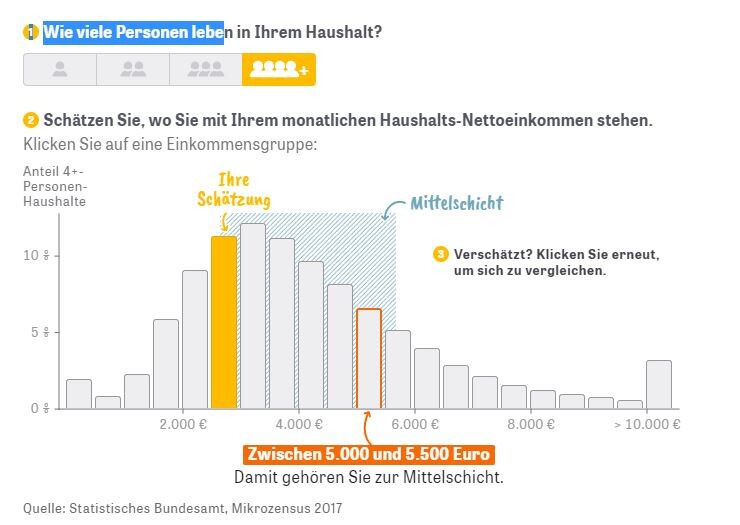
This includes the income of all earners in a household, as well as income from rental properties and capital, plus social benefits and child or parental allowances.
Bookstar schrieb:
To manage that comfortably and still have some luxury, a household net income of 5000 euros would probably be sufficient. Below that, only with compromises.
However, when I look at the statistics, the promoted 5K net income here is not necessarily the average in Germany :O
For households with four or more members, a household net income of 5K or more is not as uncommon as one might think:
This includes the income of all earners in a household, as well as income from rental properties and capital, plus social benefits and child or parental allowances.