
Hello everyone,
We are managing our build with individual contracts and have hired a very reputable local shell construction company for the structural work. We did not commission a soil survey before starting construction because the municipality had already drilled on our plot and found that the ground consists of clay and silt.
We are building a KFW 55 house with a basement. Two of the basement rooms have daylight due to a slight slope and are intended to be living spaces with underfloor heating, etc.
For insulating the concrete basement, XPS boards from the company Austrotherm were used. The whole process was supervised by a construction manager.
Now, in our region (in other development areas), more and more people are building, and we noticed that, in most houses, a black coating is applied before the insulation boards are installed, and only then are the boards attached. This was not done in our case; the boards were fixed with mechanical fasteners without this layer.
Both the construction manager and the shell contractor independently say that since we do not have any groundwater pressure, this coating is not necessary.
Am I worrying for nothing, or should I have all the boards removed (would they be reusable or would I have to use new ones?) at my own expense and apply the coating afterward?
The basement has not been backfilled yet.
The contract specifies point fastening, but it does not clearly state whether a bitumen layer or something similar should be applied in between. However, the manufacturer of the boards specifies the coating on their website.
How was this handled in your projects?
We are managing our build with individual contracts and have hired a very reputable local shell construction company for the structural work. We did not commission a soil survey before starting construction because the municipality had already drilled on our plot and found that the ground consists of clay and silt.
We are building a KFW 55 house with a basement. Two of the basement rooms have daylight due to a slight slope and are intended to be living spaces with underfloor heating, etc.
For insulating the concrete basement, XPS boards from the company Austrotherm were used. The whole process was supervised by a construction manager.
Now, in our region (in other development areas), more and more people are building, and we noticed that, in most houses, a black coating is applied before the insulation boards are installed, and only then are the boards attached. This was not done in our case; the boards were fixed with mechanical fasteners without this layer.
Both the construction manager and the shell contractor independently say that since we do not have any groundwater pressure, this coating is not necessary.
Am I worrying for nothing, or should I have all the boards removed (would they be reusable or would I have to use new ones?) at my own expense and apply the coating afterward?
The basement has not been backfilled yet.
The contract specifies point fastening, but it does not clearly state whether a bitumen layer or something similar should be applied in between. However, the manufacturer of the boards specifies the coating on their website.
How was this handled in your projects?
K
Knallkörper22 Jun 2018 13:52Snowy36 schrieb:
It’s unlikely that it says "white tank"…That’s not impossible. Don’t you have an architect?
The formulation is:
The basement exterior walls will be 25 cm (10 inches) thick, rough-faced on both sides, and cast with waterproof concrete according to the structural engineer’s specifications. At the junction between the rising wall and the ground slab, a joint sealing tape will be installed. From the top of the basement ceiling downwards, rigid foam insulation boards 100 mm (4 inches) thick and a dimpled plastic membrane will be applied all around on the outside.
The architect prepared a submission plan, which was then developed into a working drawing. However, the trades were contracted individually together with our construction supervisor.
The basement exterior walls will be 25 cm (10 inches) thick, rough-faced on both sides, and cast with waterproof concrete according to the structural engineer’s specifications. At the junction between the rising wall and the ground slab, a joint sealing tape will be installed. From the top of the basement ceiling downwards, rigid foam insulation boards 100 mm (4 inches) thick and a dimpled plastic membrane will be applied all around on the outside.
The architect prepared a submission plan, which was then developed into a working drawing. However, the trades were contracted individually together with our construction supervisor.
Knallkörper schrieb:
Sorry – that sounds somewhat naive. You’re supposed to know that. Who is responsible for the planning?Here again in this thread, a concrete basement is equated with the “white tank” method, which is not correct. Therefore, I wouldn’t agree with that statement right away 🙂
Snowy36 schrieb:
The exterior basement walls are 25cm (10 inches) thick, rough shuttered on both sides, and cast with waterproof concrete according to structural engineering specifications. At the joint where the rising wall connects to the base slab, a joint sealing tape is installed.In my opinion, this corresponds to the construction of a white tank, but still it isn’t one. A true white tank requires supervision by an expert and all the formalities that come with it. But who really needs that.
Anyway, as described, the structure is watertight. There is no need for a black bituminous coating.
What I find interesting is this:
Snowy36 schrieb:
In our case, the insulation boards were fastened without this layer.Actually fastened with mechanical anchors and not glued? That would really raise questions for me, since waterproof concrete achieves its watertightness through thickness. Mechanically fixing it with anchors could be detrimental. Usually, perimeter insulation is glued.
As promised, here is a photo.... In the foundation area, these anchors were shot into the now 25cm (10 inches) thick concrete wall. This is not only the case with our shell construction but also with the neighbor’s. There are gaps between some of the panels further down that, according to the expert who was here yesterday, need to be filled.
He also said that, given our soil conditions, we do not need the black layer and believed that in winter it might even seal everything too tightly, preventing air from escaping from the inside to the outside…
Well, we will now approach the builder to have all the damaged panels replaced and the gaps filled before backfilling.
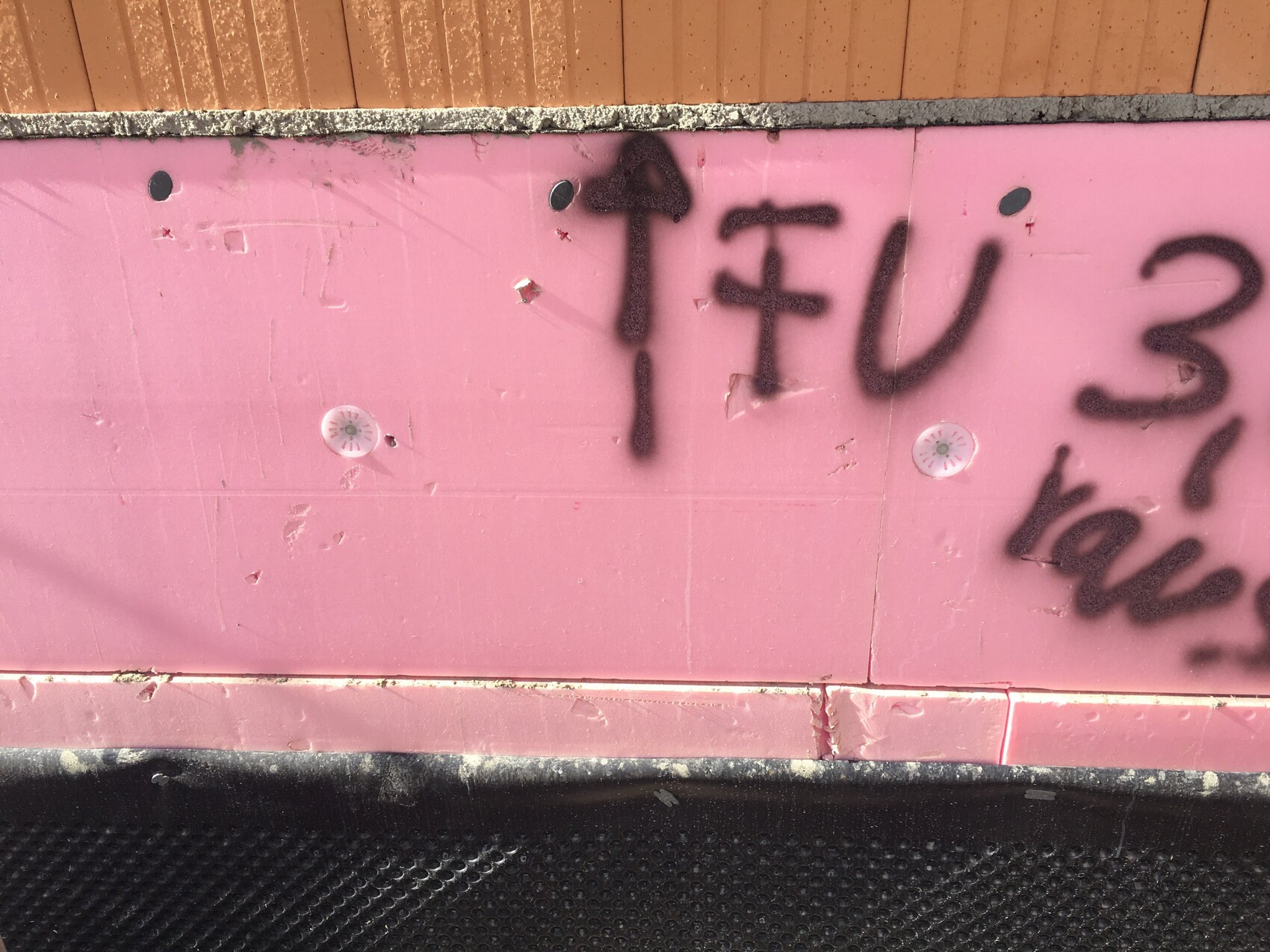
He also said that, given our soil conditions, we do not need the black layer and believed that in winter it might even seal everything too tightly, preventing air from escaping from the inside to the outside…
Well, we will now approach the builder to have all the damaged panels replaced and the gaps filled before backfilling.
I find it quite odd that XPS insulation is being fastened with anchors in the perimeter area. Especially since the watertightness of a waterproof concrete basement depends on the material thickness, which is weakened at the drilling points.
But when even the expert refers to breathable walls against soil, things are likely to get pretty interesting.
But when even the expert refers to breathable walls against soil, things are likely to get pretty interesting.
Similar topics