
ᐅ Waterproof concrete – injection during the construction phase
Created on: 4 Jan 2025 13:51
S
summoner
Hi,
we are currently in the process of building a house with a general contractor who is also responsible for the basement.
The house is a solid masonry structure with a fully basement constructed using a "white tank" (watertight concrete) system. The basement, made of watertight concrete (WU concrete), is completely below ground level and does not protrude on any side. Each room in the basement has waterproof light wells designed to resist groundwater pressure. The soil survey confirmed that there is no hydrostatic groundwater pressure.
The WU construction is or was carried out according to the contract as follows (excerpt):
Approximately 24 cm (9.5 inches) thick reinforced concrete walls cast in place, a 30 cm (12 inches) thick reinforced concrete slab with reinforcement, PE foil as a sliding layer, perimeter insulation with a thickness of 60 mm (2.4 inches), and a 5 cm (2 inch) thick blinding layer. The buried WU basement exterior walls were insulated with 100 mm (4 inches) of perimeter insulation.
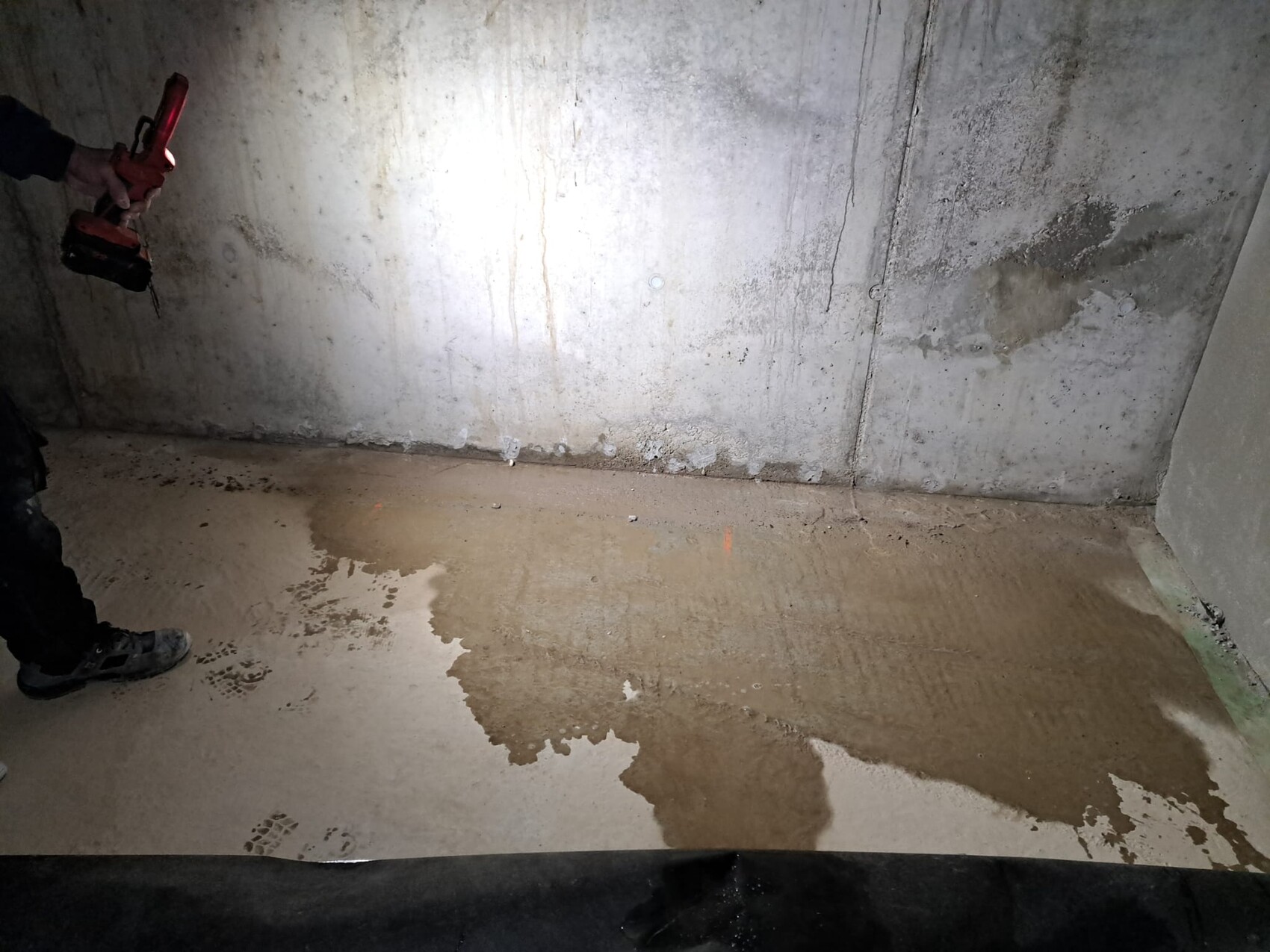
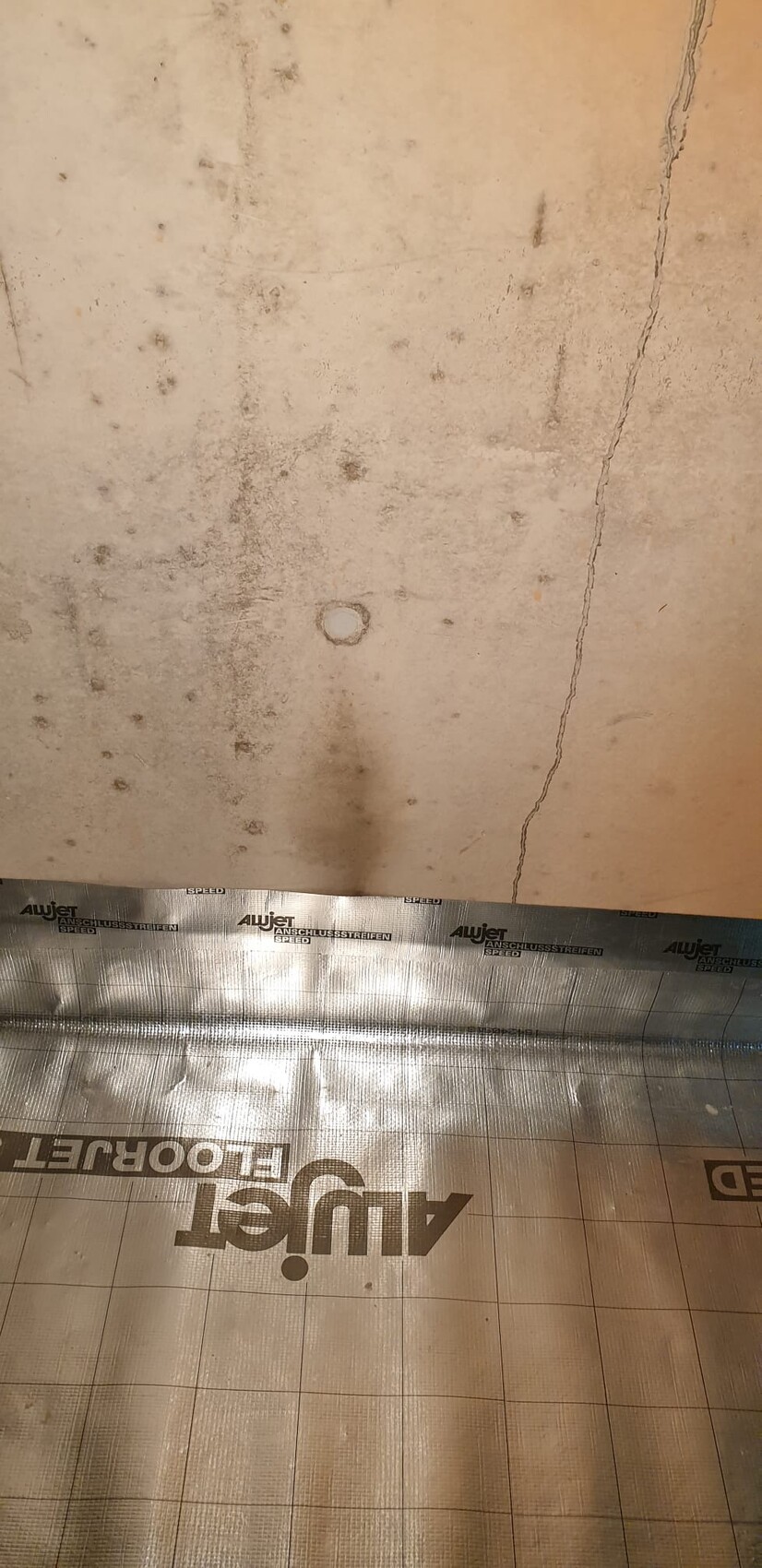
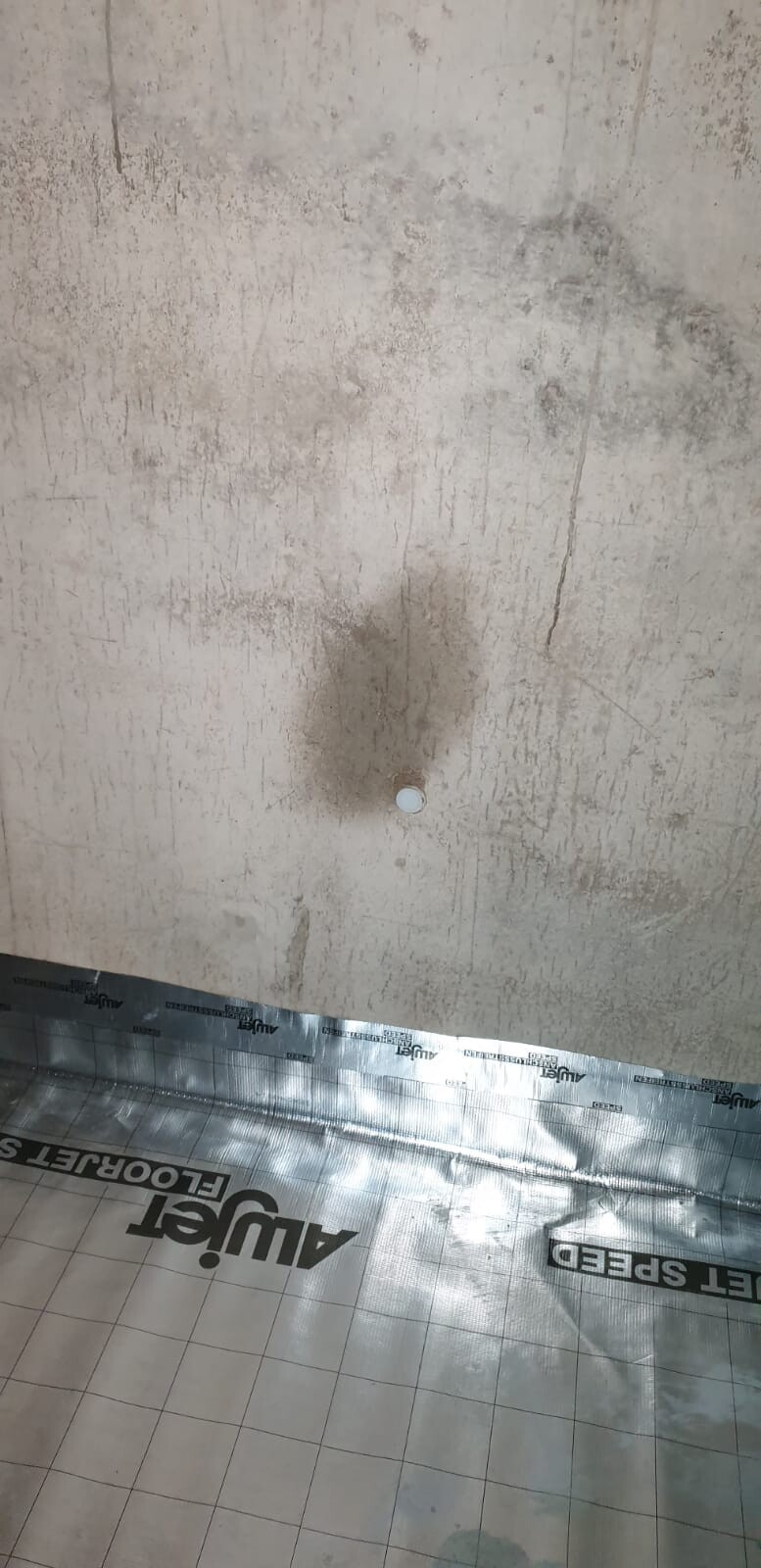
Now, the site manager and we have noticed damp spots on some walls. In one area, water seeped in slightly between the floor slab and the wall, causing a small puddle on the floor. In another area, water penetrated the wall itself (photos attached). Fortunately, the site manager acted quickly and has been following up to ensure “everything is in order.”
These spots were generously injected with sealant by a company responsible for supervising the white tank installation (one site about a month ago, the other about 2–3 months ago) and currently appear to be sealed. In one case, water leaked out during drilling of the wall; according to the employee, they had to drill through the joint protection or membrane (warning: not an expert) to ensure it was fully sealed.
During a recent site inspection, we found new damp areas and are now concerned whether it is normal that multiple injections are needed in different places so early in a new build with a white tank basement. Unfortunately, the basement has already been fully backfilled, and a “foil” (vapor barrier?) has been installed inside the basement, which, however, is only adhered to the wall.
We have already reported the new damp spots to the site manager.
Has anyone had similar experiences? Any feedback would be greatly appreciated.

we are currently in the process of building a house with a general contractor who is also responsible for the basement.
The house is a solid masonry structure with a fully basement constructed using a "white tank" (watertight concrete) system. The basement, made of watertight concrete (WU concrete), is completely below ground level and does not protrude on any side. Each room in the basement has waterproof light wells designed to resist groundwater pressure. The soil survey confirmed that there is no hydrostatic groundwater pressure.
The WU construction is or was carried out according to the contract as follows (excerpt):
Approximately 24 cm (9.5 inches) thick reinforced concrete walls cast in place, a 30 cm (12 inches) thick reinforced concrete slab with reinforcement, PE foil as a sliding layer, perimeter insulation with a thickness of 60 mm (2.4 inches), and a 5 cm (2 inch) thick blinding layer. The buried WU basement exterior walls were insulated with 100 mm (4 inches) of perimeter insulation.
Now, the site manager and we have noticed damp spots on some walls. In one area, water seeped in slightly between the floor slab and the wall, causing a small puddle on the floor. In another area, water penetrated the wall itself (photos attached). Fortunately, the site manager acted quickly and has been following up to ensure “everything is in order.”
These spots were generously injected with sealant by a company responsible for supervising the white tank installation (one site about a month ago, the other about 2–3 months ago) and currently appear to be sealed. In one case, water leaked out during drilling of the wall; according to the employee, they had to drill through the joint protection or membrane (warning: not an expert) to ensure it was fully sealed.
During a recent site inspection, we found new damp areas and are now concerned whether it is normal that multiple injections are needed in different places so early in a new build with a white tank basement. Unfortunately, the basement has already been fully backfilled, and a “foil” (vapor barrier?) has been installed inside the basement, which, however, is only adhered to the wall.
We have already reported the new damp spots to the site manager.
Has anyone had similar experiences? Any feedback would be greatly appreciated.
A
Allthewayup4 Jan 2025 18:55One more thing I thought of:
These "damp spots" in the photos from the first post don’t necessarily have to be water coming from the outside. It could be moisture condensing on the cold concrete inside due to a small gap or seam in the XPS insulation on the exterior side, residues of formwork oils, salts, or similar substances that attract moisture from the indoor air. Or was a “test drill” done exactly at that spot where water came out?
We had similar spots during the shell construction phase that disappeared on their own once it got a bit warmer in spring. Even just 2–3 degrees Celsius (35.6–37.4 °F) were enough. Once the building is occupied and heated continuously, this issue resolves itself anyway.
These "damp spots" in the photos from the first post don’t necessarily have to be water coming from the outside. It could be moisture condensing on the cold concrete inside due to a small gap or seam in the XPS insulation on the exterior side, residues of formwork oils, salts, or similar substances that attract moisture from the indoor air. Or was a “test drill” done exactly at that spot where water came out?
We had similar spots during the shell construction phase that disappeared on their own once it got a bit warmer in spring. Even just 2–3 degrees Celsius (35.6–37.4 °F) were enough. Once the building is occupied and heated continuously, this issue resolves itself anyway.
Allthewayup schrieb:
One more thought:
These “damp spots” in the photos from the first post don’t necessarily have to be water coming in from outside. It could be moisture condensing on the cold concrete inside where, for example, there is a small gap or seam in the XPS insulation on the exterior side, leftover formwork oils, salts, or similar substances that attract moisture from the indoor air. Or was a test drill made exactly there and water came out?
We also had such spots during the shell construction, but they disappeared on their own once it got a bit warmer in spring. Just 2-3 degrees Celsius (36-37°F) were enough. After moving in, when heating is continuous, it resolves itself anyway. In the photo where the injection was done, water flowed out at just one drill hole. In the other photos, no drilling (yet) took place.
Where the injection was done, everything is now dry.
A quick question: even if there is a defect, are there alternatives to injection?
A
Allthewayup4 Jan 2025 19:38summoner schrieb:
In the photo where the injection sealing was done, water was leaking at one (!) drill point. In the other photos, no drilling had been done (yet).
Where the sealing was done, everything is dry now.
One quick question: even if there is a defect, are there alternatives to injection sealing?I am not an expert, but as far as I understood from my research at the time, injection sealing is the safest/best method. There are many technical articles on this topic available online, just search for them.The problem arises when, for a relatively small basement like in a single-family house, the issue occurs at many different points; then, I suppose, it might only address symptoms while ignoring the root cause.
It should be in your interest to have certainty about whether the basement construction complies with regulations, so you should consult an expert as soon as possible. When looking for an expert, I would pay attention to their qualifications.

Allthewayup schrieb:
Where is @11ant?What do you expect me to say about an unauthorized wet basement?https://www.instagram.com/11antgmxde/
https://www.linkedin.com/company/bauen-jetzt/
A
Allthewayup5 Jan 2025 15:3011ant schrieb:
What do you expect me to say about an illegally damp basement?I thought you were the basement specialist, sorry if I misunderstood something there.Allthewayup schrieb:
I thought you were the specialist for basements; sorry if I misunderstood something.I am an independent building consultant who supports my clients in a construction-method-neutral way throughout the entire house planning process. I cooperate with a financing advisor and an energy consultant (both active nationwide like myself), as well as with building surveyors (nationwide but regionally based), although I am not one myself. I consider myself a "specialist" in explaining the basics of building planning in a way that is easy to understand for laypeople. From this many years of experience, the first and second 11ant basement rules were developed.However, even when I refer my clients to building surveyors, I prefer to do so preventively. Acting as an expert after children have fallen into the well—that is, basements whose waterproof concrete (WU) guarantees unfortunately turn out to be insufficient—is usually not a task gladly accepted by surveyors. Taking on such cases tends to damage my relationships and those of "my" clients with these surveyors. Therefore, I am grateful when affected parties (or their construction law attorneys) handle this themselves and decide whom to appoint for such matters.
https://www.instagram.com/11antgmxde/
https://www.linkedin.com/company/bauen-jetzt/
Similar topics