
Hello everyone,
Our situation:
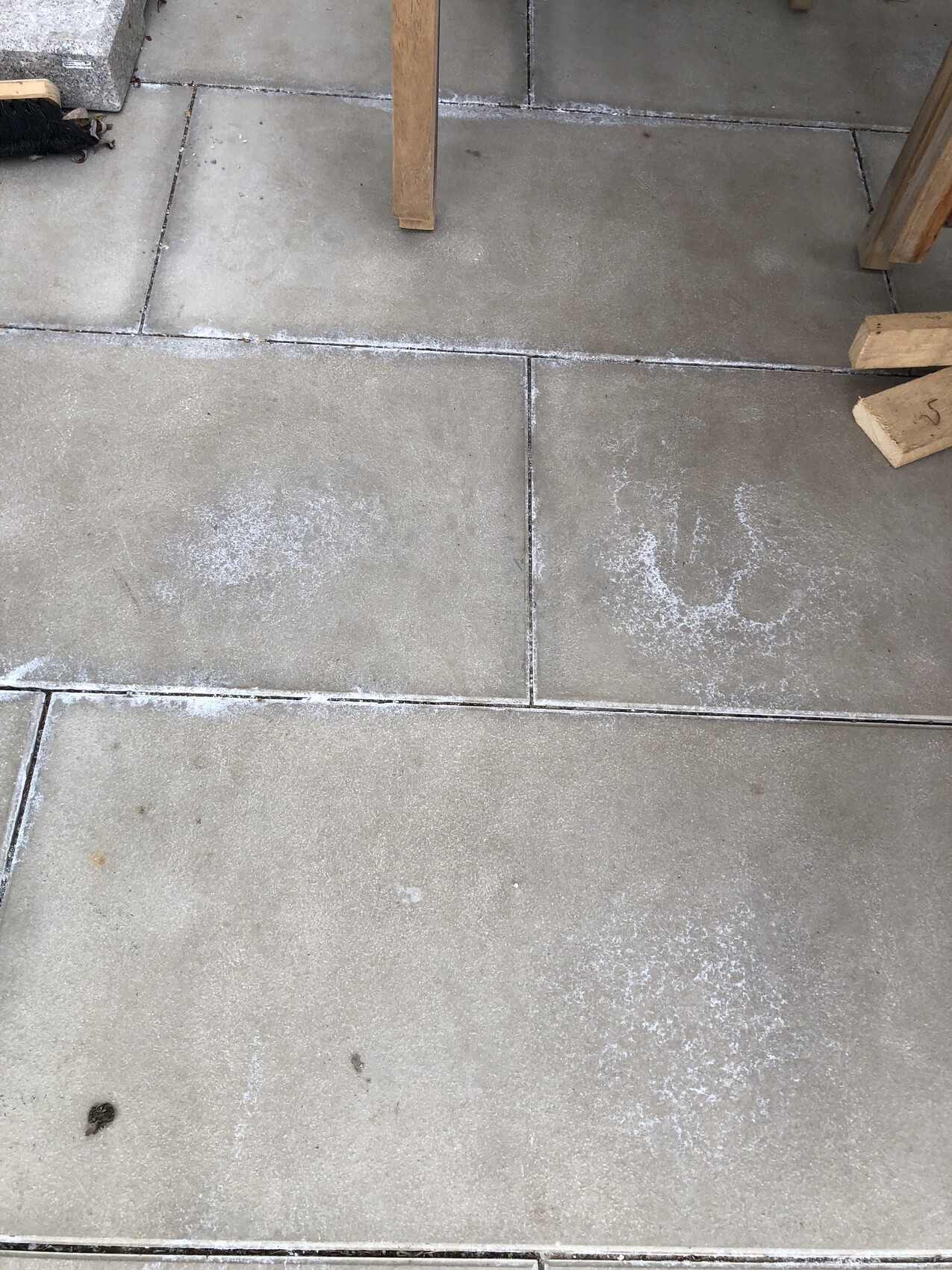
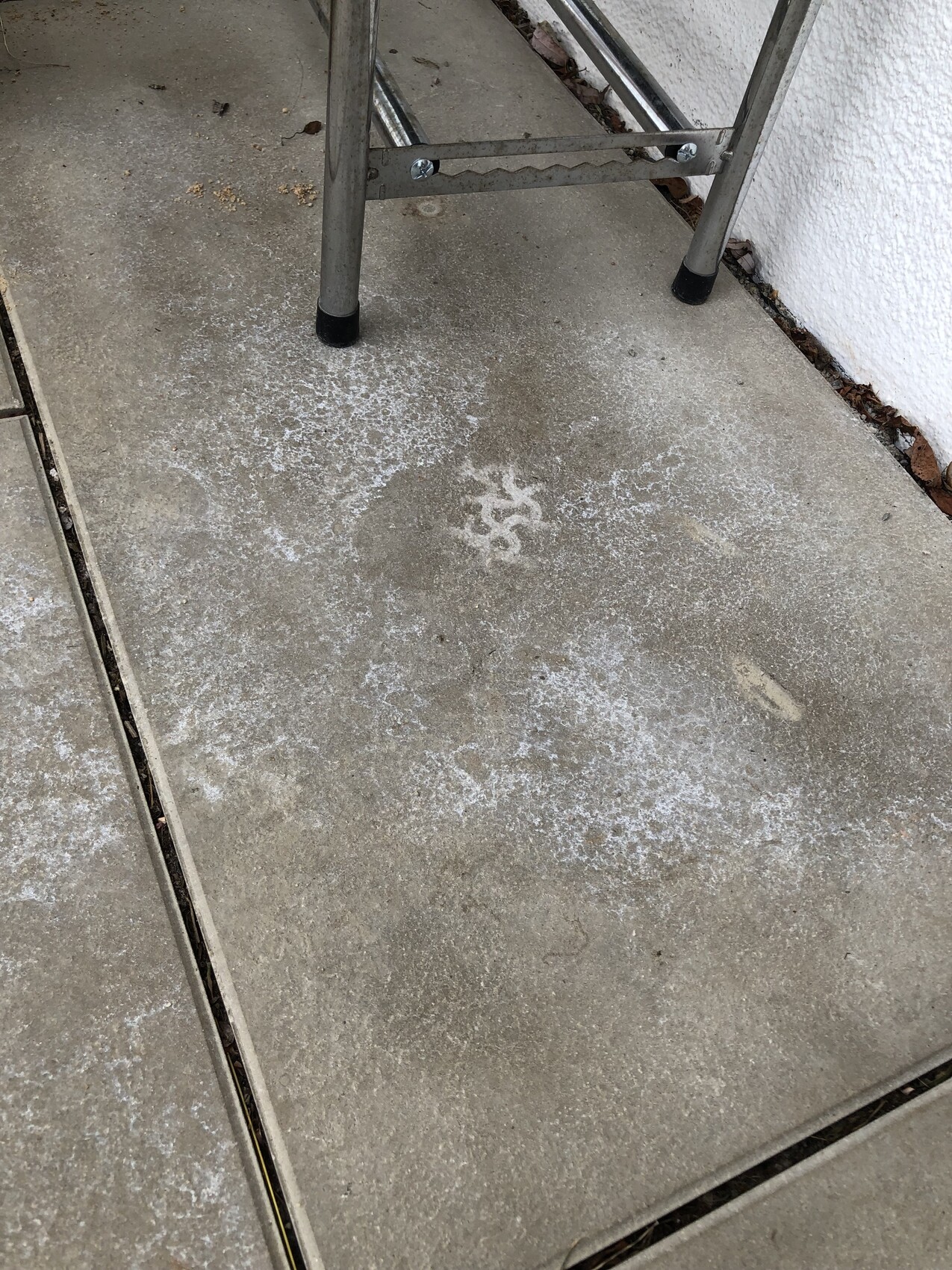
Two years ago, we had new Godelmann Gabano smooth slabs installed in beige (80x40x5 cm (31.5x15.7x2 inches)). However, the slabs aren’t beige but gray like regular concrete, and they regularly show cement efflorescence. The slabs also absorb every grease stain, for example from food. The cement residue was supposed to be washed away by rain, but now we have a roof over it. I have already removed the residue twice using the Godelmann cleaner (hydrochloric acid), but the residue keeps coming back (see attached photos from today).
We want to install a wooden deck made from local or Siberian larch on top of the slabs. Since the slabs are already (almost) level and have a slope, I don’t have to do much in that regard.
Problem: We only have 6 cm (2.4 inches) of clearance up to the door.
1. What is the best approach here? I will need about 28 mm (1.1 inches) for the decking boards, plus about 3-4 mm (0.1-0.2 inches) for pads for leveling. That leaves 28 mm (1.1 inches) for the substructure.
Can I build the substructure from the decking boards themselves, or is it better to use aluminum? Aluminum has the advantage of handling moisture well but is more expensive and harder to work with than wood.
The substructure could almost rest fully on the slabs, so there shouldn’t be any mechanical issues.
2. Does the structure have to be fastened to the slabs, or is a floating installation possible? I’d rather avoid drilling into the expensive Godelmann slabs in case the wooden floor turns out to be unsuitable for us for any reason.
Alternatively, I would have to remove the Godelmann slabs and replace them with inexpensive paving slabs. I would prefer to avoid that effort if possible. Otherwise, the Godelmann slabs are just lying around unused.
3. It is recommended to lay the boards away from the house so water can run off along the boards. However, since there is a roof, only the edge gets wet and discolored. If I install the boards parallel to the house wall, the boards at the edge could be replaced after a few years. Also, the substructure would then run perpendicular to the house wall, allowing water to drain better off the slabs.
What do you think?
Our situation:
Two years ago, we had new Godelmann Gabano smooth slabs installed in beige (80x40x5 cm (31.5x15.7x2 inches)). However, the slabs aren’t beige but gray like regular concrete, and they regularly show cement efflorescence. The slabs also absorb every grease stain, for example from food. The cement residue was supposed to be washed away by rain, but now we have a roof over it. I have already removed the residue twice using the Godelmann cleaner (hydrochloric acid), but the residue keeps coming back (see attached photos from today).
We want to install a wooden deck made from local or Siberian larch on top of the slabs. Since the slabs are already (almost) level and have a slope, I don’t have to do much in that regard.
Problem: We only have 6 cm (2.4 inches) of clearance up to the door.
1. What is the best approach here? I will need about 28 mm (1.1 inches) for the decking boards, plus about 3-4 mm (0.1-0.2 inches) for pads for leveling. That leaves 28 mm (1.1 inches) for the substructure.
Can I build the substructure from the decking boards themselves, or is it better to use aluminum? Aluminum has the advantage of handling moisture well but is more expensive and harder to work with than wood.
The substructure could almost rest fully on the slabs, so there shouldn’t be any mechanical issues.
2. Does the structure have to be fastened to the slabs, or is a floating installation possible? I’d rather avoid drilling into the expensive Godelmann slabs in case the wooden floor turns out to be unsuitable for us for any reason.
Alternatively, I would have to remove the Godelmann slabs and replace them with inexpensive paving slabs. I would prefer to avoid that effort if possible. Otherwise, the Godelmann slabs are just lying around unused.
3. It is recommended to lay the boards away from the house so water can run off along the boards. However, since there is a roof, only the edge gets wet and discolored. If I install the boards parallel to the house wall, the boards at the edge could be replaced after a few years. Also, the substructure would then run perpendicular to the house wall, allowing water to drain better off the slabs.
What do you think?
G
Gecko192717 Feb 2022 21:27tomtom79 schrieb:
Looking at this, I suspect the base layer beneath the slabs is incorrect.
Water is rising up and carrying salts with it.
Try lifting one of the slabs and check the gravel and the cement-bound base beneath it. I've heard this several times, but I can't find any fault. Beneath the slabs there is definitely coarse gravel; I lifted some last year. I was also present during the installation.
The terrace faces south and is now even covered. The white efflorescence mainly appears this winter right next to the house, where it hardly ever rains.
The base layers are:
1. An unspecified depth of gravel. Directly next to the house, where the efflorescence is most pronounced, it is at least 60cm (24 inches) – less towards the edges.
2. Another 10 to 12cm (4 to 5 inches) of gravel.
3. About 3 to 5cm (1 to 2 inches) of crushed stone (split).
4. Terrace slabs.
I don’t know if it should maybe be 15 or 20cm (6 to 8 inches), but this is not a matter of settling; it is about rising moisture, and this layer should definitely act as a capillary break.
According to a very detailed article, the bedding could be a possible cause of efflorescence, but in that case, water would be standing against the stones from below. That is definitely not the case here.
By the way, the rest of the paving on the east and north sides shows almost no efflorescence, even though the base layer is similar and the climate conditions there are actually less favorable.
Here are some photos from the installation.
What else might be causing this if it’s not the slabs themselves?
Should I consider re-sanding the joints with sand?

Our landscaping contractor prefers to use WPC beams as the substructure because they do not rot. Wooden beams tend to be the weak point after several years. Leave the panels in place, lay 3 or 4cm (1 to 1.5 inches) thick WPC beams on top, level them with rubber pads, then clip the decking boards onto them. You can fix the beams to the panels with dowels (which is what we did), or not.

Hello "Gecko1927".
That is an interesting problem you describe!
As already mentioned: decking on a gravel bed is not recommended.
Also, a "floating (loose) installation" is not advisable. The boards will “float away” under mechanical stress, meaning they will shift uncontrollably from their original position.
Installing on joists is recommended. The only apparent drawback is the low overall height of 60mm (2.4 inches).
Ventilation underneath is essential for wood and wood-based materials.
WPC decking on a system-compatible substructure would be a good idea.
But be careful: with hollow chamber profiles, I have experienced several surprises professionally. Solid profiles proved to be much more stable.
Adjustable pedestals can be omitted since the existing slabs appear to be level and sloped, making them suitable as a substructure.
Self-made support strips should be avoided because system-compatible solutions often include clips that hold the boards in their starting position.
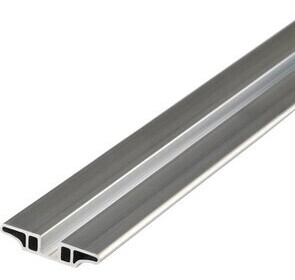
Metal substructures like these would essentially be suitable (overall height <20mm (0.8 inches)) but should be installed in strips on rubber granulate mats that are water-resistant glued to the underside of the profile.
This is not a simple task since the slabs must remain in place and only limited build-up height is available.
In my opinion, wood as a support is not ideal because it would be “standing with its feet” in water. However, if there is extensive roofing, this point should be reconsidered!
----------------------
Good luck: KlaRa
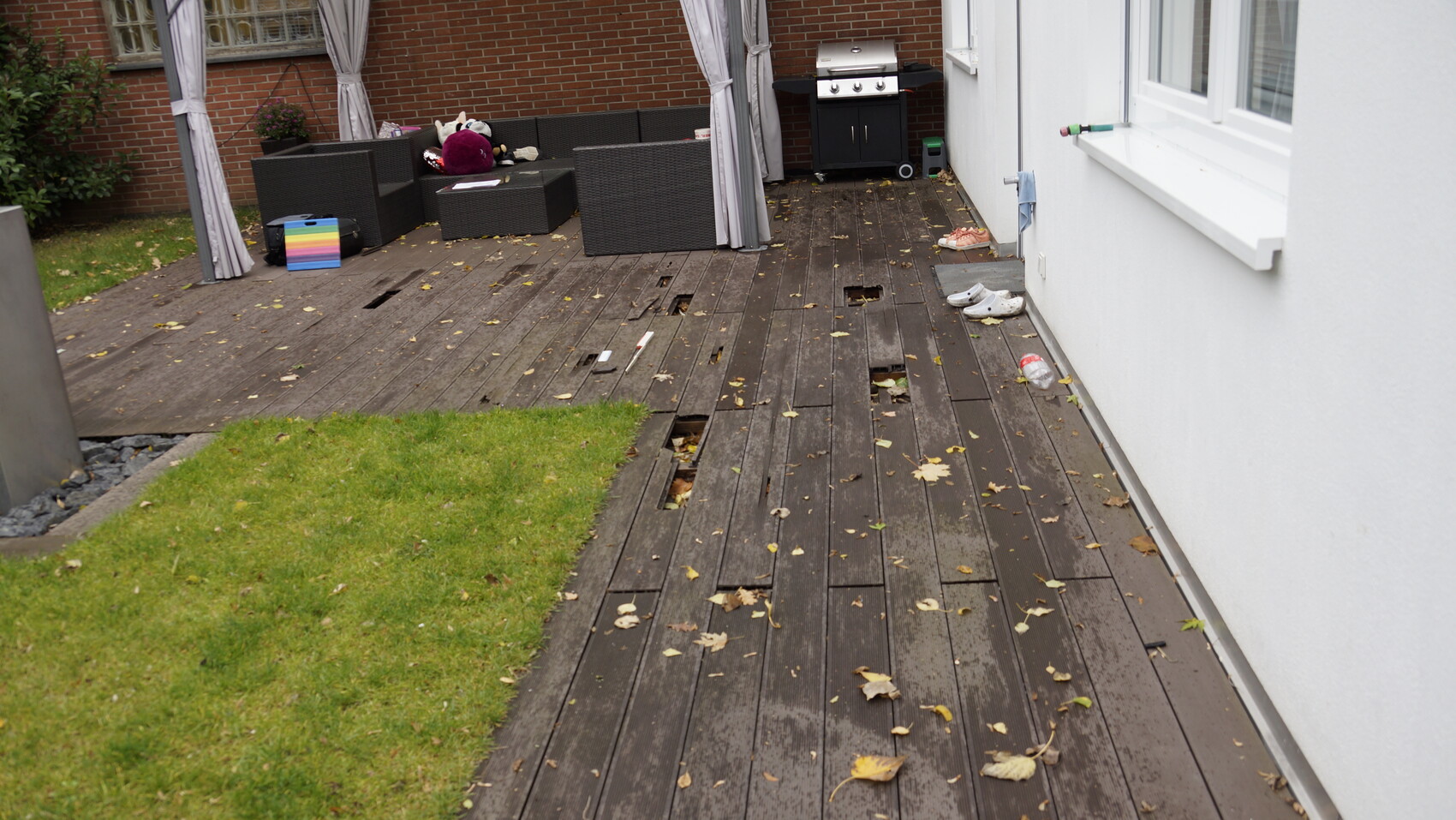
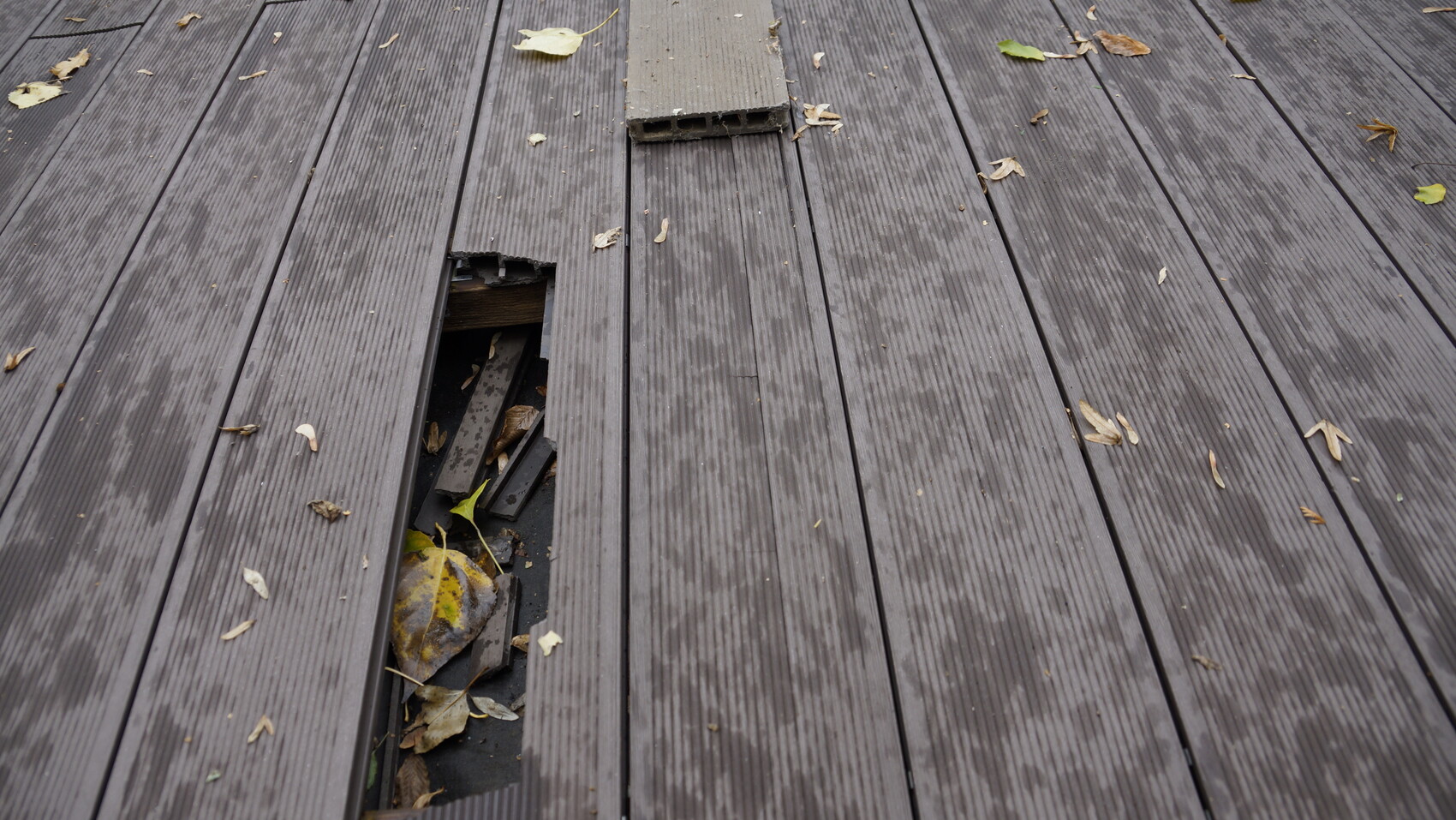
That is an interesting problem you describe!
As already mentioned: decking on a gravel bed is not recommended.
Also, a "floating (loose) installation" is not advisable. The boards will “float away” under mechanical stress, meaning they will shift uncontrollably from their original position.
Installing on joists is recommended. The only apparent drawback is the low overall height of 60mm (2.4 inches).
Ventilation underneath is essential for wood and wood-based materials.
WPC decking on a system-compatible substructure would be a good idea.
But be careful: with hollow chamber profiles, I have experienced several surprises professionally. Solid profiles proved to be much more stable.
Adjustable pedestals can be omitted since the existing slabs appear to be level and sloped, making them suitable as a substructure.
Self-made support strips should be avoided because system-compatible solutions often include clips that hold the boards in their starting position.
Metal substructures like these would essentially be suitable (overall height <20mm (0.8 inches)) but should be installed in strips on rubber granulate mats that are water-resistant glued to the underside of the profile.
This is not a simple task since the slabs must remain in place and only limited build-up height is available.
In my opinion, wood as a support is not ideal because it would be “standing with its feet” in water. However, if there is extensive roofing, this point should be reconsidered!
----------------------
Good luck: KlaRa
G
Gecko192718 Feb 2022 21:11@Nida35a and @KlaRa Thank you very much for your replies. We have decided to give the boards one last chance. If we still encounter the same problem by the end of this year, we will revisit the project and take your advice into account.
Similar topics