
ᐅ Windows with roller shutters in new construction, a solution for planning challenges?
Created on: 9 Nov 2019 09:12
E
EinMarc
Hello,
we are currently planning a new single-family house with an architect. At the moment, we are facing an issue with the selection and installation of windows.
The walls consist of 20cm (8 inches) sand-lime brick, with 16cm (6 inches) mineral wool insulation applied on top. So far, the drafts by Architect A include external rolling shutters as shown in the attached detail.
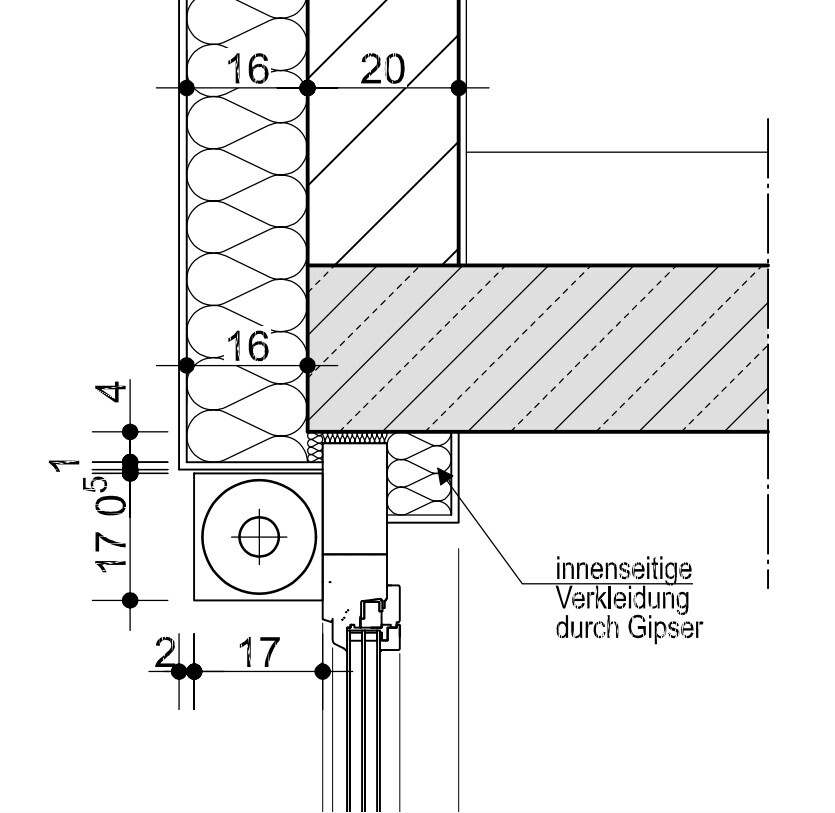
Yesterday we visited a window manufacturer who pointed out that, with this type of installation, plastic spacer profiles of 60mm (2.4 inches) must be installed not only at the top (as seen in the detail) but also on both sides.
This is because with external rolling shutters (i.e. external maintenance access), the shutter guide rails must be removable in order to remove the inspection cover. This means the rails cannot be plastered over. Therefore, these rails have to be mounted on the window frame outside the plaster and cannot be embedded in the wall.
Furthermore, the insulation layer must also be extended around the masonry for this reason. Overall, this means that in addition to the outer window frame with a depth of 76mm (3 inches), an additional 60mm (2.4 inches) plastic frame profile is required, which would be visible from the inside unless it is specially covered, as already indicated at the upper edge in the detail.
Because both the spacer profiles and the necessary cladding on the top and sides involve considerable additional costs, we asked about alternative solutions. And that leads to the next problem.
One possible alternative would have been to choose windows with built-in rolling shutters and internal maintenance access. While this solves the above issues, it is apparently not ideal in terms of energy efficiency due to thinner insulation layers at certain points within the shutter box.
Another alternative might have been to set the windows with built-in rolling shutters within the insulation layer (?), but this conflicts with our requirement for RC2-certified fastening of the window frames.
I hope I have not misrepresented anything; this was all quite complex at once, so please don’t focus too much on the drawings.
My main question is:
What would be a safe, sensible, and cost-effective way to select and install windows with rolling shutters in this wall assembly?
Here again are the given and required details:
Wall assembly: 20cm (8 inches) sand-lime brick + 16cm (6 inches) mineral wool
Window U-value required according to energy saving regulation calculation: minimum 0.94 (triple glazing)
RC2-certified installation and fastening
Rolling shutters on all doors and windows
Ideally, the rolling shutters should be plastered from the outside, which is currently my wife's preference
Doors up to max. 120cm (47 inches) wide (installation size) and 240cm (94 inches) high (without rolling shutter)
Windows up to 2m (6.6 feet) wide and 1.63m (5.3 feet) high (two-leaf)
I hope I have described the problem clearly and correctly and would be very grateful for any advice.
Best regards to all,
Marc
we are currently planning a new single-family house with an architect. At the moment, we are facing an issue with the selection and installation of windows.
The walls consist of 20cm (8 inches) sand-lime brick, with 16cm (6 inches) mineral wool insulation applied on top. So far, the drafts by Architect A include external rolling shutters as shown in the attached detail.
Yesterday we visited a window manufacturer who pointed out that, with this type of installation, plastic spacer profiles of 60mm (2.4 inches) must be installed not only at the top (as seen in the detail) but also on both sides.
This is because with external rolling shutters (i.e. external maintenance access), the shutter guide rails must be removable in order to remove the inspection cover. This means the rails cannot be plastered over. Therefore, these rails have to be mounted on the window frame outside the plaster and cannot be embedded in the wall.
Furthermore, the insulation layer must also be extended around the masonry for this reason. Overall, this means that in addition to the outer window frame with a depth of 76mm (3 inches), an additional 60mm (2.4 inches) plastic frame profile is required, which would be visible from the inside unless it is specially covered, as already indicated at the upper edge in the detail.
Because both the spacer profiles and the necessary cladding on the top and sides involve considerable additional costs, we asked about alternative solutions. And that leads to the next problem.
One possible alternative would have been to choose windows with built-in rolling shutters and internal maintenance access. While this solves the above issues, it is apparently not ideal in terms of energy efficiency due to thinner insulation layers at certain points within the shutter box.
Another alternative might have been to set the windows with built-in rolling shutters within the insulation layer (?), but this conflicts with our requirement for RC2-certified fastening of the window frames.
I hope I have not misrepresented anything; this was all quite complex at once, so please don’t focus too much on the drawings.
My main question is:
What would be a safe, sensible, and cost-effective way to select and install windows with rolling shutters in this wall assembly?
Here again are the given and required details:
Wall assembly: 20cm (8 inches) sand-lime brick + 16cm (6 inches) mineral wool
Window U-value required according to energy saving regulation calculation: minimum 0.94 (triple glazing)
RC2-certified installation and fastening
Rolling shutters on all doors and windows
Ideally, the rolling shutters should be plastered from the outside, which is currently my wife's preference
Doors up to max. 120cm (47 inches) wide (installation size) and 240cm (94 inches) high (without rolling shutter)
Windows up to 2m (6.6 feet) wide and 1.63m (5.3 feet) high (two-leaf)
I hope I have described the problem clearly and correctly and would be very grateful for any advice.
Best regards to all,
Marc
Roller shutters with an integrated box are great; however, in our case, they blend in discreetly since they are flush with the brickwork and therefore do not protrude. We mainly chose this so that the shutters can be accessed from the outside, avoiding the need to open the interior, replaster, and repaint.
However, I don’t understand why anyone would want external roller shutters with internal access, as that seems to negate the advantage.
However, I don’t understand why anyone would want external roller shutters with internal access, as that seems to negate the advantage.
I don’t quite understand this now...
I don’t necessarily want roller shutters mounted directly on or in front of the window.
What I would like is described in my first post:
I am basically open to how and with what this can be achieved.
But as soon as there is external access, the guide rails must be removable from the outside to remove the service flap.
And that means the rails cannot be recessed into the facade but have to be mounted on the frame. That probably means, if I understood correctly, that additional plastic profiles on the sides become necessary, which cost around 23,- per meter. Also, these then have to be either covered on the inside or you have to accept a 16cm (6 inches) wide edge (not including the sash, which comes on top), and we don’t like that either.
Besides, it is not so easy to access them from the outside on, for example, the first floor compared to the ground floor.
If I have misunderstood anything here, I’m happy to be corrected, which is why I’m asking here.
I don’t necessarily want roller shutters mounted directly on or in front of the window.
What I would like is described in my first post:
EinMarc schrieb:
How could a safe, practical, and cost-effective selection and installation of windows with roller shutters look in the existing wall construction here?
Here again are the given and required details:
Wall structure: calcium silicate brick 20cm (8 inches) + mineral wool 16cm (6 inches)
Window U-value required according to energy saving regulation calculation minimum 0.94 (= triple glazing)
RC2 certified installation and mounting
Roller shutters on all doors and windows
Ideally, the roller shutters could be plastered over from the outside, which is my wife's current wish
Doors up to max 120cm (47 inches) width (installation dimension) and 240cm (94 inches) height (without roller shutters)
Windows up to 2m (79 inches) width and 1.63m (64 inches) height (double-leaf)
I am basically open to how and with what this can be achieved.
But as soon as there is external access, the guide rails must be removable from the outside to remove the service flap.
And that means the rails cannot be recessed into the facade but have to be mounted on the frame. That probably means, if I understood correctly, that additional plastic profiles on the sides become necessary, which cost around 23,- per meter. Also, these then have to be either covered on the inside or you have to accept a 16cm (6 inches) wide edge (not including the sash, which comes on top), and we don’t like that either.
Besides, it is not so easy to access them from the outside on, for example, the first floor compared to the ground floor.
If I have misunderstood anything here, I’m happy to be corrected, which is why I’m asking here.
N
nightdancer17 Nov 2019 09:06EinMarc schrieb:
I hope I have described the problem clearly and accurately, and I would really appreciate if someone could share their thoughts on this.
Best regards to everyone,
Marc1. This is a planning task for your architect, not the window manufacturer. The windows are only specified once the overall window planning is complete. So I find it surprising that you already have a window supplier.
2. If you want the all-in-one perfect solution, you will have to invest more. That would mean insulated external roller shutters mounted in front of the masonry, not—as in your case—in front of the window frame extension (which I find quite poor). You will hardly avoid having a frame extension (with steel reinforcement) of 25mm (1 inch) on both the left and right sides (which I consider visually unproblematic) to eliminate the thermal bridge, since the frame is insulated by 30mm (1¼ inches). The tricky part is that with your window sizes, the external thermal insulation composite system (ETICS) would increase to 24cm (9½ inches).
Thank you for your contribution.
Yes, that is the responsibility of the architect, correct. However, in my opinion, even an architect can’t know everything, and it could simply have been an oversight, misunderstanding, or another reason for an ultimately incorrect result. That’s why I directed my question to the person who deals with this on a daily basis—the window installer.
Actually, not even "our" window installer, but "a" window installer, whom the architect referred us to, initially regarding the front door. But I didn’t actually mention that before, did I?
Because this person seemed kind and knowledgeable and also had a comprehensive showroom featuring various types of windows, we asked to be shown all the options, the differences, and so on.
And since the detail shown above was included on the plan, the topic came up as well.
For now, I’ve chosen the simplest approach for me (and in my opinion, the correct one regarding our contracts): I connected the architect and the window installer and shared my wish list (see above) with both of them. They have now discussed the matter together, and it turned out there was a small misunderstanding in communication regarding the exterior-visible roller shutter box.
However, I can only report on the exact outcome after we have had another joint appointment.
Yes, that is the responsibility of the architect, correct. However, in my opinion, even an architect can’t know everything, and it could simply have been an oversight, misunderstanding, or another reason for an ultimately incorrect result. That’s why I directed my question to the person who deals with this on a daily basis—the window installer.
Actually, not even "our" window installer, but "a" window installer, whom the architect referred us to, initially regarding the front door. But I didn’t actually mention that before, did I?
Because this person seemed kind and knowledgeable and also had a comprehensive showroom featuring various types of windows, we asked to be shown all the options, the differences, and so on.
And since the detail shown above was included on the plan, the topic came up as well.
For now, I’ve chosen the simplest approach for me (and in my opinion, the correct one regarding our contracts): I connected the architect and the window installer and shared my wish list (see above) with both of them. They have now discussed the matter together, and it turned out there was a small misunderstanding in communication regarding the exterior-visible roller shutter box.
However, I can only report on the exact outcome after we have had another joint appointment.
Similar topics