
ᐅ Windows with roller shutters in new construction, a solution for planning challenges?
Created on: 9 Nov 2019 09:12
E
EinMarcHello,
we are currently planning a new single-family house with an architect. At the moment, we are facing an issue with the selection and installation of windows.
The walls consist of 20cm (8 inches) sand-lime brick, with 16cm (6 inches) mineral wool insulation applied on top. So far, the drafts by Architect A include external rolling shutters as shown in the attached detail.
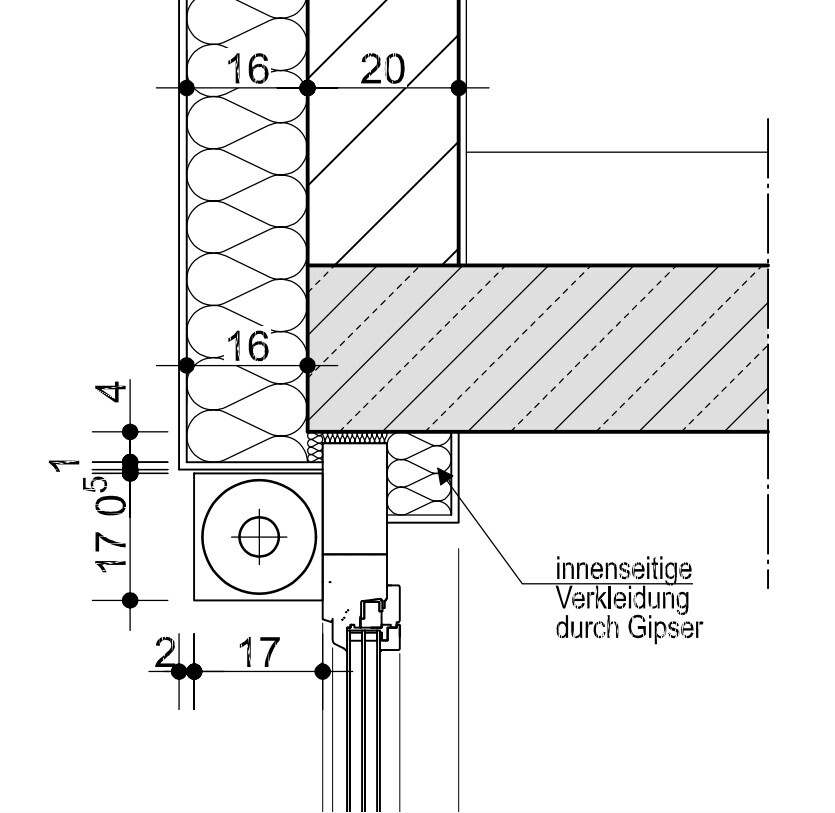
Yesterday we visited a window manufacturer who pointed out that, with this type of installation, plastic spacer profiles of 60mm (2.4 inches) must be installed not only at the top (as seen in the detail) but also on both sides.
This is because with external rolling shutters (i.e. external maintenance access), the shutter guide rails must be removable in order to remove the inspection cover. This means the rails cannot be plastered over. Therefore, these rails have to be mounted on the window frame outside the plaster and cannot be embedded in the wall.
Furthermore, the insulation layer must also be extended around the masonry for this reason. Overall, this means that in addition to the outer window frame with a depth of 76mm (3 inches), an additional 60mm (2.4 inches) plastic frame profile is required, which would be visible from the inside unless it is specially covered, as already indicated at the upper edge in the detail.
Because both the spacer profiles and the necessary cladding on the top and sides involve considerable additional costs, we asked about alternative solutions. And that leads to the next problem.
One possible alternative would have been to choose windows with built-in rolling shutters and internal maintenance access. While this solves the above issues, it is apparently not ideal in terms of energy efficiency due to thinner insulation layers at certain points within the shutter box.
Another alternative might have been to set the windows with built-in rolling shutters within the insulation layer (?), but this conflicts with our requirement for RC2-certified fastening of the window frames.
I hope I have not misrepresented anything; this was all quite complex at once, so please don’t focus too much on the drawings.
My main question is:
What would be a safe, sensible, and cost-effective way to select and install windows with rolling shutters in this wall assembly?
Here again are the given and required details:
Wall assembly: 20cm (8 inches) sand-lime brick + 16cm (6 inches) mineral wool
Window U-value required according to energy saving regulation calculation: minimum 0.94 (triple glazing)
RC2-certified installation and fastening
Rolling shutters on all doors and windows
Ideally, the rolling shutters should be plastered from the outside, which is currently my wife's preference
Doors up to max. 120cm (47 inches) wide (installation size) and 240cm (94 inches) high (without rolling shutter)
Windows up to 2m (6.6 feet) wide and 1.63m (5.3 feet) high (two-leaf)
I hope I have described the problem clearly and correctly and would be very grateful for any advice.
Best regards to all,
Marc
we are currently planning a new single-family house with an architect. At the moment, we are facing an issue with the selection and installation of windows.
The walls consist of 20cm (8 inches) sand-lime brick, with 16cm (6 inches) mineral wool insulation applied on top. So far, the drafts by Architect A include external rolling shutters as shown in the attached detail.
Yesterday we visited a window manufacturer who pointed out that, with this type of installation, plastic spacer profiles of 60mm (2.4 inches) must be installed not only at the top (as seen in the detail) but also on both sides.
This is because with external rolling shutters (i.e. external maintenance access), the shutter guide rails must be removable in order to remove the inspection cover. This means the rails cannot be plastered over. Therefore, these rails have to be mounted on the window frame outside the plaster and cannot be embedded in the wall.
Furthermore, the insulation layer must also be extended around the masonry for this reason. Overall, this means that in addition to the outer window frame with a depth of 76mm (3 inches), an additional 60mm (2.4 inches) plastic frame profile is required, which would be visible from the inside unless it is specially covered, as already indicated at the upper edge in the detail.
Because both the spacer profiles and the necessary cladding on the top and sides involve considerable additional costs, we asked about alternative solutions. And that leads to the next problem.
One possible alternative would have been to choose windows with built-in rolling shutters and internal maintenance access. While this solves the above issues, it is apparently not ideal in terms of energy efficiency due to thinner insulation layers at certain points within the shutter box.
Another alternative might have been to set the windows with built-in rolling shutters within the insulation layer (?), but this conflicts with our requirement for RC2-certified fastening of the window frames.
I hope I have not misrepresented anything; this was all quite complex at once, so please don’t focus too much on the drawings.
My main question is:
What would be a safe, sensible, and cost-effective way to select and install windows with rolling shutters in this wall assembly?
Here again are the given and required details:
Wall assembly: 20cm (8 inches) sand-lime brick + 16cm (6 inches) mineral wool
Window U-value required according to energy saving regulation calculation: minimum 0.94 (triple glazing)
RC2-certified installation and fastening
Rolling shutters on all doors and windows
Ideally, the rolling shutters should be plastered from the outside, which is currently my wife's preference
Doors up to max. 120cm (47 inches) wide (installation size) and 240cm (94 inches) high (without rolling shutter)
Windows up to 2m (6.6 feet) wide and 1.63m (5.3 feet) high (two-leaf)
I hope I have described the problem clearly and correctly and would be very grateful for any advice.
Best regards to all,
Marc

EinMarc schrieb:
One possible alternative could have been to use windows with exterior roller shutters and interior access. These do address the issues mentioned above but, due to thinner insulation layers in certain parts of the roller shutter box, they are probably not as energy-efficient. However, this is not a major problem and is fully state-of-the-art, being implemented daily everywhere. For you, this is the most cost-effective and straightforward option to complete the project without complications or additional thermal bridges.
From an energy efficiency perspective, this is not a problem at all. You use insulated boxes, and that’s it. It’s also much more straightforward than the outlined construction method, meaning fewer potential mistakes.
An insulated roller shutter box always has better U-values than the window below it... So why the concern?
I’m more puzzled as to why, despite alternatives, people are so fixated on designing unattractive surface-mounted boxes in new builds.
An insulated roller shutter box always has better U-values than the window below it... So why the concern?
I’m more puzzled as to why, despite alternatives, people are so fixated on designing unattractive surface-mounted boxes in new builds.
Thank you very much for the answers!
Where exactly are the windows positioned—right at the edge near the insulation, centrally within the wall, or how is it usually done? Depending on that, do the side parts of the wall also need to be insulated?
Does anyone possibly have a cross-section drawing or sketch showing how the external roller shutters and thick insulation are arranged?
Where exactly are the windows positioned—right at the edge near the insulation, centrally within the wall, or how is it usually done? Depending on that, do the side parts of the wall also need to be insulated?
Does anyone possibly have a cross-section drawing or sketch showing how the external roller shutters and thick insulation are arranged?
A 20cm (8 inches) sand-lime brick wall should be sufficient to fully enclose the entire element within the wall. Of course, this depends on the type of window and the roller shutter box used. This needs to be checked on a case-by-case basis. The exact position of the window in the wall plane is up to you or your architect. Window manufacturers sometimes have input on this as well. Typically, the window will look like this, but it can also be flush with the exterior wall or completely within the insulation.
Similar topics