
ᐅ Who is responsible for restoring the height of the garage/parking space?
Created on: 27 Sep 2023 15:54
D
darksun
Hello,
we have built and now there is some uncertainty about who is responsible for the costs of the necessary retaining walls (L-shaped concrete blocks) in the area of the garages and parking space.
For your information, there are two houses. The driveway area and house area for both houses have been excavated and are now at (let’s say) 0 meters (0 feet) elevation.
This is correct.
The area for the two garages and the parking space between the garages is also at 0 meters (0 feet).
Garage A is retaining earth at the back and will be backfilled with soil.
The adjacent parking space area A will have retaining walls at the rear, so that the garden area can be restored to the elevation shown in the building plan (let's say: 270 cm (106 inches)).
Neighbor A will pay for these retaining walls.
What is unclear is the area marked in red.
Retaining walls are also needed there, because the sidewall of Garage B is not earth-retaining and must be protected from soil pressure.
Neighbor A argues:
B must pay because the original elevation, as shown in the development plan (in the garden area), must be restored, and soil must therefore be replaced along the 2-meter (6.5 feet) area of the Garage B sidewall.
Neighbor B argues:
Neighbor A must pay for the retaining walls on the sidewall of their garage (2 meters / 6.5 feet) so that soil does not press against and damage their garage wall.
The replaced soil would damage Neighbor B’s garage.
What is the correct interpretation of the elevations in the development plan?
Does A have to bear the costs so that this elevation can be restored,
or does B have to pay because the red-marked area must be brought back to the elevation in the development plan at their expense?

we have built and now there is some uncertainty about who is responsible for the costs of the necessary retaining walls (L-shaped concrete blocks) in the area of the garages and parking space.
For your information, there are two houses. The driveway area and house area for both houses have been excavated and are now at (let’s say) 0 meters (0 feet) elevation.
This is correct.
The area for the two garages and the parking space between the garages is also at 0 meters (0 feet).
Garage A is retaining earth at the back and will be backfilled with soil.
The adjacent parking space area A will have retaining walls at the rear, so that the garden area can be restored to the elevation shown in the building plan (let's say: 270 cm (106 inches)).
Neighbor A will pay for these retaining walls.
What is unclear is the area marked in red.
Retaining walls are also needed there, because the sidewall of Garage B is not earth-retaining and must be protected from soil pressure.
Neighbor A argues:
B must pay because the original elevation, as shown in the development plan (in the garden area), must be restored, and soil must therefore be replaced along the 2-meter (6.5 feet) area of the Garage B sidewall.
Neighbor B argues:
Neighbor A must pay for the retaining walls on the sidewall of their garage (2 meters / 6.5 feet) so that soil does not press against and damage their garage wall.
The replaced soil would damage Neighbor B’s garage.
What is the correct interpretation of the elevations in the development plan?
Does A have to bear the costs so that this elevation can be restored,
or does B have to pay because the red-marked area must be brought back to the elevation in the development plan at their expense?

Everyone has hired the same earthworks company to excavate "their" area; we both use the same company (otherwise it would have been more "complicated").
Yes, it is a new development area.
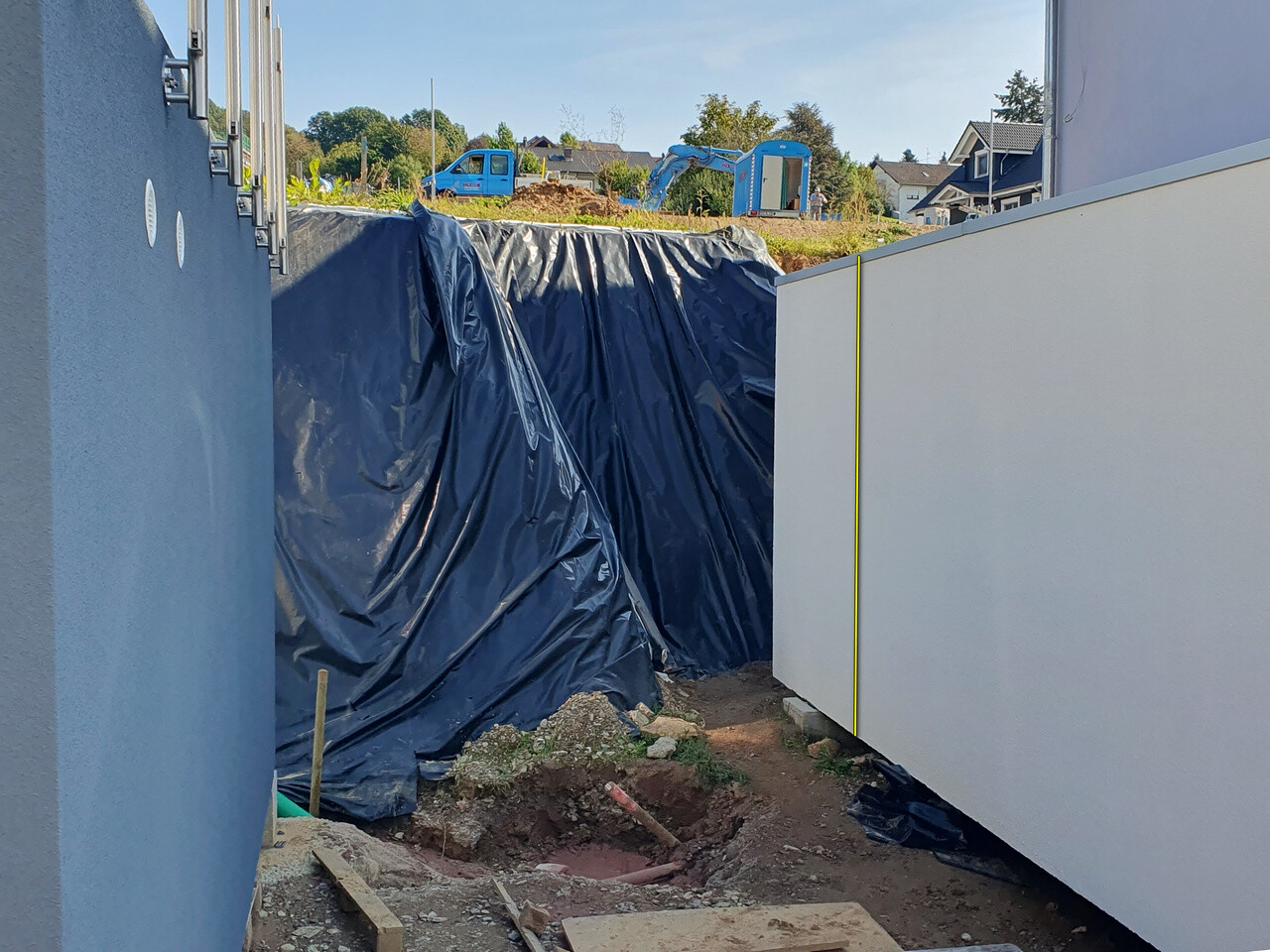
Attached is a photo showing the garages, the parking space, and the (still unfilled) workspace.
Yes, it is a new development area.
Attached is a photo showing the garages, the parking space, and the (still unfilled) workspace.
So, in my opinion, I would also say that everyone needs to protect their own property, since both of you started at the same time, removed soil, and then refilled it.
However, I know that the law sometimes views things differently. There are opinions stating that the party causing the disturbance must keep the affected party free from any burden caused by that disturbance.
Someone might actually argue that when Building B’s garage was constructed, there was no soil there. If you refill your property, you are responsible for ensuring that their garage remains intact.
But I am not a lawyer, and a true legal professional should not provide advice here. So, it’s best to consult a lawyer before relying on a legal position that might not hold up in court.
However, I know that the law sometimes views things differently. There are opinions stating that the party causing the disturbance must keep the affected party free from any burden caused by that disturbance.
Someone might actually argue that when Building B’s garage was constructed, there was no soil there. If you refill your property, you are responsible for ensuring that their garage remains intact.
But I am not a lawyer, and a true legal professional should not provide advice here. So, it’s best to consult a lawyer before relying on a legal position that might not hold up in court.
Tolentino schrieb:
... when setting up B's garage, there was no soil there.Of course there was no soil there, it had been excavated in that area specifically so the garage(s) could be installed ... If you can really argue like that ... well, hmm ...
S
sascha-t4-le28 Sep 2023 14:04After seeing the picture, things have become a bit clearer.
The excavation in the mentioned area was only necessary because of his garage. So, he created an excavation, and you allowed him to slope the ground on your property. That alone makes it clear to me that it is his excavation; you would have managed without the last 2 meters (6.5 feet). Therefore, he must also close his excavation and take care of everything else that goes with it.
Either way, not a good start.
The excavation in the mentioned area was only necessary because of his garage. So, he created an excavation, and you allowed him to slope the ground on your property. That alone makes it clear to me that it is his excavation; you would have managed without the last 2 meters (6.5 feet). Therefore, he must also close his excavation and take care of everything else that goes with it.
Either way, not a good start.

Wow, that is quite a difference in height.
How does B secure the garage on the side facing the lawn at the back? Can he just fill it in? Both prefabricated garages are only built on strip foundations.
Basically, you could also install the L-shaped blocks angled toward the corner of B’s garage, but then he would pay for an additional block and the cutting work.
But you haven’t answered the question of who was hired to excavate the slope, have you? It must have been an excavator that removed both at the same time, not two separate ones.
How does B secure the garage on the side facing the lawn at the back? Can he just fill it in? Both prefabricated garages are only built on strip foundations.
Basically, you could also install the L-shaped blocks angled toward the corner of B’s garage, but then he would pay for an additional block and the cutting work.
But you haven’t answered the question of who was hired to excavate the slope, have you? It must have been an excavator that removed both at the same time, not two separate ones.
Similar topics