
F
frosch00613 Oct 2014 13:27Hello,
since we need to build onto an existing fire wall, I probably cannot add more insulation. I found a type of brick and would like to hear your opinion on it, especially regarding how such bricks behave when they connect directly to the fire wall without plaster. I have a section of exposed brick wall without plaster, and the weather affects it quite a bit. Does this also happen with fire walls?
How is this usually resolved to prevent any building damage in the long term?
Here is the specification of the brick and the manufacturer’s information. Is something like this sufficient nowadays to minimize the energy needed for heating? I want to move towards a near zero-energy house, but without having to notice a drop in comfort.
ma
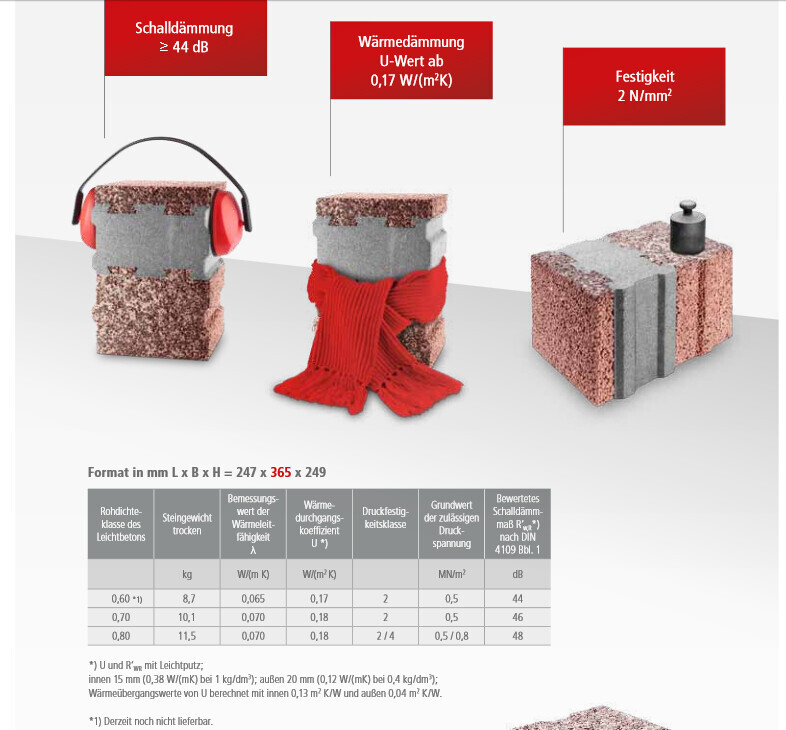
since we need to build onto an existing fire wall, I probably cannot add more insulation. I found a type of brick and would like to hear your opinion on it, especially regarding how such bricks behave when they connect directly to the fire wall without plaster. I have a section of exposed brick wall without plaster, and the weather affects it quite a bit. Does this also happen with fire walls?
How is this usually resolved to prevent any building damage in the long term?
Here is the specification of the brick and the manufacturer’s information. Is something like this sufficient nowadays to minimize the energy needed for heating? I want to move towards a near zero-energy house, but without having to notice a drop in comfort.
ma
T
toxicmolotof13 Oct 2014 14:42What does your architect think about these stones?
If you add an extension with stone, where will the ventilation come from? The upper joint will probably be made weatherproof, right? Again, what does your planner say about this?
And regarding the topic of a zero-energy house... how do you define that? You can achieve it with any type of stone if all other factors are taken into account. Whether it is always worth it is another question.
If you add an extension with stone, where will the ventilation come from? The upper joint will probably be made weatherproof, right? Again, what does your planner say about this?
And regarding the topic of a zero-energy house... how do you define that? You can achieve it with any type of stone if all other factors are taken into account. Whether it is always worth it is another question.
F
frosch00613 Oct 2014 20:42Hello,
We don’t have an architect—do we need one? We have a master bricklayer who said we only need a draftsman, and that would be sufficient.
We haven’t discussed the construction method yet; maybe I’m being a bit premature. I like to research thoroughly beforehand so I can participate in discussions when the time comes and not be completely uninformed. He suggested that for our case, a Ytong block would be a good choice because it offers very good insulation.
What speaks against using Ytong blocks for me is our existing house. In 1974, interior walls were built using aerated concrete blocks, and no wall plugs hold securely in those problematic walls. Nowadays, there are special wall plugs that have lateral wings. I tried those, but when hammering them into the drilled hole, the wings were sheared off. At the hardware store, I was advised to chip away the plaster around the drilled hole and then replaster it afterwards. That’s a lot of effort just for a wall plug, so there has to be another type of masonry, or a different masonry must be used in the new build.
Regarding a zero-energy house or passive house, I don’t want to overemphasize it. Ultimately, the goal is to use as little energy as possible, especially since everything is getting more expensive. However, it should remain within a reasonable price-performance range.
ma
We don’t have an architect—do we need one? We have a master bricklayer who said we only need a draftsman, and that would be sufficient.
We haven’t discussed the construction method yet; maybe I’m being a bit premature. I like to research thoroughly beforehand so I can participate in discussions when the time comes and not be completely uninformed. He suggested that for our case, a Ytong block would be a good choice because it offers very good insulation.
What speaks against using Ytong blocks for me is our existing house. In 1974, interior walls were built using aerated concrete blocks, and no wall plugs hold securely in those problematic walls. Nowadays, there are special wall plugs that have lateral wings. I tried those, but when hammering them into the drilled hole, the wings were sheared off. At the hardware store, I was advised to chip away the plaster around the drilled hole and then replaster it afterwards. That’s a lot of effort just for a wall plug, so there has to be another type of masonry, or a different masonry must be used in the new build.
Regarding a zero-energy house or passive house, I don’t want to overemphasize it. Ultimately, the goal is to use as little energy as possible, especially since everything is getting more expensive. However, it should remain within a reasonable price-performance range.
ma
B
Bauexperte14 Oct 2014 10:07Hello,
As a little reminder: a zero-energy house fully supplies itself, while a passive house may only require a heating demand of less than 15 kWh/(m²a) and a primary energy demand including hot water and household electricity of under 120 kWh/(m²a).
Regards, Bauexperte
frosch006 schrieb:Even if that were true, a simple copier/application stamper will probably not be enough in your case...
We have a master mason who said we only need a draftsman, that would be sufficient.
frosch006 schrieb:Ultimately, your budget decides. Since I believe you have no idea about the construction costs of a zero-energy or passive house, you should perhaps mention how much you are willing to invest in euros.
Zero-energy house or passive house, I don’t want to overestimate it; ultimately, as little energy as possible should be used, since everything is known to be getting more expensive. But it should remain within a reasonable and cost-effective range.
As a little reminder: a zero-energy house fully supplies itself, while a passive house may only require a heating demand of less than 15 kWh/(m²a) and a primary energy demand including hot water and household electricity of under 120 kWh/(m²a).
Regards, Bauexperte
Similar topics