
ᐅ Which plot would you choose? Single-family home with a double garage
Created on: 13 Apr 2025 20:49
B
Buddy90
Hello everyone!
I’m planning to build a new house.
It will be a single-family home (about 150m² (1,615 sq ft)) with a double garage.
I have registered for two plots of land, and the allocation decision will be made on Tuesday.
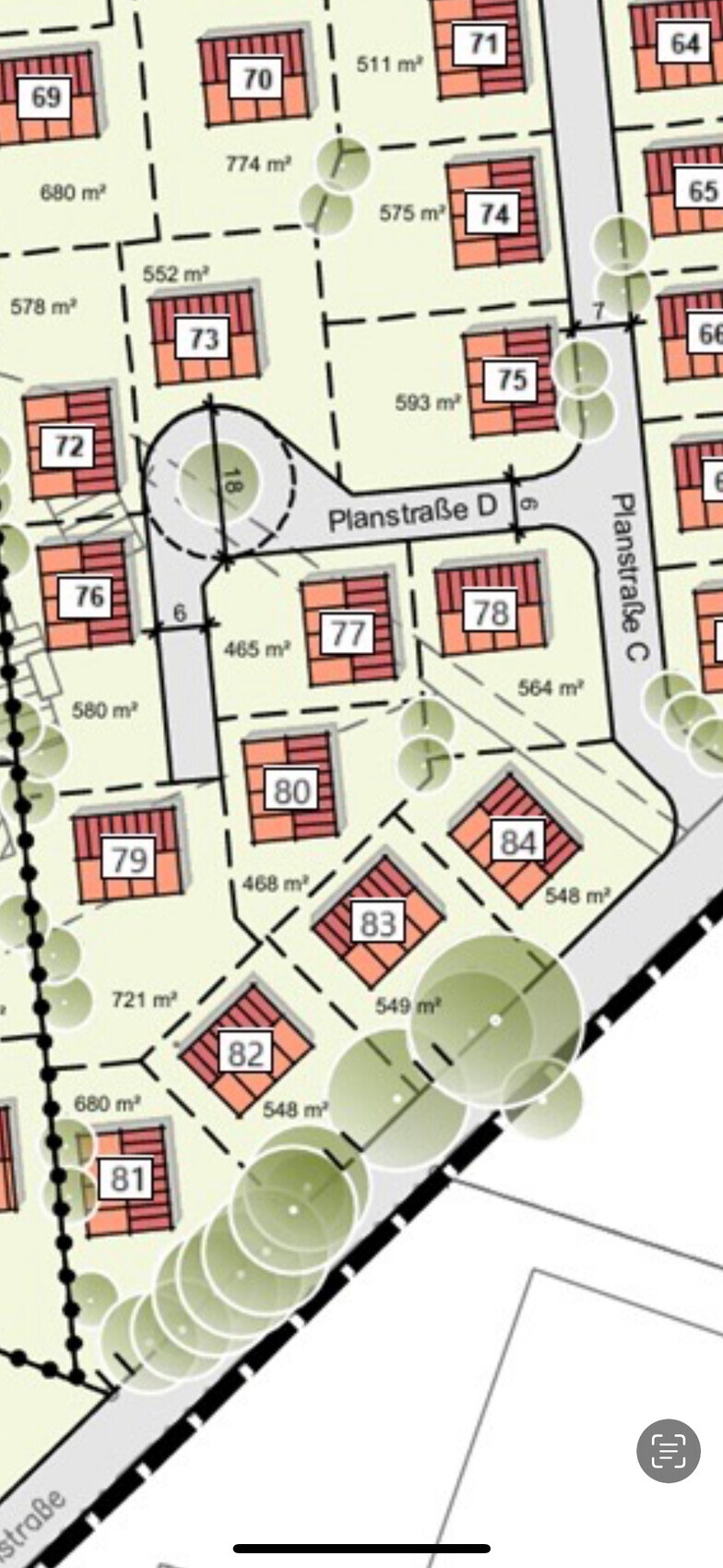
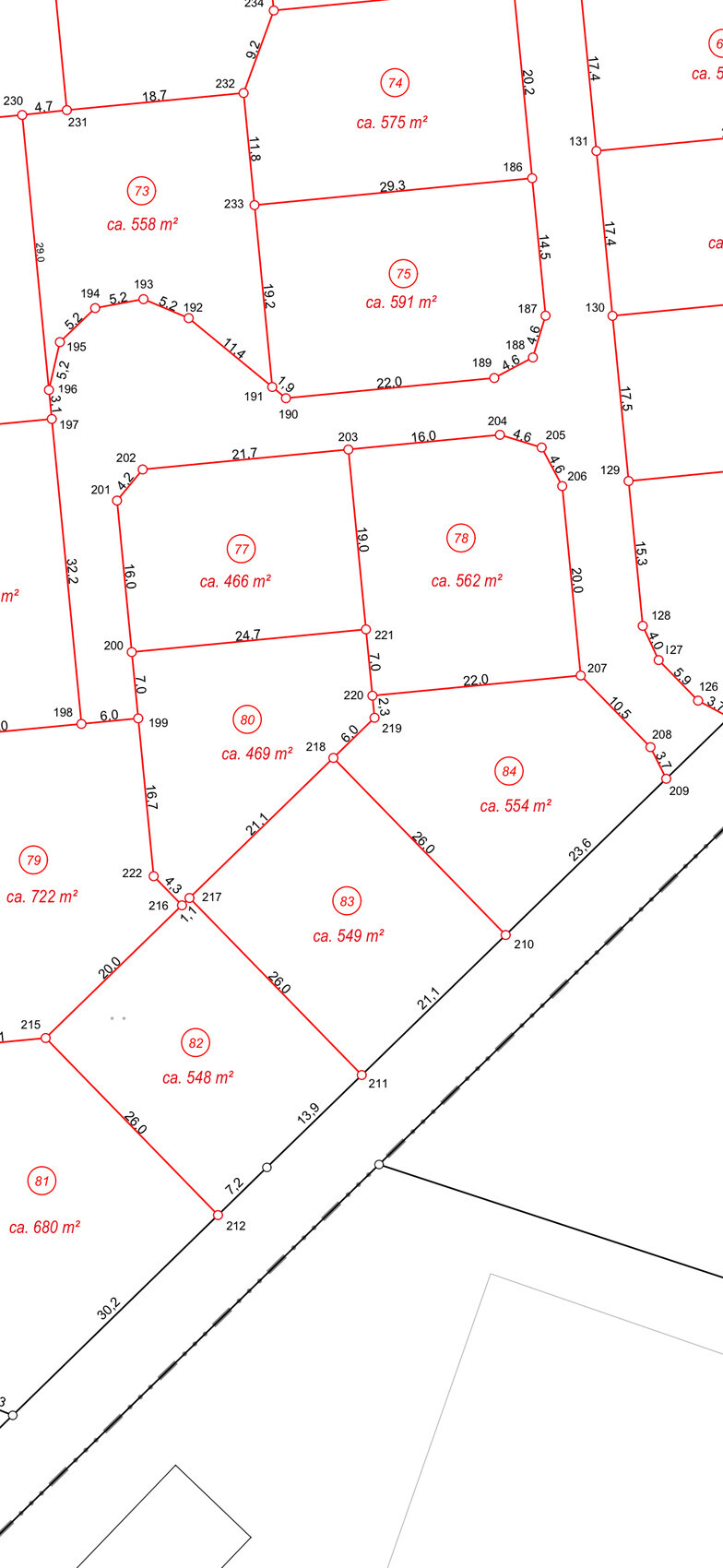
Favorite 1: Number 83
Favorite 2: Number 80
Since I built a house only six years ago, I have unfortunately moved to the bottom of the social housing priority list. Most likely, plot 83 will be taken before I get the chance (the marketer is still waiting for documents from other interested parties).
However, there are apparently no other interested parties for plot number 80, so my chances there are quite good!
The downside of plot 83 would be a row of trees that (exactly as marked) run along the front of the house/driveway/garden… which would negatively affect the planned photovoltaic system.
On the other hand, it has good dimensions.
The downside of plot 80 is its unusual “shape.”
But would it still be possible to build a nice house with a double garage there?
It would probably be better for photovoltaic yield, and being in a cul-de-sac would mean more peace and quiet.
The plot is also somewhat cheaper overall compared to 83.
I don’t need a large garden.
What do you think?
I’m attaching a plan for you.
I’m planning to build a new house.
It will be a single-family home (about 150m² (1,615 sq ft)) with a double garage.
I have registered for two plots of land, and the allocation decision will be made on Tuesday.
Favorite 1: Number 83
Favorite 2: Number 80
Since I built a house only six years ago, I have unfortunately moved to the bottom of the social housing priority list. Most likely, plot 83 will be taken before I get the chance (the marketer is still waiting for documents from other interested parties).
However, there are apparently no other interested parties for plot number 80, so my chances there are quite good!
The downside of plot 83 would be a row of trees that (exactly as marked) run along the front of the house/driveway/garden… which would negatively affect the planned photovoltaic system.
On the other hand, it has good dimensions.
The downside of plot 80 is its unusual “shape.”
But would it still be possible to build a nice house with a double garage there?
It would probably be better for photovoltaic yield, and being in a cul-de-sac would mean more peace and quiet.
The plot is also somewhat cheaper overall compared to 83.
I don’t need a large garden.
What do you think?
I’m attaching a plan for you.
M
motorradsilke19 Apr 2025 12:42ypg schrieb:
Sure. I also have my own opinion on that. You don’t need pavement to park vehicles.But in the end, it doesn’t really matter whether the surface is paved or gravelled. Water soaks into both, and nothing grows on either. If anything, you have to be consistent and use grass pavers. Unfortunately, hardly anyone does that anymore.
motorradsilke schrieb:
But in the end, it doesn't matter whether the surface is paved or covered with gravel. Water soaks into both, and nothing grows on either.With gravel, water soaks through naturally, while paved surfaces may require a drainage system. There is a clear difference between heavy rain falling on a paved area versus on gravel. On paved surfaces, water needs to find a way to drain off. That’s why permeable paving is still considered a sealed surface. Grass pavers are now also classified as paving, but I’m quite fond of them. They are now available in straight-line patterns as well, which some people prefer over the diagonal honeycomb design.M
motorradsilke19 Apr 2025 14:32ypg schrieb:
Gravel allows water to infiltrate, while paved surfaces may require drainage systems. There is a clear difference between heavy rain falling on a paved area and on gravel. Water has to find its way through paving. That’s why permeable paving is still considered a form of sealing. Grass pavers are now also classified as paving, but I really like them. Nowadays, they are also available in straight patterns, which some prefer over the diagonal honeycomb design. We have basic paving, and water seeps through it as well. During heavy rain, water might pool for a while, but it soaks in after a few hours. There is gravel or crushed stone between and beneath the individual stones, and below that, there is a layer of aggregate base. Exceptions might occur if the material used between stones prevents water infiltration.
If your base is natural soil that doesn’t allow water to pass through (e.g., clay soil), you will need drainage. This also applies to gravel surfaces.
motorradsilke schrieb:
after a few hours it has seeped away.Exactly, after a few hours, on gravel it's just a few seconds.M
MachsSelbst19 Apr 2025 17:49So, I still have gravel around the house, and during the last heavy rain, I believe it was in August, with 60 to 70 liters (about 16 to 18 gallons), water remained standing for several hours.
M
motorradsilke19 Apr 2025 21:00ypg schrieb:
Exactly, with gravel it only takes a few seconds after a couple of hours.But that wasn’t the question; it was about general infiltration. Of course, it happens faster there. We also have gravel on the driveway to the property. It infiltrates faster there, but not in seconds during heavy rain. And we already have sandy soil underneath.Similar topics