
ᐅ Which material is best for the structural shell regarding thermal and sound insulation?
Created on: 23 Jan 2020 10:03
D
DASI90
Hello everyone,
We are currently considering which material to use for the shell construction. Our goal is to achieve at least KFW 55 energy efficiency, and due to noise levels from the nearby railway, we also need passive sound insulation. External thermal insulation composite systems (ETICS) are not an option for us. Therefore, I see two possible solutions:
- Filled Poroton brick without additional external or internal insulation
- Cavity wall construction with calcium silicate blocks and core insulation
I currently prefer the first option, as I assume it is still more cost-effective than the two-layer masonry and results in a less thick wall. However, I am not sure if the filled Poroton brick will meet our sound insulation needs.
Could anyone share their experiences regarding the thermal and sound insulation properties of the above options?
We are currently considering which material to use for the shell construction. Our goal is to achieve at least KFW 55 energy efficiency, and due to noise levels from the nearby railway, we also need passive sound insulation. External thermal insulation composite systems (ETICS) are not an option for us. Therefore, I see two possible solutions:
- Filled Poroton brick without additional external or internal insulation
- Cavity wall construction with calcium silicate blocks and core insulation
I currently prefer the first option, as I assume it is still more cost-effective than the two-layer masonry and results in a less thick wall. However, I am not sure if the filled Poroton brick will meet our sound insulation needs.
Could anyone share their experiences regarding the thermal and sound insulation properties of the above options?
Scout schrieb:
By the way, this is the crumbly brick (Unipor Coriso W07). I estimate that the total brick thickness is just over 10cm (4 inches).
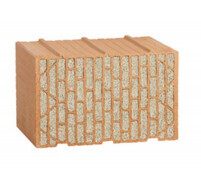
Yeah, with this crumbly brick, I’m worried every day that my house might collapse.
You’ve never even held the brick yourself, have you? But you have to make a silly comment anyway!
 Vicky Pedia24 Jan 2020 20:40
Sand-lime brick is well recognized and proven in practice for good sound insulation due to its mass and high bulk densities. However, even the best soundproofing is ineffective—such as in a partition wall between apartments—if the adjacent building components compromise it. It has been proven that sound transmission occurs through both the separating components and the adjoining elements, such as ceilings, internal, and external walls.

Vicky Pedia schrieb:
Calcium silicate blocks are well-known and proven in practice for good sound insulation due to their mass and high bulk density. However, even the best soundproofing is ineffective—such as in an apartment dividing wall—if the adjoining structural elements compromise it. It is established that sound transmission occurs through both the separating components and the adjoining parts, such as ceilings, interior, and exterior walls. Applied to the exterior walls of a detached single-family home, are you saying that calcium silicate blocks are the best choice in terms of sound insulation?
Vicky Pedia24 Jan 2020 21:30No! There are as many opinions as there are building materials. If there were one perfect stone, only that one would be used. I am personally a fan of aerated concrete. That will surely trigger 10 opponents right away. Poroton also has its merits, as do many materials with their pros and cons. Since this was specifically about sound insulation, calcium silicate bricks naturally come into consideration. They also have disadvantages.
So it depends on the specific situation! Recently, I managed the house construction for a then good friend. She wanted interior walls made of drywall (because that’s apparently common). I convinced her to use 11.5 cm (4.5 inches) aerated concrete interior walls, and she is happy with that choice today.
There is no one single opinion! And this is something all contributors here should keep in mind and not tear each other apart!!!
So it depends on the specific situation! Recently, I managed the house construction for a then good friend. She wanted interior walls made of drywall (because that’s apparently common). I convinced her to use 11.5 cm (4.5 inches) aerated concrete interior walls, and she is happy with that choice today.
There is no one single opinion! And this is something all contributors here should keep in mind and not tear each other apart!!!
Yes, anything with a high surface weight (mass per m2 of exterior surface) also provides good sound insulation.
From this perspective, concrete is very effective, as are traditional solid bricks without crumbly filling.
You can improve this further with a double-wall construction including an air gap or mineral wool in between; even a 3cm (1.2 inches) gap adds around 12 dB of sound reduction. If you make the gap wider, the sound insulation doesn’t increase much more, but you can add more insulation material.
From this perspective, concrete is very effective, as are traditional solid bricks without crumbly filling.
You can improve this further with a double-wall construction including an air gap or mineral wool in between; even a 3cm (1.2 inches) gap adds around 12 dB of sound reduction. If you make the gap wider, the sound insulation doesn’t increase much more, but you can add more insulation material.
Similar topics