
ᐅ Which type of heating system is recommended for a KfW 55 energy-efficient house?
Created on: 28 Aug 2011 21:12
A
amazingbee
Hello! We are currently planning a house and, since this is not something you do often, we have many questions. Due to the development plan for our plot, we are required to build a KfW 55 energy efficiency house and are now unsure about what type of heating system we need. Builders have given us different advice!
Is it possible to install a standard gas condensing boiler combined with solar water heating, or do we have to use geothermal or air-source heat pumps?
I would appreciate any answers!
Is it possible to install a standard gas condensing boiler combined with solar water heating, or do we have to use geothermal or air-source heat pumps?
I would appreciate any answers!
Subsidy for air-to-water heat pump €1500 instead of ground-source heat pump €4000 (area/trench) or €4500 (drilling). But lower annual performance factor? Where did you get that from?
Here is the flyer from the geothermal newspaper:
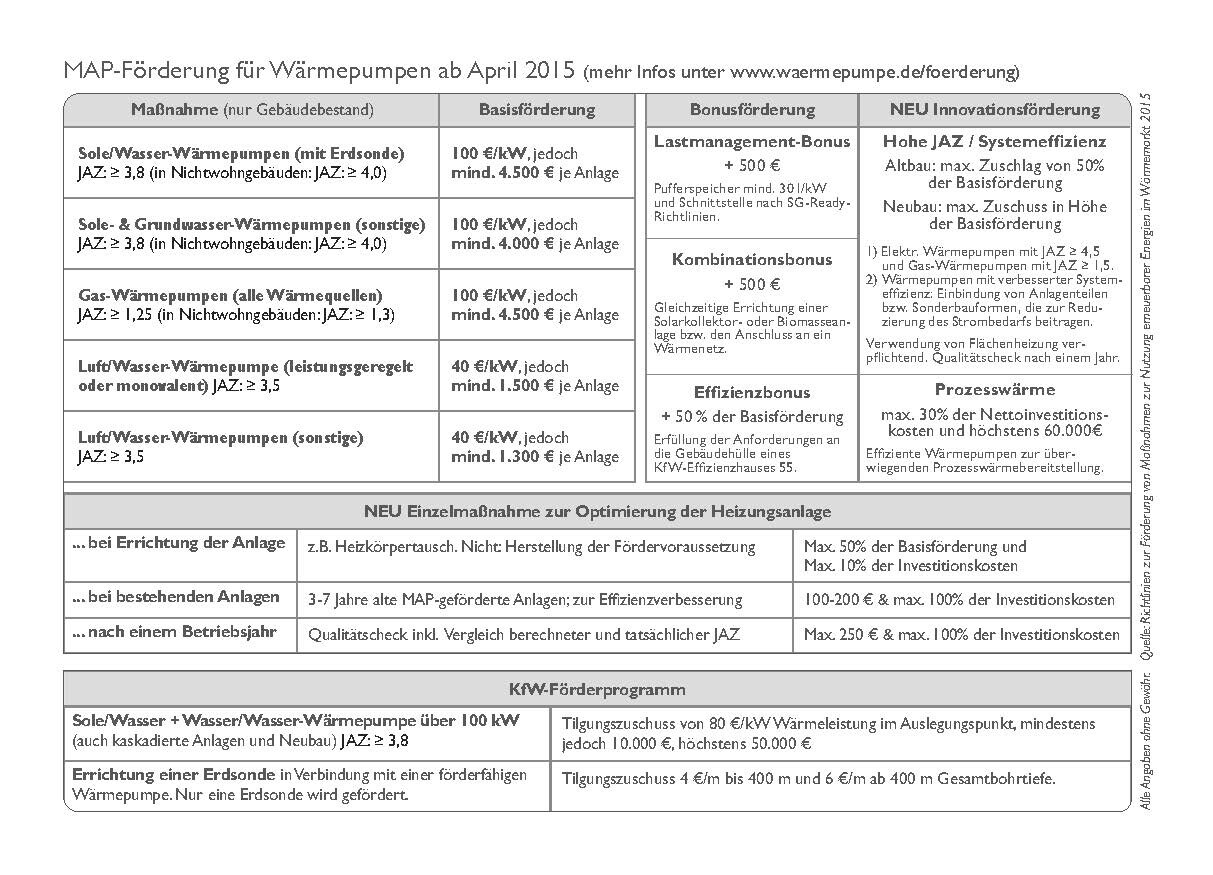
I don’t want to claim that a heat pump must be the best choice for the coming years, but I would like to briefly list my reasons for installation:
- no emissions → no need for a chimney
- small footprint (compared to pellet systems)
- low maintenance
- the ground collector can possibly be installed by yourself (ground-source heat pump)
- combination with photovoltaics (excess energy can be used otherwise or sold – unlike with solar thermal)
- smart grid compatibility
- cooling possible
Here is the flyer from the geothermal newspaper:
I don’t want to claim that a heat pump must be the best choice for the coming years, but I would like to briefly list my reasons for installation:
- no emissions → no need for a chimney
- small footprint (compared to pellet systems)
- low maintenance
- the ground collector can possibly be installed by yourself (ground-source heat pump)
- combination with photovoltaics (excess energy can be used otherwise or sold – unlike with solar thermal)
- smart grid compatibility
- cooling possible
 EveundGerd1 Jun 2015 19:02
We received a subsidy for our gas condensing boiler in the new building from our energy provider.
That was just under €1,500 (around $1,600). Additionally, we are exempt from meter rental fees for the first year.
The chimney sweep costs about €80 (around $85) per year, and maintenance costs €160 (around $170).
The consumption was initially estimated generously at €60 (around $65) per month, including hot water. When I compare the lower construction costs of our energy standard according to the Energy Saving Ordinance 2014 with a KfW 55 plan using a ground source heat pump, I calculate a savings of about €30,000 (around $32,000) in house construction.
We had KfW 55 quotes from four sources, including our general contractor, because we were undecided.
For €30,000 (around $32,000), I can heat a massage pool!
Just a thought for others who are undecided. A gas tank would not have been an option!
That was just under €1,500 (around $1,600). Additionally, we are exempt from meter rental fees for the first year.
The chimney sweep costs about €80 (around $85) per year, and maintenance costs €160 (around $170).
The consumption was initially estimated generously at €60 (around $65) per month, including hot water. When I compare the lower construction costs of our energy standard according to the Energy Saving Ordinance 2014 with a KfW 55 plan using a ground source heat pump, I calculate a savings of about €30,000 (around $32,000) in house construction.
We had KfW 55 quotes from four sources, including our general contractor, because we were undecided.
For €30,000 (around $32,000), I can heat a massage pool!
Just a thought for others who are undecided. A gas tank would not have been an option!
You are mixing the cost of the Energy Saving Ordinance standard with the heating technology. For us, the additional cost for the ground source heat pump is practically zero when the Energy Saving Ordinance standard is met and subsidies are taken into account.
Here, "amazingbee" has the KfW 55 standard as a requirement.
Here, "amazingbee" has the KfW 55 standard as a requirement.
S
Sebastian791 Jun 2015 20:23That can't be right – a gas boiler including the gas connection does not cost as much as a ground source heat pump. And then there is the drilling – depending on the region, 7,000 to 15,000 EUR. In this case, the subsidy doesn't reduce the price significantly...
Another "that can’t be true" comment – I recently got that from a lady here in the forum. Do I come across as so unbelievable?
Let’s take the Viessmann Vitocal 343-G as an example, so we’re not using a cheap unit as a reference. COP 4.6.
Price including a 200-liter (53-gallon) domestic hot water tank: €8,500 (gross)
Add a ground or trench collector.
Material costs around €900 for the pipes plus antifreeze and manifold... let’s generously say €1,700 total.
That makes €10,200 plus excavation plus beer and sausages for the helpers installing the collector.
So around €11,000? €11,500?
Subtracting a €4,000 subsidy leaves roughly €7,000–7,500. For a cheaper heat pump, it would be less.
I think a gas boiler plus tank plus flue installation plus gas connection costs at least the same, even though I haven’t requested any quotes – please share what you are seeing! Installation and connection will probably cost about the same.
If you have to or want to drill, of course, that changes things – in my case, it would’ve increased the total cost by a hefty €10,000 right away...
Let’s take the Viessmann Vitocal 343-G as an example, so we’re not using a cheap unit as a reference. COP 4.6.
Price including a 200-liter (53-gallon) domestic hot water tank: €8,500 (gross)
Add a ground or trench collector.
Material costs around €900 for the pipes plus antifreeze and manifold... let’s generously say €1,700 total.
That makes €10,200 plus excavation plus beer and sausages for the helpers installing the collector.
So around €11,000? €11,500?
Subtracting a €4,000 subsidy leaves roughly €7,000–7,500. For a cheaper heat pump, it would be less.
I think a gas boiler plus tank plus flue installation plus gas connection costs at least the same, even though I haven’t requested any quotes – please share what you are seeing! Installation and connection will probably cost about the same.
If you have to or want to drill, of course, that changes things – in my case, it would’ve increased the total cost by a hefty €10,000 right away...
S
Sebastian791 Jun 2015 20:59See, now you have written a lot of text, but I was referring to the borehole.
With a surface/ditch collector, of course, the situation looks completely different—but it’s not always possible. In our case, it wasn’t an option. In the end, I am quite glad that I now have the reliable solution with the borehole.
With a surface/ditch collector, of course, the situation looks completely different—but it’s not always possible. In our case, it wasn’t an option. In the end, I am quite glad that I now have the reliable solution with the borehole.
Similar topics