
Hello,
My husband and I are currently trying to decide which heating system to install in our planned house.
I insist on having a ventilation system and a wood-burning stove in the living room. So the heating should be compatible with these.
Our chosen construction company has now offered us three heat pumps:
Air-to-water heat pump: Nibe F2040-8 with Nibe VVM320
Exhaust air heat pump: Nibe F750 P with supply air module SAM 40
Ground source heat pump: Nibe 1245-6 with deep drilling
My husband currently prefers the exhaust air heat pump because he thinks it works like the air-to-water heat pump but makes better use of the warm air from running computers... Everywhere I read, though, it says: "Avoid exhaust air heat pumps unless you are building a passive house."
Does the supply air module actually make it function somewhat like an air-to-water heat pump, but with better use of the warm indoor air?
The house is planned as a two-story timber frame construction with KfW 55 standard. To be honest, I am completely overwhelmed by this complicated heating topic. The more information I get, the more complex it seems.
My husband and I are currently trying to decide which heating system to install in our planned house.
I insist on having a ventilation system and a wood-burning stove in the living room. So the heating should be compatible with these.
Our chosen construction company has now offered us three heat pumps:
Air-to-water heat pump: Nibe F2040-8 with Nibe VVM320
Exhaust air heat pump: Nibe F750 P with supply air module SAM 40
Ground source heat pump: Nibe 1245-6 with deep drilling
My husband currently prefers the exhaust air heat pump because he thinks it works like the air-to-water heat pump but makes better use of the warm air from running computers... Everywhere I read, though, it says: "Avoid exhaust air heat pumps unless you are building a passive house."
Does the supply air module actually make it function somewhat like an air-to-water heat pump, but with better use of the warm indoor air?
The house is planned as a two-story timber frame construction with KfW 55 standard. To be honest, I am completely overwhelmed by this complicated heating topic. The more information I get, the more complex it seems.
Grym... you’re exaggerating.
No house uses 12,000 kWh of electricity with an exhaust air heat pump ($3,000) and only 2,000 kWh ($500) with a ground-source heat pump – that’s just mathematically nonsense. That would mean the ground-source heat pump has a seasonal performance factor of 6.0, assuming the exhaust air heat pumps are direct electric heaters.
Exhaust air heat pumps aren’t exactly top performers, but they’re not that bad either.
Here are the consumption figures for Viebrockhaus homes:
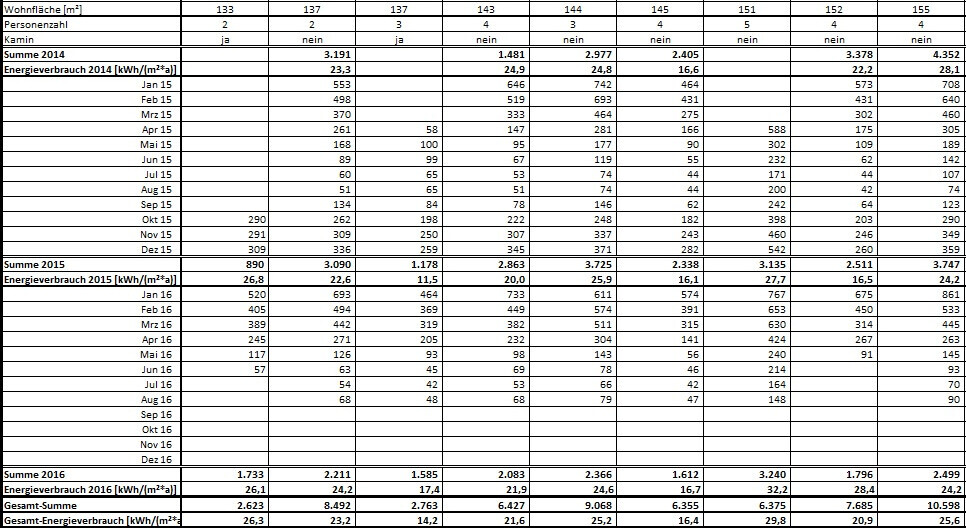
No house uses 12,000 kWh of electricity with an exhaust air heat pump ($3,000) and only 2,000 kWh ($500) with a ground-source heat pump – that’s just mathematically nonsense. That would mean the ground-source heat pump has a seasonal performance factor of 6.0, assuming the exhaust air heat pumps are direct electric heaters.
Exhaust air heat pumps aren’t exactly top performers, but they’re not that bad either.
Here are the consumption figures for Viebrockhaus homes:
@BeHaElJa @Grym
We don’t need to discuss selected individual cases. Both the figures are exaggerated, as is your table, since there are many counterexamples.
An exhaust air heat pump can work, but you need to be fully aware of its limitations. In most cases where an exhaust air heat pump works, an air-to-water heat pump would perform better.
We don’t need to discuss selected individual cases. Both the figures are exaggerated, as is your table, since there are many counterexamples.
An exhaust air heat pump can work, but you need to be fully aware of its limitations. In most cases where an exhaust air heat pump works, an air-to-water heat pump would perform better.
The frustrating heating issue is really tough. I completely understand the back and forth.
We struggled for a long time deciding between district heating and heat pump systems.
Summary:
District heating: installation costs are already way too high.
Air source heat pump: there were many negative experiences reported online, and energy consumption was sometimes extremely high.
Air-to-water heat pump: very dependent on the brand and calibration. Otherwise, many positive reports, including locally. In Rechlinghausen, Heinz von Heiden equipped an entire residential area with heat pumps (with split units). The noise levels were hardly noticeable, and apparently, there were no bad experiences (we spoke to three people there).
Ground source heat pump: highest upfront costs but the most economical in the long run. However, it really takes a long time for the extra expense to pay off.
In short, we chose the middle ground and went with an air-to-water heat pump. It comes with a 300-liter (80-gallon) tank included in the offer. It’s said that for a household of four with “normal” consumption, a 180-liter (48-gallon) tank is sufficient. I wouldn’t personally opt for a significantly larger tank just for guests. Maybe choose a middle ground here, too.
As for the fireplace: be honest with yourselves about how often you would actually use it. For many, it’s more of a decorative feature. That means they might only light it once a week during the winter. So, I wouldn’t use that as an argument against an air source heat pump.
We struggled for a long time deciding between district heating and heat pump systems.
Summary:
District heating: installation costs are already way too high.
Air source heat pump: there were many negative experiences reported online, and energy consumption was sometimes extremely high.
Air-to-water heat pump: very dependent on the brand and calibration. Otherwise, many positive reports, including locally. In Rechlinghausen, Heinz von Heiden equipped an entire residential area with heat pumps (with split units). The noise levels were hardly noticeable, and apparently, there were no bad experiences (we spoke to three people there).
Ground source heat pump: highest upfront costs but the most economical in the long run. However, it really takes a long time for the extra expense to pay off.
In short, we chose the middle ground and went with an air-to-water heat pump. It comes with a 300-liter (80-gallon) tank included in the offer. It’s said that for a household of four with “normal” consumption, a 180-liter (48-gallon) tank is sufficient. I wouldn’t personally opt for a significantly larger tank just for guests. Maybe choose a middle ground here, too.
As for the fireplace: be honest with yourselves about how often you would actually use it. For many, it’s more of a decorative feature. That means they might only light it once a week during the winter. So, I wouldn’t use that as an argument against an air source heat pump.
C
Carsten-le18 Oct 2016 13:58iLunatic schrieb:
Just a quick question: How many cubic meters of water does a groundwater heat pump typically pump per hour/per day? In my opinion, it depends on the heat pump’s capacity, or am I wrong? I once heard something like 2 m³/h (about 2.6 cubic yards per hour) for a standard single-family home.
What do you generally think about groundwater heat pumps?
If they are approved, they are more expensive than an air-to-water heat pump but cheaper than a brine-to-water heat pump and ultimately more efficient.
But how does it work with groundwater that is not completely ideal? If you have relatively high groundwater levels, the drilling is by far not as expensive as drilling one or two boreholes down 50–100 meters (160–330 feet), right?
Similar topics