
P
Peter Hausbau20 Jan 2020 14:15Hello,
I would like to know what options there are for installing water and electrical lines.
As far as electricity is concerned, my understanding is that the best option is to lay conduits inside the precast concrete slab before the floor slabs are poured, and then embed them in the concrete. If there are several conduits grouped together in one area, that spot is reinforced with additional steel mesh.
Water pipes, however, should not be embedded in the slab because they might need repairs at some point. Instead, they are typically installed on top of the concrete slab, and that is where complications begin. I have heard many different approaches, and some are even described in forums as poor workmanship.
For example, water pipes are placed on the concrete slab, and the impact sound insulation around the pipes is cut out where the pipes are located. After the pipes are laid, the voids are filled and the screed is applied over it. Then the underfloor heating is installed on top. Some say this method is faulty because the insulation is interrupted by it. However, I know someone who did it that way and said it doesn’t cause any noticeable issues.
So, what is the correct way to do this?
Where is the best place to install the pipes for heating and potable water?
In some rooms, I am also considering wall heating, but in others like the kitchen, it is not possible because all walls are fully occupied with cabinets and appliances.
!!!
If you only want to answer my question, you can skip the block in brackets, otherwise please read:
[ No, I will not produce my own floor slabs. No, I will not draw the plan myself. Yes, I am aware that you need training for this. Yes, a structural engineer will calculate everything. Yes, the electrical installation plan will be done by an electrician. Yes, the water and heating plans will be done by a heating installer. Yes, in the end the structural design will be checked by a civil engineer. Everything will be planned by a professional, but I would like to understand how all of this is done correctly in order to discuss the options with them.]
!!!
I would like to know what options there are for installing water and electrical lines.
As far as electricity is concerned, my understanding is that the best option is to lay conduits inside the precast concrete slab before the floor slabs are poured, and then embed them in the concrete. If there are several conduits grouped together in one area, that spot is reinforced with additional steel mesh.
Water pipes, however, should not be embedded in the slab because they might need repairs at some point. Instead, they are typically installed on top of the concrete slab, and that is where complications begin. I have heard many different approaches, and some are even described in forums as poor workmanship.
For example, water pipes are placed on the concrete slab, and the impact sound insulation around the pipes is cut out where the pipes are located. After the pipes are laid, the voids are filled and the screed is applied over it. Then the underfloor heating is installed on top. Some say this method is faulty because the insulation is interrupted by it. However, I know someone who did it that way and said it doesn’t cause any noticeable issues.
So, what is the correct way to do this?
Where is the best place to install the pipes for heating and potable water?
In some rooms, I am also considering wall heating, but in others like the kitchen, it is not possible because all walls are fully occupied with cabinets and appliances.
!!!
If you only want to answer my question, you can skip the block in brackets, otherwise please read:
[ No, I will not produce my own floor slabs. No, I will not draw the plan myself. Yes, I am aware that you need training for this. Yes, a structural engineer will calculate everything. Yes, the electrical installation plan will be done by an electrician. Yes, the water and heating plans will be done by a heating installer. Yes, in the end the structural design will be checked by a civil engineer. Everything will be planned by a professional, but I would like to understand how all of this is done correctly in order to discuss the options with them.]
!!!

Apart from ceiling outlets and spotlights, everything was installed on the finished raw ceiling in our case. There was usually still enough space above for two thin layers of insulation. Our home savings contract had no issues with this, and so far, I haven’t noticed any differences on the screed either.
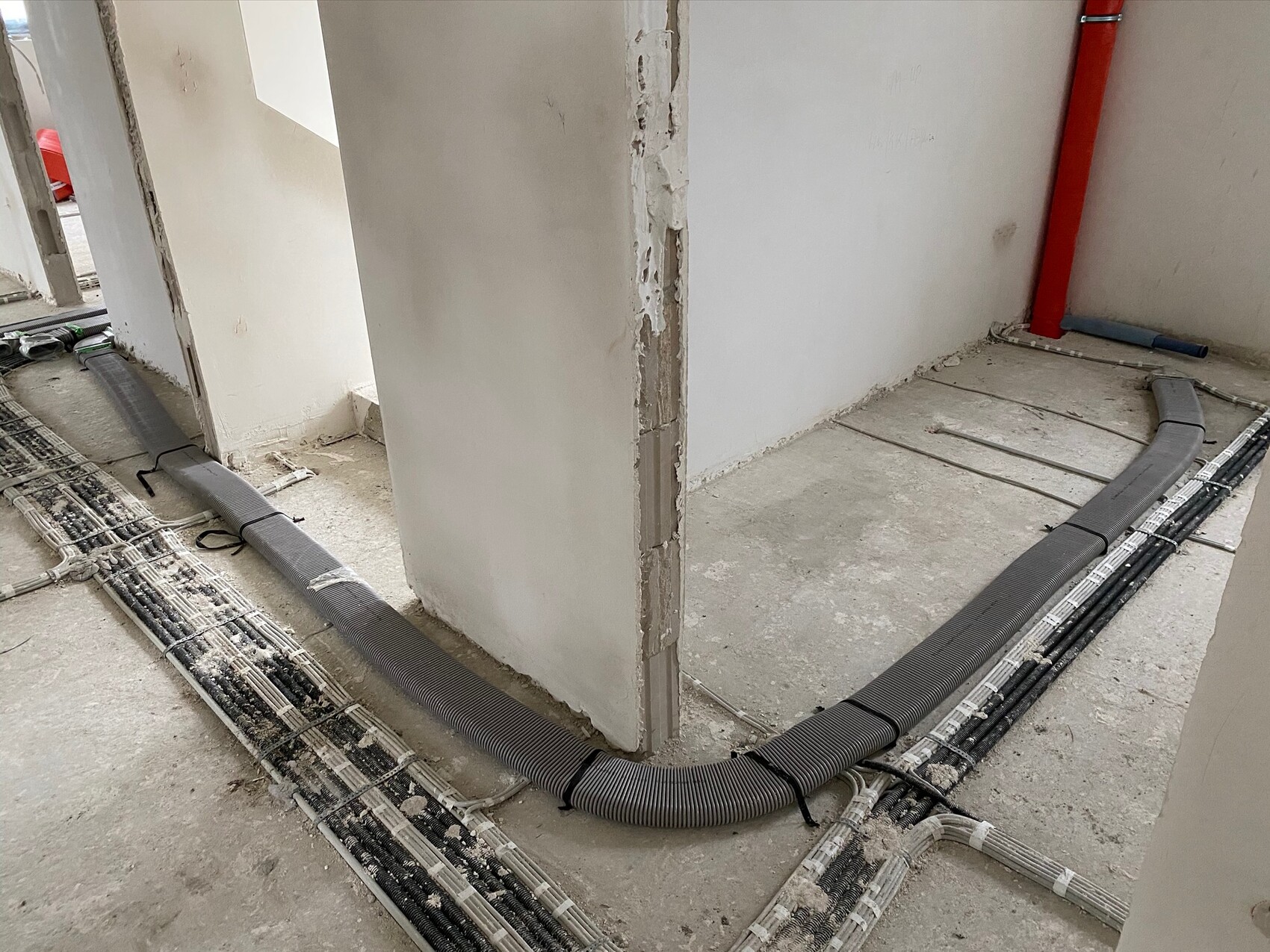

On the floor or under the ceiling.
There is no right or wrong. Depending on the construction type, wiring, and so on, one option, the other, or both can make sense.
For example, we route the kitchen from the basement with a ceiling opening. Most of the wiring is installed under the ceiling. This also depends on our floor, which is cast in at 250°C (482°F), and we plan to suspend the ceilings anyway. The electrical wiring is mostly inside embedded conduit (concrete walls).
There is no right or wrong. Depending on the construction type, wiring, and so on, one option, the other, or both can make sense.
For example, we route the kitchen from the basement with a ceiling opening. Most of the wiring is installed under the ceiling. This also depends on our floor, which is cast in at 250°C (482°F), and we plan to suspend the ceilings anyway. The electrical wiring is mostly inside embedded conduit (concrete walls).
N
nordanney20 Jan 2020 14:56The easiest way is to simply place everything on the unfinished subfloor and then "patch it together" as you described. This is how most home builders do it.
B
boxandroof20 Jan 2020 15:54In our house, the concrete ceiling between the ground floor and first floor contains electrical installations. Under the screed, within the insulation, there are water pipes, heating pipes to the manifolds, and from the manifolds, some underfloor heating supply lines leading to more distant rooms. Ventilation ducts are installed in the concrete ceiling and within the insulation of the top floor ceiling.
I have often seen electrical installations on the rough subfloor in other houses as well.
I have often seen electrical installations on the rough subfloor in other houses as well.
Similar topics