
Hello dear forum,
We spoke with the plumbing company about planning an irrigation system for our garden and asked what preparations might be needed. Unfortunately, they are not very familiar with this (understandable, as they are not landscape gardeners). However, they assume that no special planning is required and that the irrigation can later be connected with a T-piece to the regular outdoor water tap (along with a garden water meter). When I asked whether the pressure would be sufficient, they suggested not reducing or reducing less the pressure for this tap... (at least that’s how I understood it).
These statements seem a bit vague to me, so I’d like to ask you: how did you handle this, and can you confirm their advice?
Best regards!
We spoke with the plumbing company about planning an irrigation system for our garden and asked what preparations might be needed. Unfortunately, they are not very familiar with this (understandable, as they are not landscape gardeners). However, they assume that no special planning is required and that the irrigation can later be connected with a T-piece to the regular outdoor water tap (along with a garden water meter). When I asked whether the pressure would be sufficient, they suggested not reducing or reducing less the pressure for this tap... (at least that’s how I understood it).
These statements seem a bit vague to me, so I’d like to ask you: how did you handle this, and can you confirm their advice?
Best regards!
Hello,
due to recent developments, I want to double-check that I have correctly understood your advice (from this and the other threads).
So:
-I will ask the plumber to install a pipe from the utility/technical room directly to the outside (keeping the pipe as short as possible)
-the pipe should have an adequately sized diameter (would that be 3/4 inch?)
-the garden water meter, which must be integrated into the water system (a municipal requirement), should be located in the utility/technical room and also be 3/4 inch
-the outdoor faucet should also be 3/4 inch
Is that correct so far???
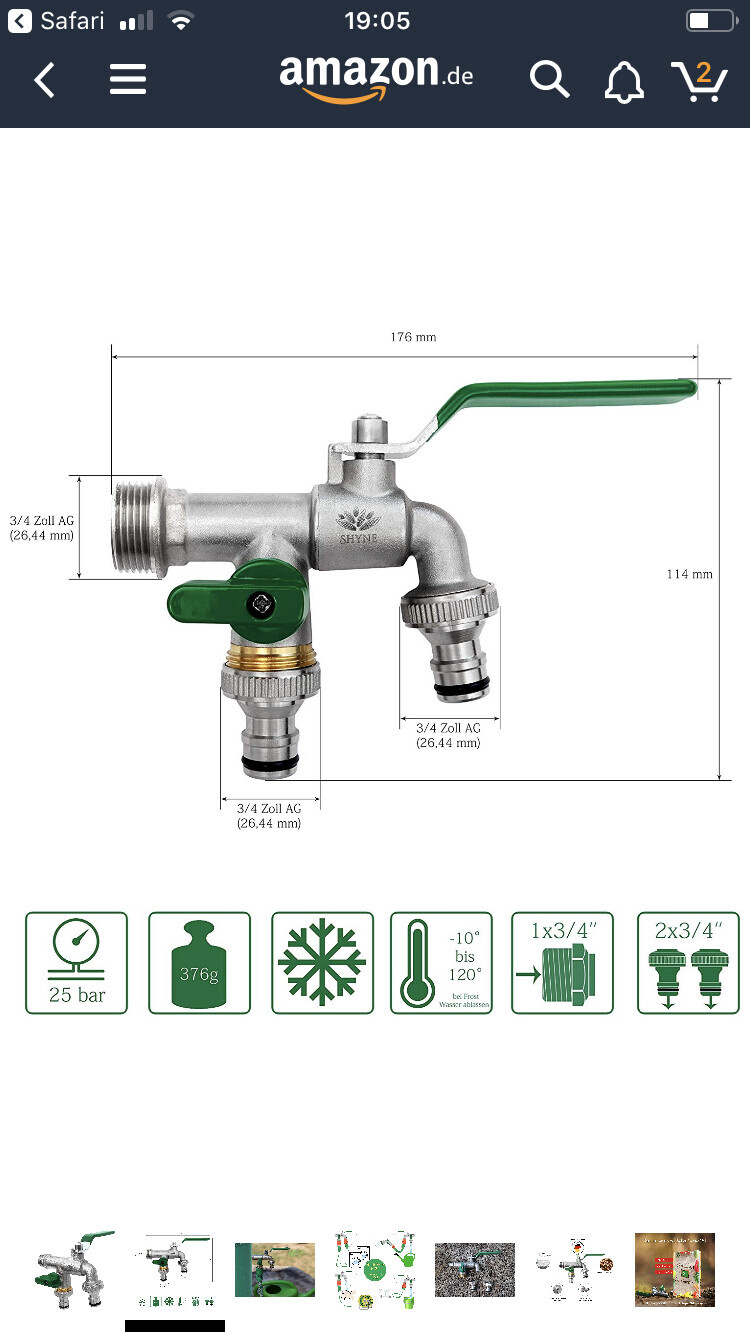
One more question: does an outdoor faucet like the one in the photo make sense? I like the idea because one outlet could be used for an irrigation controller and the other could remain free for hand washing, etc.
Thanks in advance for your help!
due to recent developments, I want to double-check that I have correctly understood your advice (from this and the other threads).
So:
-I will ask the plumber to install a pipe from the utility/technical room directly to the outside (keeping the pipe as short as possible)
-the pipe should have an adequately sized diameter (would that be 3/4 inch?)
-the garden water meter, which must be integrated into the water system (a municipal requirement), should be located in the utility/technical room and also be 3/4 inch
-the outdoor faucet should also be 3/4 inch
Is that correct so far???
One more question: does an outdoor faucet like the one in the photo make sense? I like the idea because one outlet could be used for an irrigation controller and the other could remain free for hand washing, etc.
Thanks in advance for your help!

@Katdreas Basically, much of what you are planning is correct.
3/4 inch is fine. It is important that your water meter(s) are also 3/4 inch (25mm) because otherwise, you will have additional pressure losses. As mentioned, a 3/4 inch pipe theoretically delivers about 2,400 liters per hour. Considering losses in the pipes, you can expect around 2,000 liters per hour.
You could use a faucet like this. Irrigation should be done in the very early morning hours. Running irrigation and drawing water from a second branch at the same time is not possible, as then there won’t be enough water available for irrigation. This is not a problem for a short period since the sprinklers will retract and raise again as soon as there is enough water.
Unfortunately, you haven’t shared any information about your property or planned garden yet. From what you say, I assume that by irrigation computer you mean a device like a Gardena unit that simply attaches to the faucet. However, it can only control a maximum of two zones, which is usually not enough. You only have 2,000 liters per hour available. Depending on the system used, this is not much—e.g., one zone for lawn and one zone for drip irrigation for hedges. It is better to install a cistern with refill and a properly sized pump.
In all cases, I recommend you forget the Gardena irrigation computer and instead install a valve box buried in the ground. From the faucet, run the pipe to the valve box and distribute from there. Also run a control cable to it (number of wires = number of valves + 1). This way, you can manage several zones.
For the irrigation controller, I recommend something like the Hunter Hydrawise with 6 zones. If you need more zones, get a larger model from the start or add an expansion module later. It can be controlled via an app and web interface and has access to weather stations. Additionally, sensors can be connected if desired, although they’re usually not necessary.
If you run a conduit through the wall, you can use an indoor irrigation controller (which is cheaper). You will need a power outlet and Wi-Fi at this location. The control cable is also routed to the controller.
If you don’t make a wall conduit, use the outdoor version. Power, Wi-Fi, and the control cable should be connected directly at that point.
Feel free to ask if you have any questions.
3/4 inch is fine. It is important that your water meter(s) are also 3/4 inch (25mm) because otherwise, you will have additional pressure losses. As mentioned, a 3/4 inch pipe theoretically delivers about 2,400 liters per hour. Considering losses in the pipes, you can expect around 2,000 liters per hour.
You could use a faucet like this. Irrigation should be done in the very early morning hours. Running irrigation and drawing water from a second branch at the same time is not possible, as then there won’t be enough water available for irrigation. This is not a problem for a short period since the sprinklers will retract and raise again as soon as there is enough water.
Unfortunately, you haven’t shared any information about your property or planned garden yet. From what you say, I assume that by irrigation computer you mean a device like a Gardena unit that simply attaches to the faucet. However, it can only control a maximum of two zones, which is usually not enough. You only have 2,000 liters per hour available. Depending on the system used, this is not much—e.g., one zone for lawn and one zone for drip irrigation for hedges. It is better to install a cistern with refill and a properly sized pump.
In all cases, I recommend you forget the Gardena irrigation computer and instead install a valve box buried in the ground. From the faucet, run the pipe to the valve box and distribute from there. Also run a control cable to it (number of wires = number of valves + 1). This way, you can manage several zones.
For the irrigation controller, I recommend something like the Hunter Hydrawise with 6 zones. If you need more zones, get a larger model from the start or add an expansion module later. It can be controlled via an app and web interface and has access to weather stations. Additionally, sensors can be connected if desired, although they’re usually not necessary.
If you run a conduit through the wall, you can use an indoor irrigation controller (which is cheaper). You will need a power outlet and Wi-Fi at this location. The control cable is also routed to the controller.
If you don’t make a wall conduit, use the outdoor version. Power, Wi-Fi, and the control cable should be connected directly at that point.
Feel free to ask if you have any questions.
G
Grantlhaua2 Sep 2019 07:34Good morning,
I’ll try to explain how we solved this.
We buried a 7,500 liter (about 2,000 gallons) cistern in the garden, which should also be fed by the drainage pipes in addition to collecting rainwater. There is a powerful automatic pressure pump inside with nearly 6 bar (about 87 psi) (unfortunately currently broken), which is supplied by a 1-inch underground water pipe (the standard type, the same as the one used for your house connection). From there, we use a T-piece to feed water into the house in order to supply the outdoor faucets with cistern water, and then continue on to the garage. There, I installed a leftover underfloor heating manifold box into the wall and plastered over it. This is where the valves for the sprinklers will be placed, which can be operated via radio-controlled actuators. From the manifold, I run a 25 mm (1 inch) pipe (we used a regular water pipe, but Gardena laying pipe would also work) toward the sprinklers. I haven’t installed anything further yet since the garden won’t be done until next year.
For example, you could replace the manifold in the wall with a floor-mounted manifold in the garden. It’s important to include a drainage system. This means that if you switch off the pump in winter, the remaining water in the pipes will drain into the ground, preventing the pipes from freezing and bursting.
I’ll try to explain how we solved this.
We buried a 7,500 liter (about 2,000 gallons) cistern in the garden, which should also be fed by the drainage pipes in addition to collecting rainwater. There is a powerful automatic pressure pump inside with nearly 6 bar (about 87 psi) (unfortunately currently broken), which is supplied by a 1-inch underground water pipe (the standard type, the same as the one used for your house connection). From there, we use a T-piece to feed water into the house in order to supply the outdoor faucets with cistern water, and then continue on to the garage. There, I installed a leftover underfloor heating manifold box into the wall and plastered over it. This is where the valves for the sprinklers will be placed, which can be operated via radio-controlled actuators. From the manifold, I run a 25 mm (1 inch) pipe (we used a regular water pipe, but Gardena laying pipe would also work) toward the sprinklers. I haven’t installed anything further yet since the garden won’t be done until next year.
For example, you could replace the manifold in the wall with a floor-mounted manifold in the garden. It’s important to include a drainage system. This means that if you switch off the pump in winter, the remaining water in the pipes will drain into the ground, preventing the pipes from freezing and bursting.
@Grantlhaua A "standard" water pipe is more durable and cost-effective than Gardena.
You don’t need infiltration because you blow out the pipes and sprinklers with compressed air at the end of the season.
Have you already planned your garden? Do you know how many zones you will need?
How much water does your pump actually deliver? Saying 6 bar (87 psi) alone doesn’t tell much. The volume also matters. Since it’s in a cistern, there is at least a 2-meter (6.5-feet) height difference...
You’ll also need to run power to the valves, even if they are controlled wirelessly. This is expensive and not very practical.
It sounds like you’ve put some thought into this, but you may have taken a few wrong turns.
Have you considered the required backflow preventer for refilling the cistern?
You don’t need infiltration because you blow out the pipes and sprinklers with compressed air at the end of the season.
Have you already planned your garden? Do you know how many zones you will need?
How much water does your pump actually deliver? Saying 6 bar (87 psi) alone doesn’t tell much. The volume also matters. Since it’s in a cistern, there is at least a 2-meter (6.5-feet) height difference...
You’ll also need to run power to the valves, even if they are controlled wirelessly. This is expensive and not very practical.
It sounds like you’ve put some thought into this, but you may have taken a few wrong turns.
Have you considered the required backflow preventer for refilling the cistern?
G
Grantlhaua2 Sep 2019 08:24rick2018 schrieb:
@Grantlhaua A "regular" water pipe is more durable and cheaper than Gardena. I just requested what we still had from the house construction at home—so the standard 25mm (1 inch) PVC pipes that are typically installed indoors.
rick2018 schrieb:
Have you planned your garden yet? Do you know how many zones you need? No, but I just laid as many pipes as can fit through my 100mm (4 inch) sewer pipe (I have to go under the garage). So I have connections for four zones and could add more if needed since our garage is being paved. That way, I can always pull more lines through the garage later if necessary.
rick2018 schrieb:
How much water does your pump really deliver? Saying 6 bar doesn’t tell much. Volume is also important. Since it’s in a cistern, you already have about 2 meters (6.5 feet) of elevation difference... As far as I recall, about 6000 liters per hour (around 1600 gallons per hour) at 10 meters (33 feet) of delivery height—I probably have only 3 meters (10 feet).
rick2018 schrieb:
You also have to provide power to the valves even if they are controlled wirelessly. Expensive and not very practical. I installed two power outlets with electronic boxes right above the control box and laid empty conduit between the boxes and the control panel. I’ll use these outlets to charge the batteries of my tools.
rick2018 schrieb:
Have you considered the required backflow preventer for the cistern refill system? I have a pump pit for the drainage and, if anything, pump drainage water to the system. Supplying fresh water to the cistern is not planned, and if necessary, will be done via a standard outdoor faucet.
I just wanted to give, for example, @Katdreas a few tips on how I solved it.
So, you happened to choose the better option for the pipes by chance.
Regarding the pump: a pump with 6 bar pressure cannot handle a height difference of 10 meters (33 feet). Take a look at your pump curve to see how much water it delivers at 3–4 meters (10–13 feet). You might consider upgrading your faulty pump to a more suitable one.
If necessary, you can also branch off behind the garage and install another valve box with control there. It seems you have some reserves available.
How are you controlling the valves? You probably don’t want to operate them manually all the time, right?
Regarding the pump: a pump with 6 bar pressure cannot handle a height difference of 10 meters (33 feet). Take a look at your pump curve to see how much water it delivers at 3–4 meters (10–13 feet). You might consider upgrading your faulty pump to a more suitable one.
If necessary, you can also branch off behind the garage and install another valve box with control there. It seems you have some reserves available.
How are you controlling the valves? You probably don’t want to operate them manually all the time, right?
Similar topics