
ᐅ What size opening is needed for a new staircase, and is it possible to preserve the existing plaster moldings or beams? Also, how extensive is the work involved?
Created on: 10 May 2026 15:29
C
Chris1234567
Hello everyone,
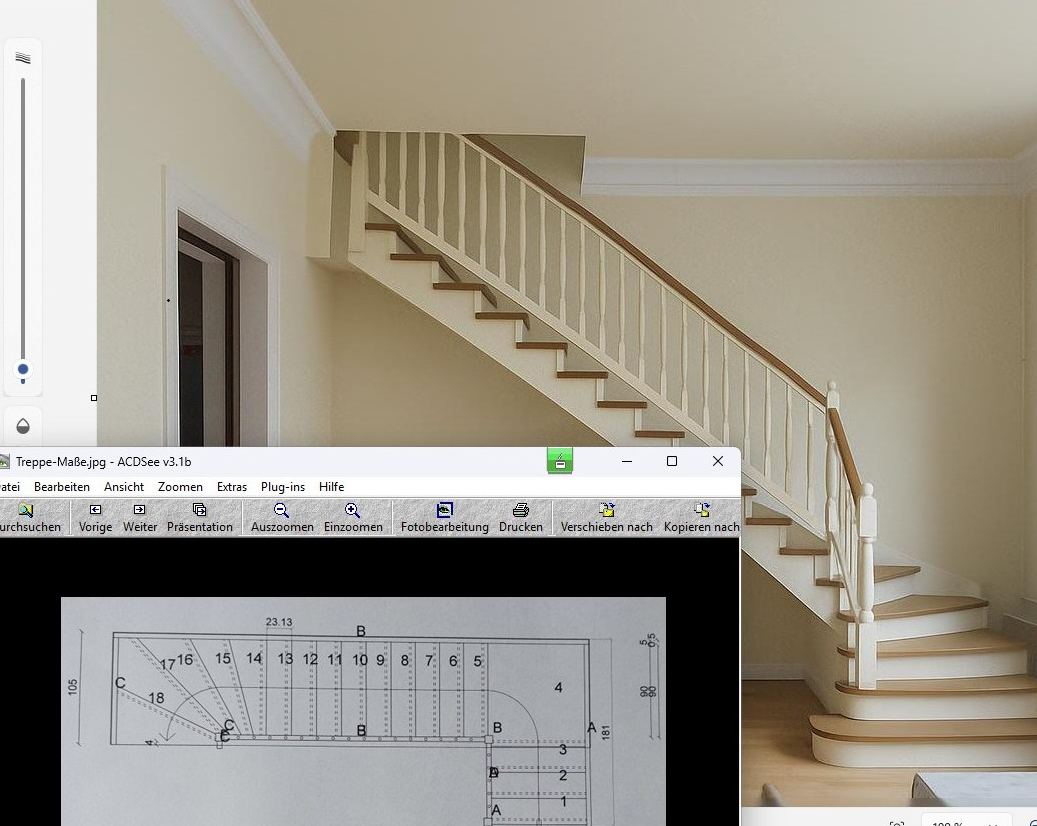
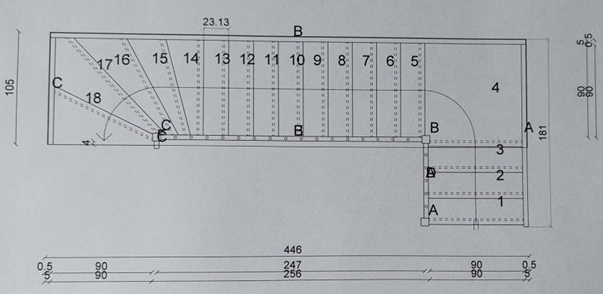
I used AI to create a representation of the staircase, showing the plasterwork and stair dimensions. The beams of the clay ceiling run lengthwise after the first opening and inspection. The beam, which is presumably supported within the wall and carries the clay ceiling and wooden floor, ends roughly level with the plasterwork, about 10-12cm (4-5 inches) from the exterior wall. The second beam follows 90cm (35 inches) further along.
Questions:
Thank you very much for your advice and experience.#
Regards,
Christian
I used AI to create a representation of the staircase, showing the plasterwork and stair dimensions. The beams of the clay ceiling run lengthwise after the first opening and inspection. The beam, which is presumably supported within the wall and carries the clay ceiling and wooden floor, ends roughly level with the plasterwork, about 10-12cm (4-5 inches) from the exterior wall. The second beam follows 90cm (35 inches) further along.
Questions:
- How large does the opening need to be in the lengthwise/downward direction? One person suggests 2m (6 ft 7 in), another 3.40m (11 ft 2 in), arguing that otherwise, you might hit your head, and that the entrance width for the first landing shouldn’t be included. I find this hard to imagine—what exactly is the issue?
- For the clay ceiling opening, I’ve received price estimates ranging from 1800 to 8000 euros. How can the necessary work be roughly divided into effort categories (duration of breaking through, dust and debris, dust protection, drywall partition, finishing work)? Above the opening, a drywall partition is planned instead of a railing.
- Regarding the plasterwork, it pains me, and the question is whether it can be preserved, and if living with an opening of 90cm (35 inches) instead of 1.05m (3 ft 5 in) is feasible. Above all, what impact could modifying the beam in the masonry have on the structural integrity? Would a planned later removal (in about 15 years) be easier than accepting this compromise?
Thank you very much for your advice and experience.#
Regards,
Christian
S
sascha-t4-le11 May 2026 15:32The clear ceiling height is 3.50 m (11 ft 6 in)? That means the rise of each step is 20 cm (8 inches). The support width should be at least 26 cm (10 inches).
If you are standing on the intermediate landing, the distance to the ceiling is 3.5 – 4 × 20 cm (11 ft 6 in – 4 × 8 inches) = 2.70 m (8 ft 10 in).
Three steps further up, it’s 2.10 m (6 ft 11 in), which seems too low to me. It’s better to make the ceiling opening from step 7, which makes the stair opening length about 3.10 m (10 ft 2 in).
In older houses, ceiling joists are often spaced at 55 cm (22 inches). Is there a photo of the opening location?
Somehow I feel like I’m missing something.
If you are standing on the intermediate landing, the distance to the ceiling is 3.5 – 4 × 20 cm (11 ft 6 in – 4 × 8 inches) = 2.70 m (8 ft 10 in).
Three steps further up, it’s 2.10 m (6 ft 11 in), which seems too low to me. It’s better to make the ceiling opening from step 7, which makes the stair opening length about 3.10 m (10 ft 2 in).
In older houses, ceiling joists are often spaced at 55 cm (22 inches). Is there a photo of the opening location?
Somehow I feel like I’m missing something.
H
hanghaus202311 May 2026 15:39I overlooked your response.
GH 3.85 means the step height is about 20.3 cm (8 inches).
2.3 / 0.203 is approximately 11.33, so 12 steps,
counting from the top.
The opening needs to be at step 7.
If someone in the house is taller than 1.8 m (5 ft 11 in), you should consider one more step.
The plaster around the opening should be removed to gain a bit more staircase width than 0.9 m (35 inches).
Why didn’t you tell KI to plan the opening correctly?
GH 3.85 means the step height is about 20.3 cm (8 inches).
2.3 / 0.203 is approximately 11.33, so 12 steps,
counting from the top.
The opening needs to be at step 7.
If someone in the house is taller than 1.8 m (5 ft 11 in), you should consider one more step.
The plaster around the opening should be removed to gain a bit more staircase width than 0.9 m (35 inches).
Why didn’t you tell KI to plan the opening correctly?
C
Chris123456711 May 2026 23:58Hello everyone,
I measured everything again precisely. The clear ceiling height in the room is 3.46m (11 ft 4 in). There is also a staircase in the stairwell. It has 20 steps to cover the same height. The steps are approximately 18–18.5–22cm (7–7.3–8.7 inches) high, with a total height of 3.81m (12 ft 6 in). So, the height varies by a few centimeters, for some reason.
Which AI tool is used for this? Or maybe I’m just not good at describing it. The AI couldn’t even get the landing right. I was told you need a landing from 18 steps, but mainly my wife needs it because she’s afraid of stairs. I’m 1.80m (5 ft 11 in) tall myself.
Now I finally understood it. At 1.9m (6 ft 3 in), I get 7.73 steps (3.81 / 19 = 20.05cm (7.9 in) per step, so (3.45 – 1.90 = 1.55 / 20.05 = 7.7 steps, which brings me to the end of the 7th step). The opening would be tight, so with 7.7 steps at 2.86m to 3.10m (9 ft 5 in to 10 ft 2 in), it’s safer. Finally got it and checked off!
Here are the ceiling and the old drawing from 1900 as well as the ceiling from the inside.
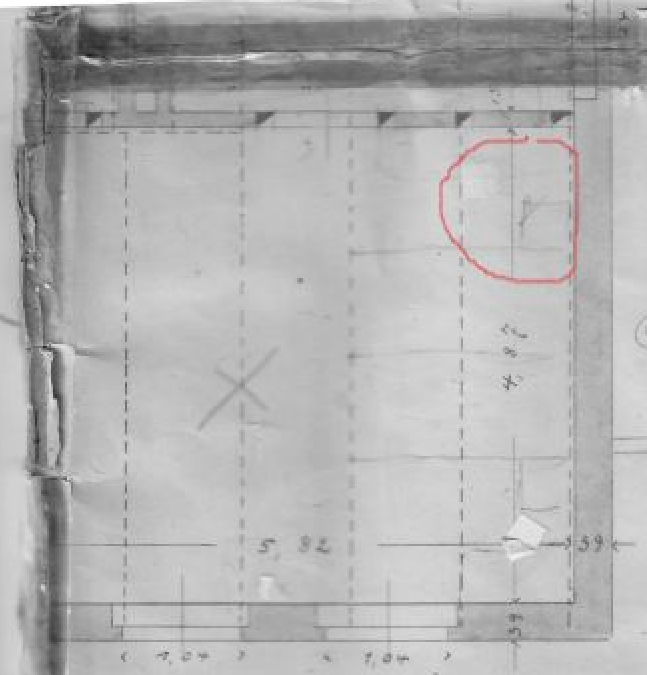
Old architect’s drawing
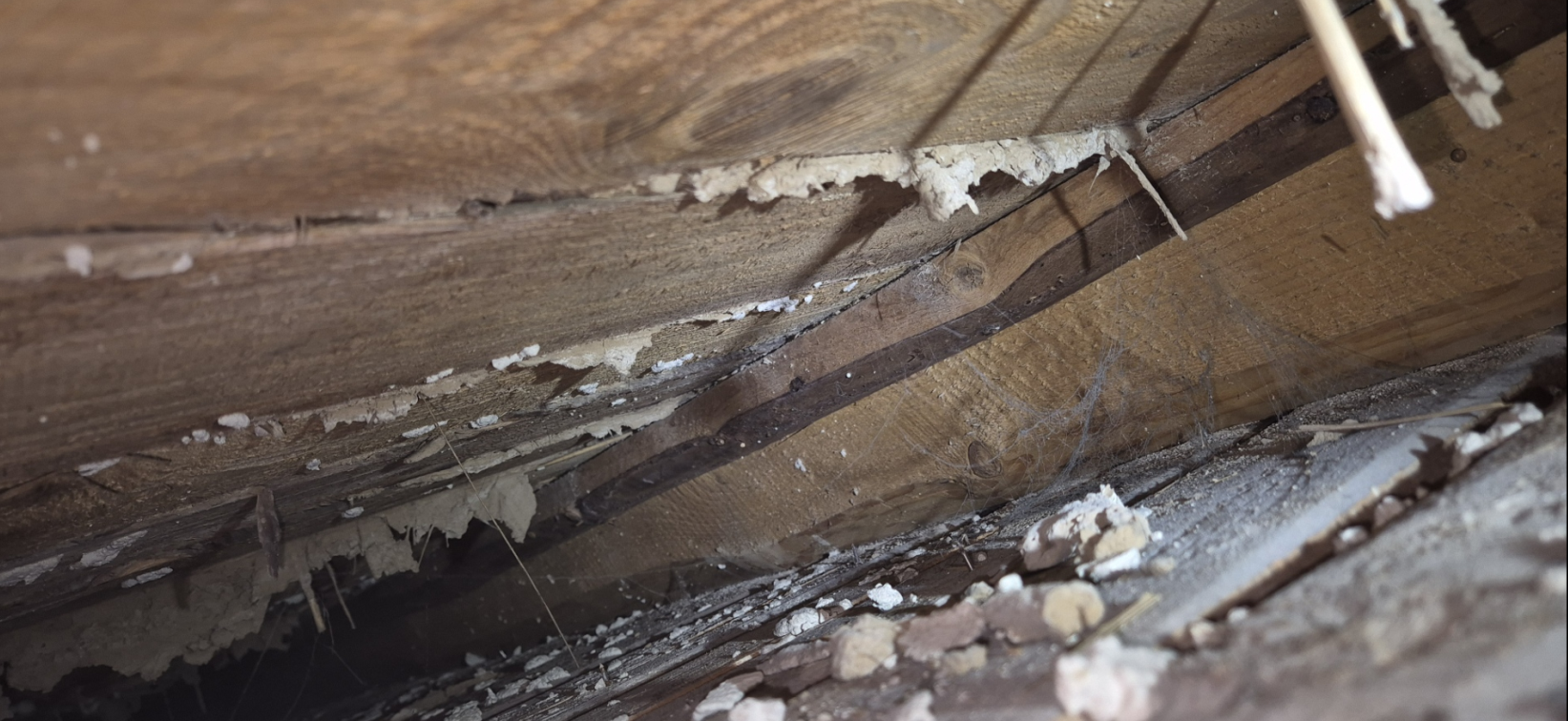
Beams in the room

Beam by the exterior wall
The question is whether the beam is just embedded in the masonry and sticking out or how else it is constructed? The distance in between is 90cm (35 inches).
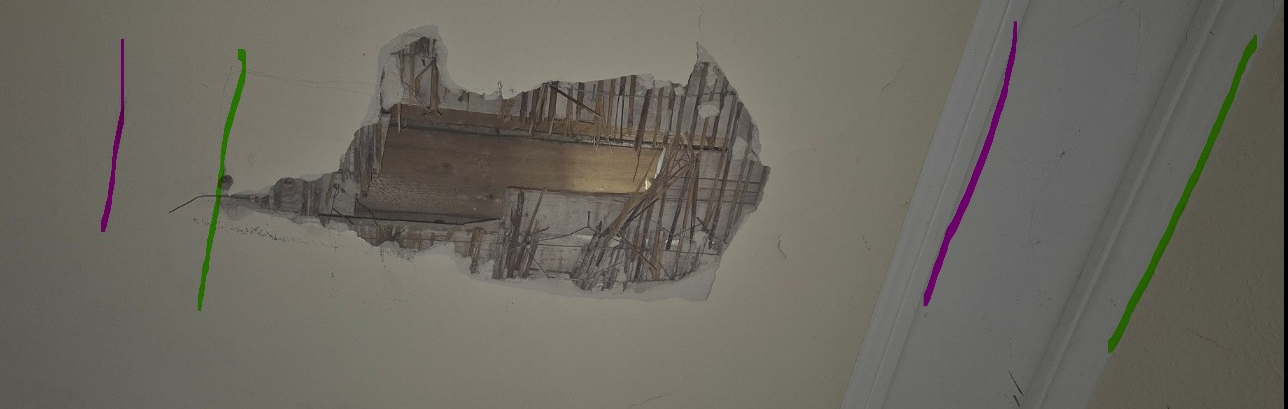
The red marks show the beginning and end of the beam; the green marks indicate the 90cm (35 inches) space for the stairs or from the green plaster start to the red into the room with 1.05m (3 ft 5 in). So, the beams would have to be tapered, and the plaster removed? I wonder what could be load-bearing if the ceiling load from the clay is gone and there is no longer any load above, like from the wall cabinet.
I measured everything again precisely. The clear ceiling height in the room is 3.46m (11 ft 4 in). There is also a staircase in the stairwell. It has 20 steps to cover the same height. The steps are approximately 18–18.5–22cm (7–7.3–8.7 inches) high, with a total height of 3.81m (12 ft 6 in). So, the height varies by a few centimeters, for some reason.
Which AI tool is used for this? Or maybe I’m just not good at describing it. The AI couldn’t even get the landing right. I was told you need a landing from 18 steps, but mainly my wife needs it because she’s afraid of stairs. I’m 1.80m (5 ft 11 in) tall myself.
Now I finally understood it. At 1.9m (6 ft 3 in), I get 7.73 steps (3.81 / 19 = 20.05cm (7.9 in) per step, so (3.45 – 1.90 = 1.55 / 20.05 = 7.7 steps, which brings me to the end of the 7th step). The opening would be tight, so with 7.7 steps at 2.86m to 3.10m (9 ft 5 in to 10 ft 2 in), it’s safer. Finally got it and checked off!
Here are the ceiling and the old drawing from 1900 as well as the ceiling from the inside.
Old architect’s drawing
Beams in the room
Beam by the exterior wall
The question is whether the beam is just embedded in the masonry and sticking out or how else it is constructed? The distance in between is 90cm (35 inches).
The red marks show the beginning and end of the beam; the green marks indicate the 90cm (35 inches) space for the stairs or from the green plaster start to the red into the room with 1.05m (3 ft 5 in). So, the beams would have to be tapered, and the plaster removed? I wonder what could be load-bearing if the ceiling load from the clay is gone and there is no longer any load above, like from the wall cabinet.