
ᐅ What size opening is needed for a new staircase, and is it possible to preserve the existing plaster moldings or beams? Also, how extensive is the work involved?
Created on: 10 May 2026 15:29
C
Chris1234567C
Chris123456710 May 2026 15:29Hello everyone,
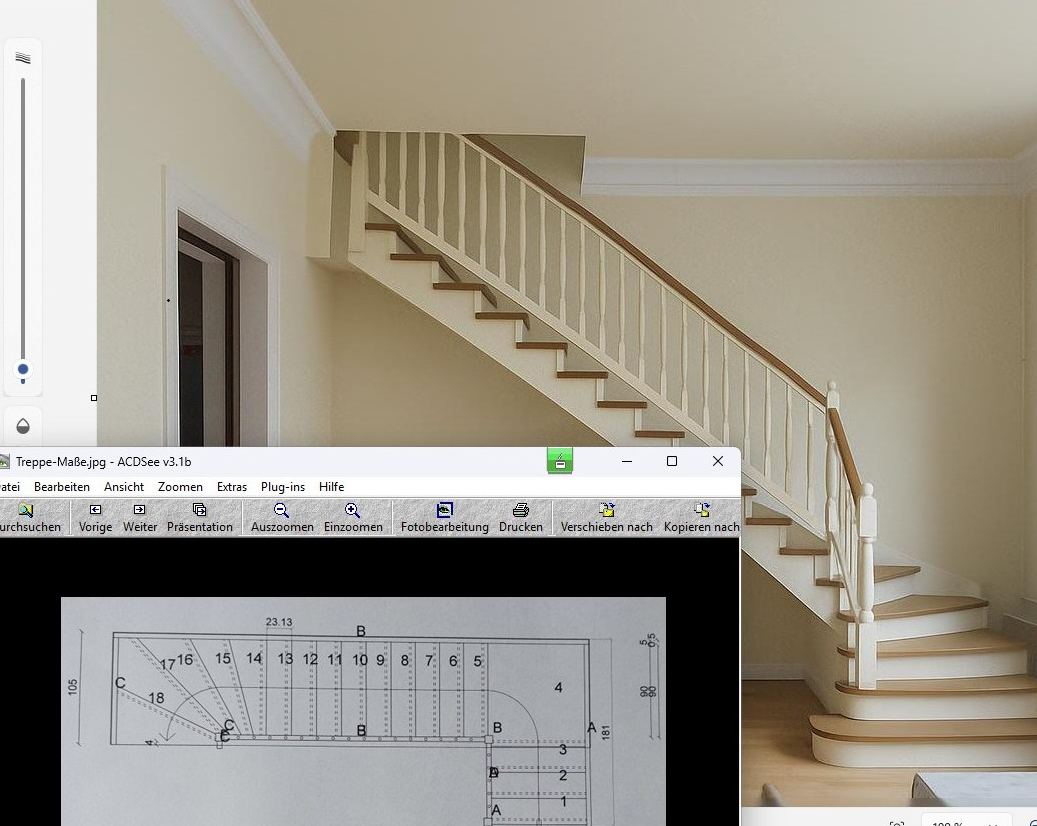
I used AI to create a representation of the staircase, showing the plasterwork and stair dimensions. The beams of the clay ceiling run lengthwise after the first opening and inspection. The beam, which is presumably supported within the wall and carries the clay ceiling and wooden floor, ends roughly level with the plasterwork, about 10-12cm (4-5 inches) from the exterior wall. The second beam follows 90cm (35 inches) further along.
Questions:
Thank you very much for your advice and experience.#
Regards,
Christian
I used AI to create a representation of the staircase, showing the plasterwork and stair dimensions. The beams of the clay ceiling run lengthwise after the first opening and inspection. The beam, which is presumably supported within the wall and carries the clay ceiling and wooden floor, ends roughly level with the plasterwork, about 10-12cm (4-5 inches) from the exterior wall. The second beam follows 90cm (35 inches) further along.
Questions:
- How large does the opening need to be in the lengthwise/downward direction? One person suggests 2m (6 ft 7 in), another 3.40m (11 ft 2 in), arguing that otherwise, you might hit your head, and that the entrance width for the first landing shouldn’t be included. I find this hard to imagine—what exactly is the issue?
- For the clay ceiling opening, I’ve received price estimates ranging from 1800 to 8000 euros. How can the necessary work be roughly divided into effort categories (duration of breaking through, dust and debris, dust protection, drywall partition, finishing work)? Above the opening, a drywall partition is planned instead of a railing.
- Regarding the plasterwork, it pains me, and the question is whether it can be preserved, and if living with an opening of 90cm (35 inches) instead of 1.05m (3 ft 5 in) is feasible. Above all, what impact could modifying the beam in the masonry have on the structural integrity? Would a planned later removal (in about 15 years) be easier than accepting this compromise?
Thank you very much for your advice and experience.#
Regards,
Christian
Hi,
A classic case of creating a “microclimate” yourself – having the refrigerator as a cold bridge in front of the window is almost textbook, even if nobody wants to hear it. A U-value of 1.3 won’t help if the air behind it is stagnant and cools down.
Regarding your actual question, without a picture it’s a bit of a guess, but with clay plaster and the wrong paint, mold often initially grows on the surface or within the paint layer. That doesn’t automatically mean it’s safe though, because clay can buffer moisture well but also retain it. If it’s been going on for a while, the mold can spread a few millimeters deeper, invisible to the eye.
Much more important is whether the affected area was only local behind the fridge or if it has spread beyond that. Have you checked 30–50cm (12–20 inches) away to see if there’s a musty smell or any staining?
I would remove the paint mechanically, not just wipe over it, and then check how the plaster underneath looks. If it’s still solid and not turning “sandy,” it’s usually manageable. But please avoid using harsh chemicals – clay plaster tends to react sensitively.
And honestly, without permanently improving air circulation, you’re likely to face this issue again, no matter how carefully you work now. This is often underestimated.
A classic case of creating a “microclimate” yourself – having the refrigerator as a cold bridge in front of the window is almost textbook, even if nobody wants to hear it. A U-value of 1.3 won’t help if the air behind it is stagnant and cools down.
Regarding your actual question, without a picture it’s a bit of a guess, but with clay plaster and the wrong paint, mold often initially grows on the surface or within the paint layer. That doesn’t automatically mean it’s safe though, because clay can buffer moisture well but also retain it. If it’s been going on for a while, the mold can spread a few millimeters deeper, invisible to the eye.
Much more important is whether the affected area was only local behind the fridge or if it has spread beyond that. Have you checked 30–50cm (12–20 inches) away to see if there’s a musty smell or any staining?
I would remove the paint mechanically, not just wipe over it, and then check how the plaster underneath looks. If it’s still solid and not turning “sandy,” it’s usually manageable. But please avoid using harsh chemicals – clay plaster tends to react sensitively.
And honestly, without permanently improving air circulation, you’re likely to face this issue again, no matter how carefully you work now. This is often underestimated.

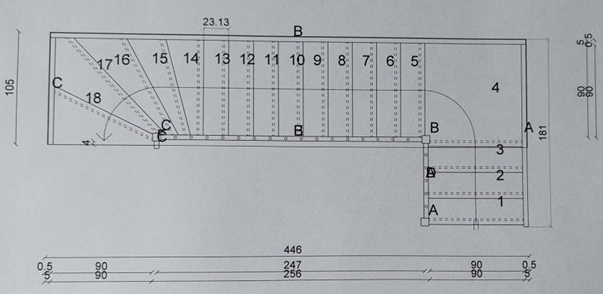
If the construction sketch of the staircase is realistic (… from the stair builder …?) and you can use it for the later fabrication, you should create (or have created) a scaled drawing of the staircase and ensure a clear passage height of 2.00 m (6 ft 7 in) above the front edge of each step – at every point along the stair run. This requirement determines the length of the stair opening.
The ceiling beam to the left of the staircase, in the direction of ascent, will experience additional load due to the ceiling change at the stair opening. This must be verified by a structural engineer. Usually, this ceiling beam will need to be reinforced accordingly. The load of the drywall balustrade on the upper floor must also be considered as an additional line load on this ceiling beam. Therefore: a calculated structural verification is necessary, not just a subjective assessment for reinforcement.
The ceiling beam to the left of the staircase, in the direction of ascent, will experience additional load due to the ceiling change at the stair opening. This must be verified by a structural engineer. Usually, this ceiling beam will need to be reinforced accordingly. The load of the drywall balustrade on the upper floor must also be considered as an additional line load on this ceiling beam. Therefore: a calculated structural verification is necessary, not just a subjective assessment for reinforcement.
C
Chris123456711 May 2026 13:51@wpic Thanks for the feedback.
The drawing is from the staircase builder, who will only start once the stair opening is in place. So the staircase supplier is confirmed.
Because of the spiral, the question is how long the opening would need to be assuming a 2m (6 ft 7 in) “head height”? I’ve received two different opinions on this. The first 2-3 steps basically go “through the ceiling thickness,” but does the spiral at the top require a larger opening? I measured in the hallway and got just over 2m (6 ft 7 in), not 3.40m (11 ft 2 in). What do you think? The ceiling height itself in the target room and on the first floor is over 3.50m (11 ft 6 in). Including the ceiling thickness, the distance to bridge is 3.85m (12 ft 7 in). I don’t understand the argument that the spiral means the opening must be larger compared to a straight flight? There should be plenty of headroom.
Regarding structural stability: One person said that as long as you don’t cut into the beam, it’s not a problem, since you’re basically just removing the wooden and clay floor rather than adding extra load. There are also differing opinions about the tapering. A drywall scaffolding shouldn’t weigh more than the cupboard that’s already fully packed upstairs. Shouldn’t such things allow some tolerance?
What about the plasterwork? Is it easy to preserve or reconstruct? Or should it be removed for now?
Regards, Chris
P.S. @Nauer The issue with removing the refrigerator is resolved. The beam is gone. It was stuck quite stubbornly, so I am carefully removing the paint and surface mechanically with a mask as recommended. Other than that, I’m good on the topic of staircase construction with the opening. Thanks again for the feedback.
The drawing is from the staircase builder, who will only start once the stair opening is in place. So the staircase supplier is confirmed.
Because of the spiral, the question is how long the opening would need to be assuming a 2m (6 ft 7 in) “head height”? I’ve received two different opinions on this. The first 2-3 steps basically go “through the ceiling thickness,” but does the spiral at the top require a larger opening? I measured in the hallway and got just over 2m (6 ft 7 in), not 3.40m (11 ft 2 in). What do you think? The ceiling height itself in the target room and on the first floor is over 3.50m (11 ft 6 in). Including the ceiling thickness, the distance to bridge is 3.85m (12 ft 7 in). I don’t understand the argument that the spiral means the opening must be larger compared to a straight flight? There should be plenty of headroom.
Regarding structural stability: One person said that as long as you don’t cut into the beam, it’s not a problem, since you’re basically just removing the wooden and clay floor rather than adding extra load. There are also differing opinions about the tapering. A drywall scaffolding shouldn’t weigh more than the cupboard that’s already fully packed upstairs. Shouldn’t such things allow some tolerance?
What about the plasterwork? Is it easy to preserve or reconstruct? Or should it be removed for now?
Regards, Chris
P.S. @Nauer The issue with removing the refrigerator is resolved. The beam is gone. It was stuck quite stubbornly, so I am carefully removing the paint and surface mechanically with a mask as recommended. Other than that, I’m good on the topic of staircase construction with the opening. Thanks again for the feedback.
H
hanghaus202311 May 2026 15:25What is the floor-to-floor height? And/or the step height?
Assuming the step is 18cm (7 inches) high, then the floor-to-floor height is 3.42m (11 ft 3 in).
Ceiling thickness assumed to be 30cm (12 inches).
3.42 - 0.3 = 3.12
Clearance height 2m (6 ft 7 in) + 0.3m (12 inches)
2.3 / 0.18 is approximately 12.78, rounded to 13 steps
counted from the top.
The opening needs to reach up to step 6.
If someone in the house is taller than 1.8m (5 ft 11 in), one additional step should be considered.
Why the landing?
Assuming the step is 18cm (7 inches) high, then the floor-to-floor height is 3.42m (11 ft 3 in).
Ceiling thickness assumed to be 30cm (12 inches).
3.42 - 0.3 = 3.12
Clearance height 2m (6 ft 7 in) + 0.3m (12 inches)
2.3 / 0.18 is approximately 12.78, rounded to 13 steps
counted from the top.
The opening needs to reach up to step 6.
If someone in the house is taller than 1.8m (5 ft 11 in), one additional step should be considered.
Why the landing?
H
hanghaus202311 May 2026 15:31Chris1234567 schrieb:
One person says 2m (6.6 ft), the other 3.40m (11.2 ft) Most likely, one is referring to the height and the other to the length.
Similar topics