
Hello everyone,
We have purchased our dream house, which unfortunately has water damage in the basement. We do not yet know the cause. Last week, I opened a pit in the basement, and it was filled with water (see photo). The building plans indicate that there should either be a lifting station or a backwater valve there. I believe it is more likely a lifting station since the pit is about 2.60m (8.5 ft) below the inspection shaft for sewage water on the street. Strangely, the water does not smell as bad as it looks in the photo; in fact, it smells quite pleasant (fabric softener?!). In the basement, there is a washing machine, a shower, a sink, and a toilet that all produce sewage water. My question is whether standing water like this is normal — probably not. Should I pump out the water? There is a floor drain in the middle of the same room. I will also include a photo of this drain. It is much deeper, and there is only about 5cm to 10cm (2 to 4 inches) of water at the very bottom. The drain is approximately 80cm (31.5 inches) deep. Additionally, not far from the pit with the pleasantly smelling water, there is a funnel-shaped drain pipe. This pipe is connected to the air-water heat pump by a condensate pipe, presumably draining the condensate from the heat pump. Unfortunately, I noticed that the water from this drain pipe drains extremely slowly. Can I use a cleaning device on this drain pipe, or should I be careful since I might damage the assumed lifting station?
I thank everyone who tries to help us save our dream house.
Thank you
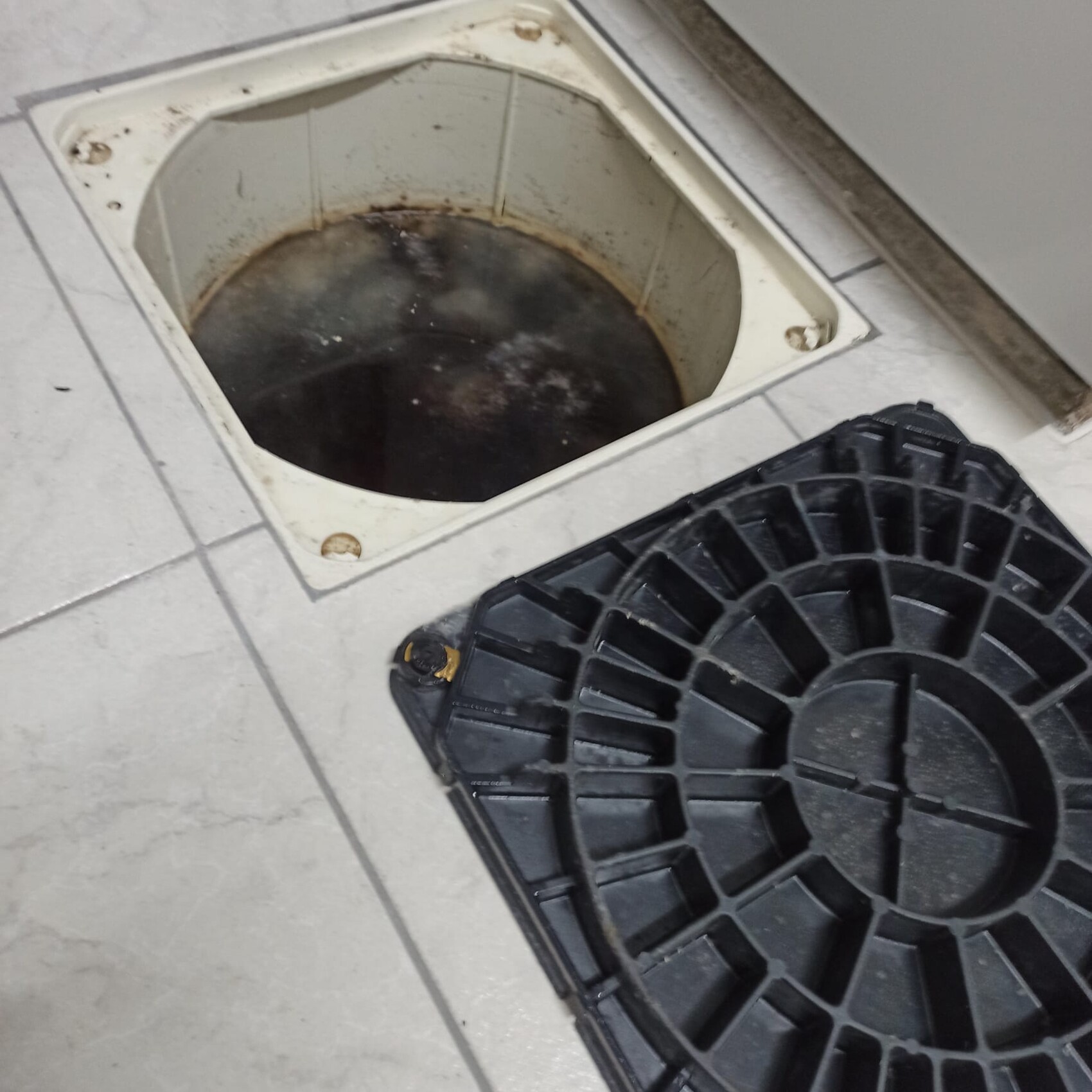
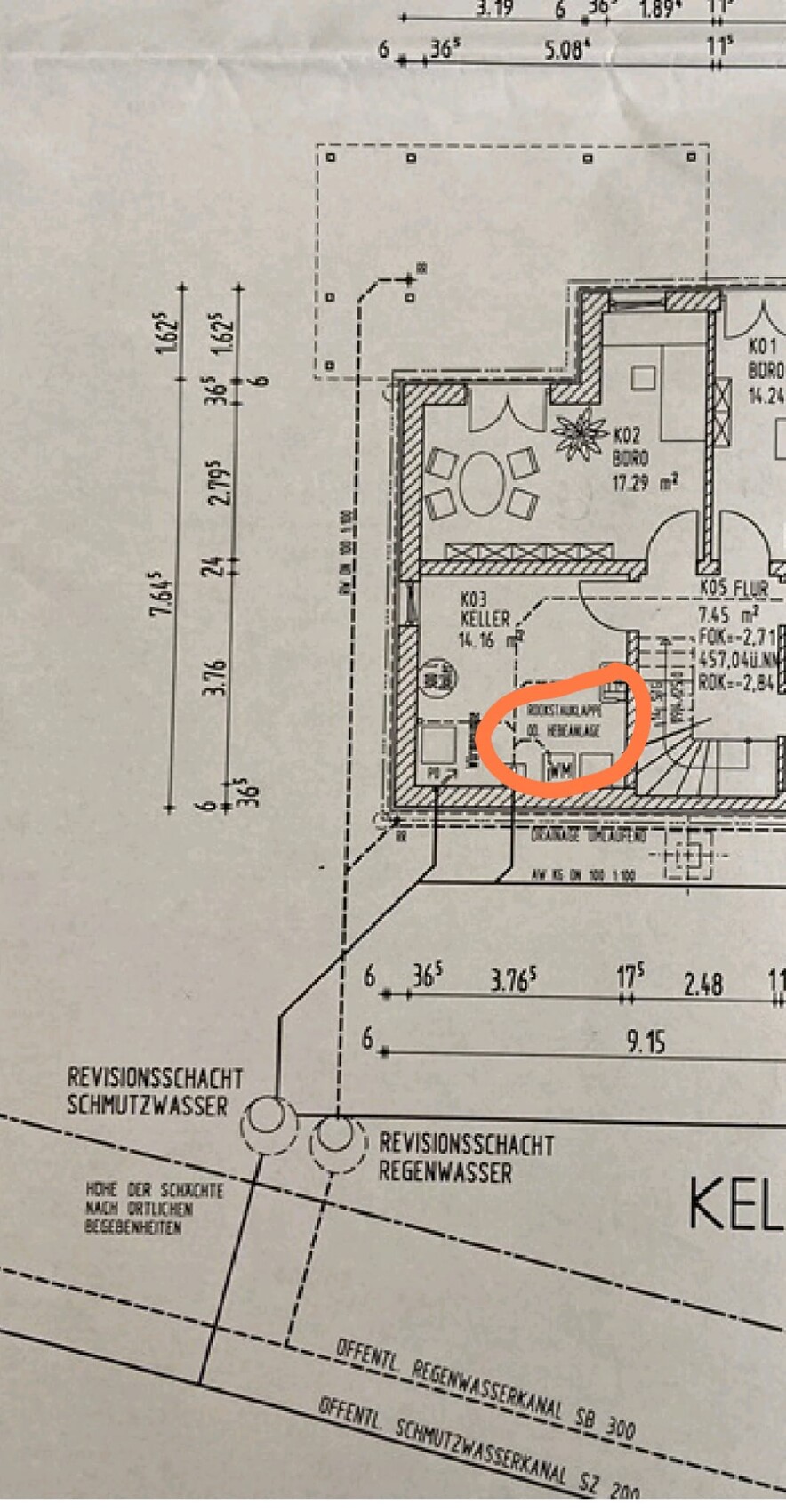
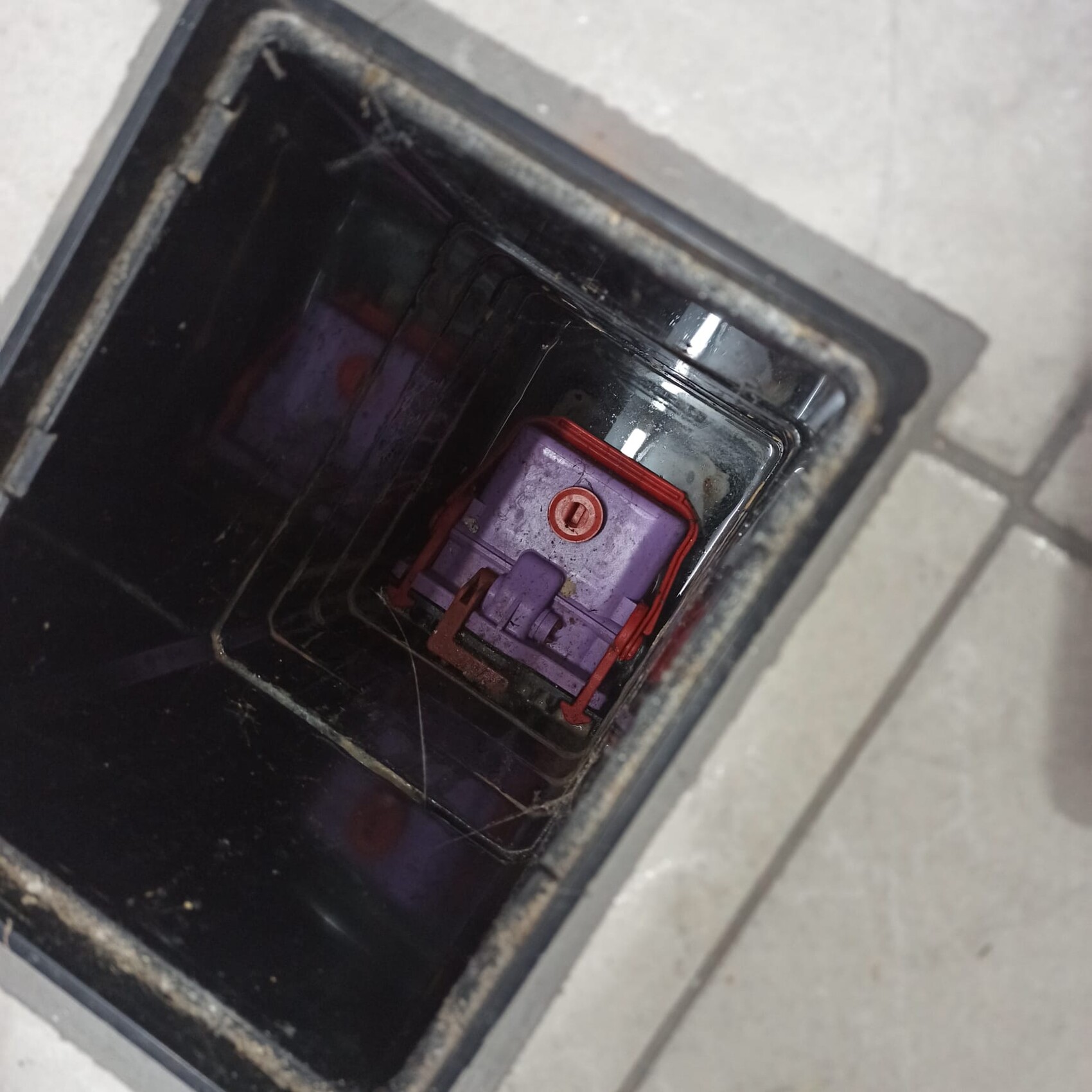
We have purchased our dream house, which unfortunately has water damage in the basement. We do not yet know the cause. Last week, I opened a pit in the basement, and it was filled with water (see photo). The building plans indicate that there should either be a lifting station or a backwater valve there. I believe it is more likely a lifting station since the pit is about 2.60m (8.5 ft) below the inspection shaft for sewage water on the street. Strangely, the water does not smell as bad as it looks in the photo; in fact, it smells quite pleasant (fabric softener?!). In the basement, there is a washing machine, a shower, a sink, and a toilet that all produce sewage water. My question is whether standing water like this is normal — probably not. Should I pump out the water? There is a floor drain in the middle of the same room. I will also include a photo of this drain. It is much deeper, and there is only about 5cm to 10cm (2 to 4 inches) of water at the very bottom. The drain is approximately 80cm (31.5 inches) deep. Additionally, not far from the pit with the pleasantly smelling water, there is a funnel-shaped drain pipe. This pipe is connected to the air-water heat pump by a condensate pipe, presumably draining the condensate from the heat pump. Unfortunately, I noticed that the water from this drain pipe drains extremely slowly. Can I use a cleaning device on this drain pipe, or should I be careful since I might damage the assumed lifting station?
I thank everyone who tries to help us save our dream house.
Thank you
T
Therettill21 May 2024 15:50Hello,
I’m sorry to hear that you are dealing with water damage in your dream home. It’s understandable that you are concerned and looking for solutions. Based on your description, it seems there might be an issue with the drainage system in the basement.
It is not normal for water to remain in a pit or sump in the basement, especially in a room where water-using appliances such as a washing machine, shower, sink, and toilet are located. It is important to identify the cause of the water ingress and take appropriate measures to prevent further damage.
Since you suspect there is a sewage lifting station or at least a backwater valve in your basement, it is advisable to have a professional inspect and repair the system.
Regarding the slow drainage in the other drain pipe, this could also indicate a drainage problem. A drain cleaning tool might help clear any blockages, but it is important to proceed carefully to avoid causing additional damage.
I’m sorry to hear that you are dealing with water damage in your dream home. It’s understandable that you are concerned and looking for solutions. Based on your description, it seems there might be an issue with the drainage system in the basement.
It is not normal for water to remain in a pit or sump in the basement, especially in a room where water-using appliances such as a washing machine, shower, sink, and toilet are located. It is important to identify the cause of the water ingress and take appropriate measures to prevent further damage.
Since you suspect there is a sewage lifting station or at least a backwater valve in your basement, it is advisable to have a professional inspect and repair the system.
Regarding the slow drainage in the other drain pipe, this could also indicate a drainage problem. A drain cleaning tool might help clear any blockages, but it is important to proceed carefully to avoid causing additional damage.
S
Sonne_ist_toll28 May 2024 11:12Hello everyone,
first of all, thank you very much for the active participation here. I would like to provide an update that might help others who are in a similar situation as I am.
I was able to prove that there is a leak somewhere in the wastewater pipe. I discovered this by closing the backwater valve and filling the pipes with water. I observed the water level in the pipes at the floor drain. I filled it to about 10cm (4 inches) below the overflow, waited an hour to make sure the water in the system was no longer sloshing. Then I inserted a folding ruler and checked hourly whether the water level dropped. The water level actually decreased by about 3-5mm (0.1-0.2 inches) per hour. Additionally, it started dripping at the sleeve in the Staufix chamber. After conducting this test a second time with the same result, I was able to confirm that there is a leak in the wastewater system.
Therefore, I hired a company to perform a camera inspection and flush the system. Only light, soft deposits were found. Otherwise, the wastewater system in the basement looked almost new, which made my repair efforts more difficult since I did not know exactly where the problem was.
The suspicion was that either a seal was forgotten during construction or was damaged during installation. Since the wastewater system has many branches and is approximately 27m (89 feet) long, only the flooding method was suitable to seal the leak. Another company came and carried out this process using a two-component system.
On the same day the procedure was carried out, the company performed a leak test. They proceeded exactly as I did, using a folding ruler and sealing the system, then filling it with water. After two hours, no movement of the water level was detected, and no water leaked from the backwater sump.
In the following days, I conducted an identical test for three hours. The water level remained completely constant, without decreasing further. I regularly measure marked wall areas with a capacitive moisture meter (still manually). Here, too, I can confirm after several weeks that the moisture levels have decreased everywhere.
However, I remain skeptical. It is possible that we have not just one, but several issues in the house. My next step is to have the screed professionally dried and to arrange core drilling for this purpose. I will be looking for a company offering this service.
If you have any experience with this, please feel free to share. At the moment, I am drying with a household dehumidifier and some electric heaters. The electric heaters consume a lot of electricity, but I only use them when my photovoltaic system's battery is fully charged.
first of all, thank you very much for the active participation here. I would like to provide an update that might help others who are in a similar situation as I am.
I was able to prove that there is a leak somewhere in the wastewater pipe. I discovered this by closing the backwater valve and filling the pipes with water. I observed the water level in the pipes at the floor drain. I filled it to about 10cm (4 inches) below the overflow, waited an hour to make sure the water in the system was no longer sloshing. Then I inserted a folding ruler and checked hourly whether the water level dropped. The water level actually decreased by about 3-5mm (0.1-0.2 inches) per hour. Additionally, it started dripping at the sleeve in the Staufix chamber. After conducting this test a second time with the same result, I was able to confirm that there is a leak in the wastewater system.
Therefore, I hired a company to perform a camera inspection and flush the system. Only light, soft deposits were found. Otherwise, the wastewater system in the basement looked almost new, which made my repair efforts more difficult since I did not know exactly where the problem was.
The suspicion was that either a seal was forgotten during construction or was damaged during installation. Since the wastewater system has many branches and is approximately 27m (89 feet) long, only the flooding method was suitable to seal the leak. Another company came and carried out this process using a two-component system.
On the same day the procedure was carried out, the company performed a leak test. They proceeded exactly as I did, using a folding ruler and sealing the system, then filling it with water. After two hours, no movement of the water level was detected, and no water leaked from the backwater sump.
In the following days, I conducted an identical test for three hours. The water level remained completely constant, without decreasing further. I regularly measure marked wall areas with a capacitive moisture meter (still manually). Here, too, I can confirm after several weeks that the moisture levels have decreased everywhere.
However, I remain skeptical. It is possible that we have not just one, but several issues in the house. My next step is to have the screed professionally dried and to arrange core drilling for this purpose. I will be looking for a company offering this service.
If you have any experience with this, please feel free to share. At the moment, I am drying with a household dehumidifier and some electric heaters. The electric heaters consume a lot of electricity, but I only use them when my photovoltaic system's battery is fully charged.
Similar topics