
Hello everyone,
We are currently building a semi-detached house, and the shell construction is now complete. Unfortunately, we experienced some water damage:
1. The connection of the ball valve on the heating circuit manifold on the ground floor leaked, possibly for several months.
2. While filling the heating system (underfloor heating) on the top floor, the installers spilled water. The exact amount of leaked water is unknown to us.
Since we were concerned that water might have penetrated the insulation layer beneath the screed, we hired a specialist company to measure the moisture under the screed. Their recommendation is now to carry out core drilling and to dry the screed including the insulation. The cost is approximately 3,700 €.
Unfortunately, we do not have enough expertise to assess whether the measured moisture levels are truly critical enough to justify this drying process now. We have already dried the screed using a special program of the underfloor heating system.
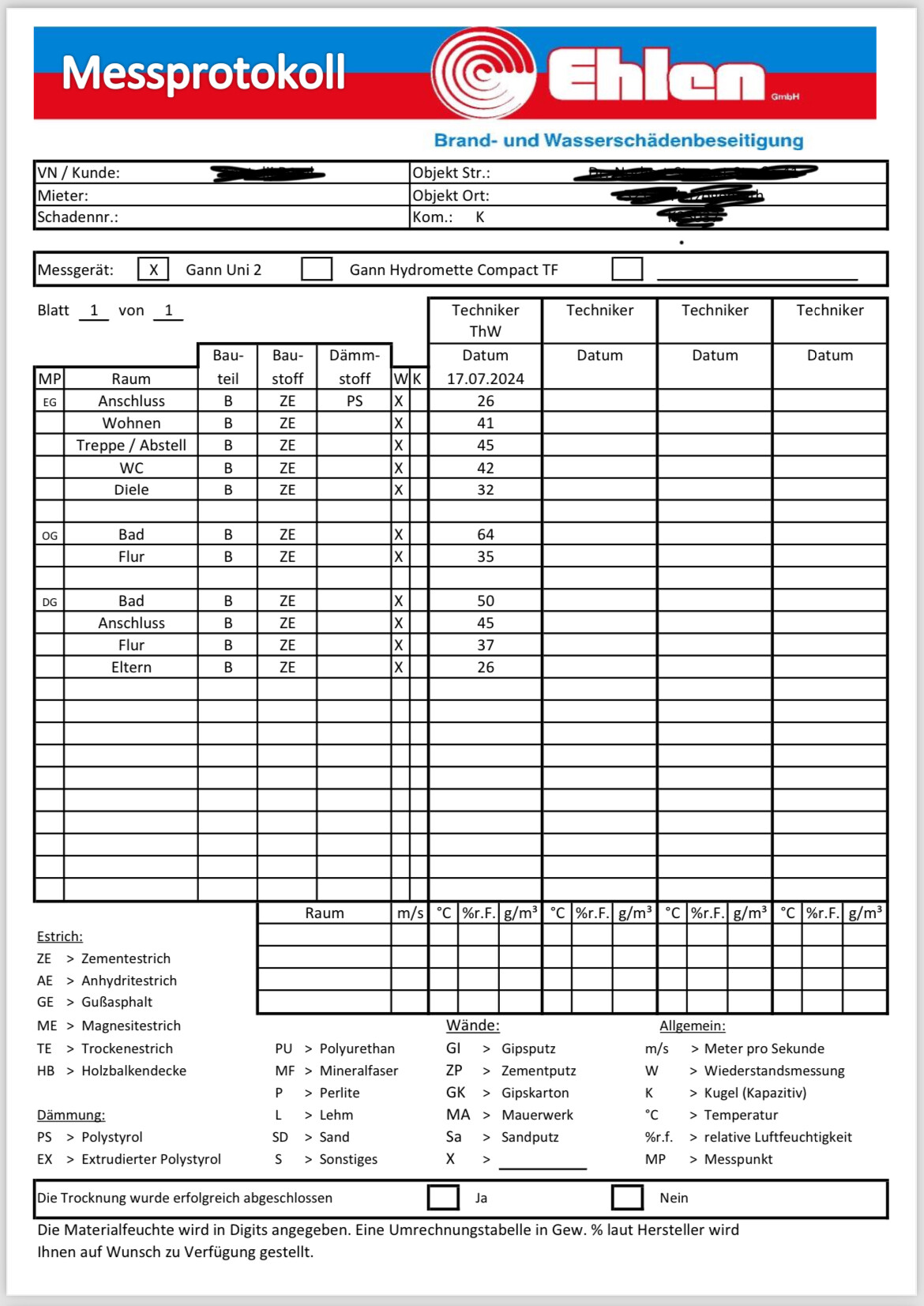
What would you recommend? Are the measured values acceptable (see image)? The heating company responsible for the damage claims that this is normal moisture for a new build. We are uncertain.
Thank you very much!
We are currently building a semi-detached house, and the shell construction is now complete. Unfortunately, we experienced some water damage:
1. The connection of the ball valve on the heating circuit manifold on the ground floor leaked, possibly for several months.
2. While filling the heating system (underfloor heating) on the top floor, the installers spilled water. The exact amount of leaked water is unknown to us.
Since we were concerned that water might have penetrated the insulation layer beneath the screed, we hired a specialist company to measure the moisture under the screed. Their recommendation is now to carry out core drilling and to dry the screed including the insulation. The cost is approximately 3,700 €.
Unfortunately, we do not have enough expertise to assess whether the measured moisture levels are truly critical enough to justify this drying process now. We have already dried the screed using a special program of the underfloor heating system.
What would you recommend? Are the measured values acceptable (see image)? The heating company responsible for the damage claims that this is normal moisture for a new build. We are uncertain.
Thank you very much!

Hello questioner.
If water drips onto a (floating) screed over an extended period, it does not necessarily mean that a damaging amount of water has penetrated beneath the screed layer!
As long as it is a cement screed, water does no harm to it.
Therefore, a targeted moisture test with the TESTOFON around the point of contact would be sufficient. While this might reduce the "scientific credibility" somewhat, this surface moisture measurement would give you a clear indication for your next steps.
The same applies to the attic. A simple moisture test based on electrical conductivity would also provide a clear indication there.
-------------------
Before we address the main topic, it’s important to understand that electrical measuring methods, such as the one from company GANN, do not provide binding numerical values (those with dimensions like % or g/kg).
Looking at the so-called measurement report from company EHLEN, even with professional knowledge, no meaningful reference can be derived!
It shows that a “GANN UNI 2” device was used, with the “W” box checked.
According to the protocol sheet, W stands for resistance measurement, while K indicates capacitive measurement.
Laypersons might be surprised, and experts puzzled (not just about this), as both devices listed in the measurement protocol (not to be confused with measuring devices!) rely on the capacitive method.
Thus, the checked “W” is misleading but ultimately irrelevant.
The technician, abbreviated “THW,” lists numerical values in column 8 without any explanation.
As an expert, this tells me something; however, the technically inexperienced client who paid for company EHLEN’s services will likely understand nothing.
You have paid for a service whose purpose and evaluation you cannot understand.
"The company now recommends taking core samples and drying the screed including the insulation."
I will tell you honestly:
This assessment is "pulled out of thin air," as it is unclear how the company arrived at this conclusion.
The test results only contain so-called “digits,” that is, display values.
Leaving aside that one can never measure down into the lower screed edge areas, let alone into the insulation layer underneath, with a capacitively working testing device, the attempt to generate an additional order here (core drilling and forced drying) is blatantly obvious!
No binding table exists that could convert digits into mass percent (%).
And the numerical values in the “report” show no abnormalities or signs of elevated levels.
--------------------------
Ultimately, I hope these insights help you understand the context better.
The flooring installer who will later lay the floor on the affected areas should perform an additional CM (calcium carbide) moisture measurement without being told why.
You can expect to pay about €90 for two extra measurements.
If increased residual moisture is actually found there, the screed can be sealed with a reaction resin.
(Just don’t suggest this to the flooring installer right away, or they might recommend this lucrative extra work without justification.)
You should expect an additional cost of about €15 per square meter.
All things considered, this is still much cheaper than €3,700, especially since no drying company (!) offers a guarantee for the success of its drying measures (dryness).
-------------------
Best regards and good luck with the further process: KlaRa
If water drips onto a (floating) screed over an extended period, it does not necessarily mean that a damaging amount of water has penetrated beneath the screed layer!
As long as it is a cement screed, water does no harm to it.
Therefore, a targeted moisture test with the TESTOFON around the point of contact would be sufficient. While this might reduce the "scientific credibility" somewhat, this surface moisture measurement would give you a clear indication for your next steps.
The same applies to the attic. A simple moisture test based on electrical conductivity would also provide a clear indication there.
-------------------
Before we address the main topic, it’s important to understand that electrical measuring methods, such as the one from company GANN, do not provide binding numerical values (those with dimensions like % or g/kg).
Looking at the so-called measurement report from company EHLEN, even with professional knowledge, no meaningful reference can be derived!
It shows that a “GANN UNI 2” device was used, with the “W” box checked.
According to the protocol sheet, W stands for resistance measurement, while K indicates capacitive measurement.
Laypersons might be surprised, and experts puzzled (not just about this), as both devices listed in the measurement protocol (not to be confused with measuring devices!) rely on the capacitive method.
Thus, the checked “W” is misleading but ultimately irrelevant.
The technician, abbreviated “THW,” lists numerical values in column 8 without any explanation.
As an expert, this tells me something; however, the technically inexperienced client who paid for company EHLEN’s services will likely understand nothing.
You have paid for a service whose purpose and evaluation you cannot understand.
"The company now recommends taking core samples and drying the screed including the insulation."
I will tell you honestly:
This assessment is "pulled out of thin air," as it is unclear how the company arrived at this conclusion.
The test results only contain so-called “digits,” that is, display values.
Leaving aside that one can never measure down into the lower screed edge areas, let alone into the insulation layer underneath, with a capacitively working testing device, the attempt to generate an additional order here (core drilling and forced drying) is blatantly obvious!
No binding table exists that could convert digits into mass percent (%).
And the numerical values in the “report” show no abnormalities or signs of elevated levels.
--------------------------
Ultimately, I hope these insights help you understand the context better.
The flooring installer who will later lay the floor on the affected areas should perform an additional CM (calcium carbide) moisture measurement without being told why.
You can expect to pay about €90 for two extra measurements.
If increased residual moisture is actually found there, the screed can be sealed with a reaction resin.
(Just don’t suggest this to the flooring installer right away, or they might recommend this lucrative extra work without justification.)
You should expect an additional cost of about €15 per square meter.
All things considered, this is still much cheaper than €3,700, especially since no drying company (!) offers a guarantee for the success of its drying measures (dryness).
-------------------
Best regards and good luck with the further process: KlaRa
Good evening KlaRa,
thank you very much for your professional and detailed response. That helps us a lot. I wanted to add that our heating circuit distributor boxes are installed directly on the ground slab (ground floor) or on the reinforced concrete ceiling (top floor), and water may have gotten under the screed and insulation. Does this change anything about the overall situation?
Best regards,
Tanja
thank you very much for your professional and detailed response. That helps us a lot. I wanted to add that our heating circuit distributor boxes are installed directly on the ground slab (ground floor) or on the reinforced concrete ceiling (top floor), and water may have gotten under the screed and insulation. Does this change anything about the overall situation?
Best regards,
Tanja
Sorry for the late reply.
If some water has seeped under the insulation layer, it will also escape back into the room air along the edge strip.
The floor installer should perform an additional CM residual moisture test at the spots you consider critical, nothing more.
Small amounts of water, as long as they could not be avoided, are not a big issue since the moisture will spread through the cross-section of the screed and, on the other hand, it is only a small amount.
I would not overestimate the whole matter and recommend waiting for the results of the CM tests!
If some water has seeped under the insulation layer, it will also escape back into the room air along the edge strip.
The floor installer should perform an additional CM residual moisture test at the spots you consider critical, nothing more.
Small amounts of water, as long as they could not be avoided, are not a big issue since the moisture will spread through the cross-section of the screed and, on the other hand, it is only a small amount.
I would not overestimate the whole matter and recommend waiting for the results of the CM tests!
Similar topics