
ᐅ How to Properly Install Wastewater Pipes in an Older Building – Main Stack or Branch Lines First?
Created on: 21 Nov 2025 20:10
F
Frank78GHello everyone,
I would appreciate any help regarding the following matter:
As part of a renovation, the relocation or replacement of the wastewater pipes is planned. The house has no basement. It is an older building without a "proper" concrete slab. The original structure was as follows: sand, then approximately 7 cm (3 inches) of concrete, followed by about 7 cm (3 inches) of screed including insulation. The screed has been removed, as well as the concrete in the areas where the main drain pipe is to be installed. This pipe will be laid in a sand bed below the concrete and screed. The wastewater connection enters the house from the side (about 20 cm (8 inches) below the "concrete slab"). From there, a new main drain pipe is to be laid under the screed, connecting on the ground floor to 1 WC, 1 washbasin, and 1 shower. From the new main drain pipe, a soil stack must also be routed to the upper floor (and above the roof) to connect a new bathroom there with a WC, washbasin, and shower, as well as to provide venting through the roof (which was not previously present in the house -.-).
Is it possible to lay everything as shown in the sketch—that is, branches from the main drain pipe upwards for the WC and washbasin, and sideways for the shower, all before the 45° bends of the new soil stack? Or should/does the soil stack first branch off towards the upper floor immediately after entering the house, and only then have the branches for the sanitary fixtures?
If it makes more sense or is better, I could possibly connect the WC and/or washbasin on the ground floor directly to the soil stack (depending on their position) instead of the horizontal main drain pipe. This is not possible for the shower due to limited height.
What would be the most practical pipe layout and why?
Looking forward to your advice. Thank you very much.
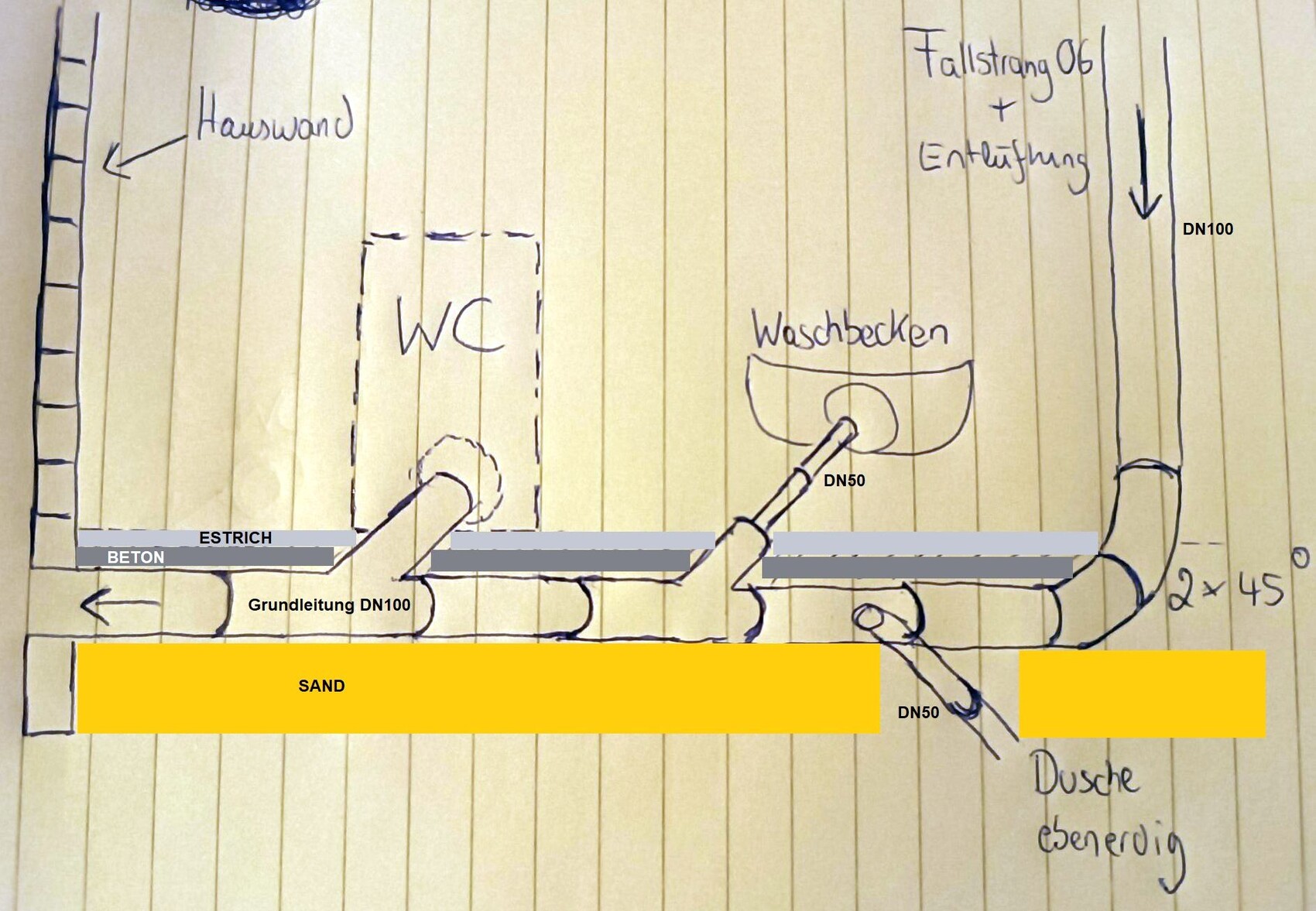
I would appreciate any help regarding the following matter:
As part of a renovation, the relocation or replacement of the wastewater pipes is planned. The house has no basement. It is an older building without a "proper" concrete slab. The original structure was as follows: sand, then approximately 7 cm (3 inches) of concrete, followed by about 7 cm (3 inches) of screed including insulation. The screed has been removed, as well as the concrete in the areas where the main drain pipe is to be installed. This pipe will be laid in a sand bed below the concrete and screed. The wastewater connection enters the house from the side (about 20 cm (8 inches) below the "concrete slab"). From there, a new main drain pipe is to be laid under the screed, connecting on the ground floor to 1 WC, 1 washbasin, and 1 shower. From the new main drain pipe, a soil stack must also be routed to the upper floor (and above the roof) to connect a new bathroom there with a WC, washbasin, and shower, as well as to provide venting through the roof (which was not previously present in the house -.-).
Is it possible to lay everything as shown in the sketch—that is, branches from the main drain pipe upwards for the WC and washbasin, and sideways for the shower, all before the 45° bends of the new soil stack? Or should/does the soil stack first branch off towards the upper floor immediately after entering the house, and only then have the branches for the sanitary fixtures?
If it makes more sense or is better, I could possibly connect the WC and/or washbasin on the ground floor directly to the soil stack (depending on their position) instead of the horizontal main drain pipe. This is not possible for the shower due to limited height.
What would be the most practical pipe layout and why?
Looking forward to your advice. Thank you very much.
Hi,
The solution shown in the sketch works – but: you are placing the branch connections before the 45-degree transition into the soil stack. This often causes flow noise and, at worst, backflow because the airflow in the stack is not properly established. The soil stack should be correctly installed first to ensure proper venting above and to maintain defined pressure conditions in the main drain line. Have you checked if you can connect the toilet on the ground floor directly into the stack? This would significantly ease the horizontal DN100 (4-inch) connection.
The DN50 (2-inch) connections seem fine, but you need to ensure that the minimum slope is maintained, even if there is only a few millimeters (inches) of adjustment possible in your floor construction. And yes, it is common to connect the shower laterally; however, I would recommend positioning it downstream of the stack if the elevation allows. Have you considered if you can fit an inspection section?
Good luck!
The solution shown in the sketch works – but: you are placing the branch connections before the 45-degree transition into the soil stack. This often causes flow noise and, at worst, backflow because the airflow in the stack is not properly established. The soil stack should be correctly installed first to ensure proper venting above and to maintain defined pressure conditions in the main drain line. Have you checked if you can connect the toilet on the ground floor directly into the stack? This would significantly ease the horizontal DN100 (4-inch) connection.
The DN50 (2-inch) connections seem fine, but you need to ensure that the minimum slope is maintained, even if there is only a few millimeters (inches) of adjustment possible in your floor construction. And yes, it is common to connect the shower laterally; however, I would recommend positioning it downstream of the stack if the elevation allows. Have you considered if you can fit an inspection section?
Good luck!
Hey, thanks for your reply. I should be able to connect the toilet and washbasin to the soil stack. I could also place the horizontal branch for the shower after the soil stack. The layout would be: house wall – sanitary sewer pipe with a 45° branch upwards for the soil stack – reduction of the sanitary sewer pipe behind the branch to DN50, then continuing towards the shower. The toilet and washbasin would connect to the soil stack and not branch off the sanitary sewer pipe. Would this be the better approach? Should the reduction of the sanitary sewer pipe to DN50 be at invert level or crown level? Could there be issues with the shower trap? An additional vent for the shower is unfortunately not possible.
Frank78G schrieb:
Is the reduction of the main pipe to DN50 supposed to be at invert level or at crown level? Could there be issues with the shower trap? Installing a separate vent for the shower is unfortunately not possible. It should be done at crown level, meaning the pipe centerline at the same height, to avoid any water pooling or slope problems. If you use invert level, water may collect in the reduction, which is unfavorable for drainage.
Good luck!
I have created another sketch. Would this setup be correct and ideal? Can or should the connections from the toilet and washbasin to the soil stack run horizontally with a 2% slope, or should a vertical drop section be planned first with the connection to the stack at a lower point?


Below the concrete slab, everything should be KG pipes with a diameter of DN 100. Sketches with length measurements would also be helpful, but they don’t need to be exact to the centimeter.
You can position the branch fittings as you prefer, and for the vertical drain pipe, you should use soundproof piping.
Another option to consider is running the KG pipe straight under the concrete slab and having it exit on the opposite side of the house as a cleaning or flushing outlet. This way, you can avoid installing an inspection piece inside the house, which can be more convenient if it needs to be used.
You can position the branch fittings as you prefer, and for the vertical drain pipe, you should use soundproof piping.
Another option to consider is running the KG pipe straight under the concrete slab and having it exit on the opposite side of the house as a cleaning or flushing outlet. This way, you can avoid installing an inspection piece inside the house, which can be more convenient if it needs to be used.
Similar topics