
Hello everyone,
Our house was built in 2014, and as is often the case, unnecessary telephone cables were installed (we bought the house only after completion, so we had no influence during the construction). I would now like to replace the telephone cables with proper network cables, but I was somewhat surprised by how the cables come out of the ceiling in the basement.
I am curious whether this already counts as a defect or is still considered acceptable. Apparently, the entire cable bundle (electrical and telephone cables tangled together) was roughly sealed around the hole in the ceiling with filler, so I would first need to chip that away. To be honest, I have no idea what to expect behind it.
What are your thoughts?
Thanks for any feedback and best regards,
Jens
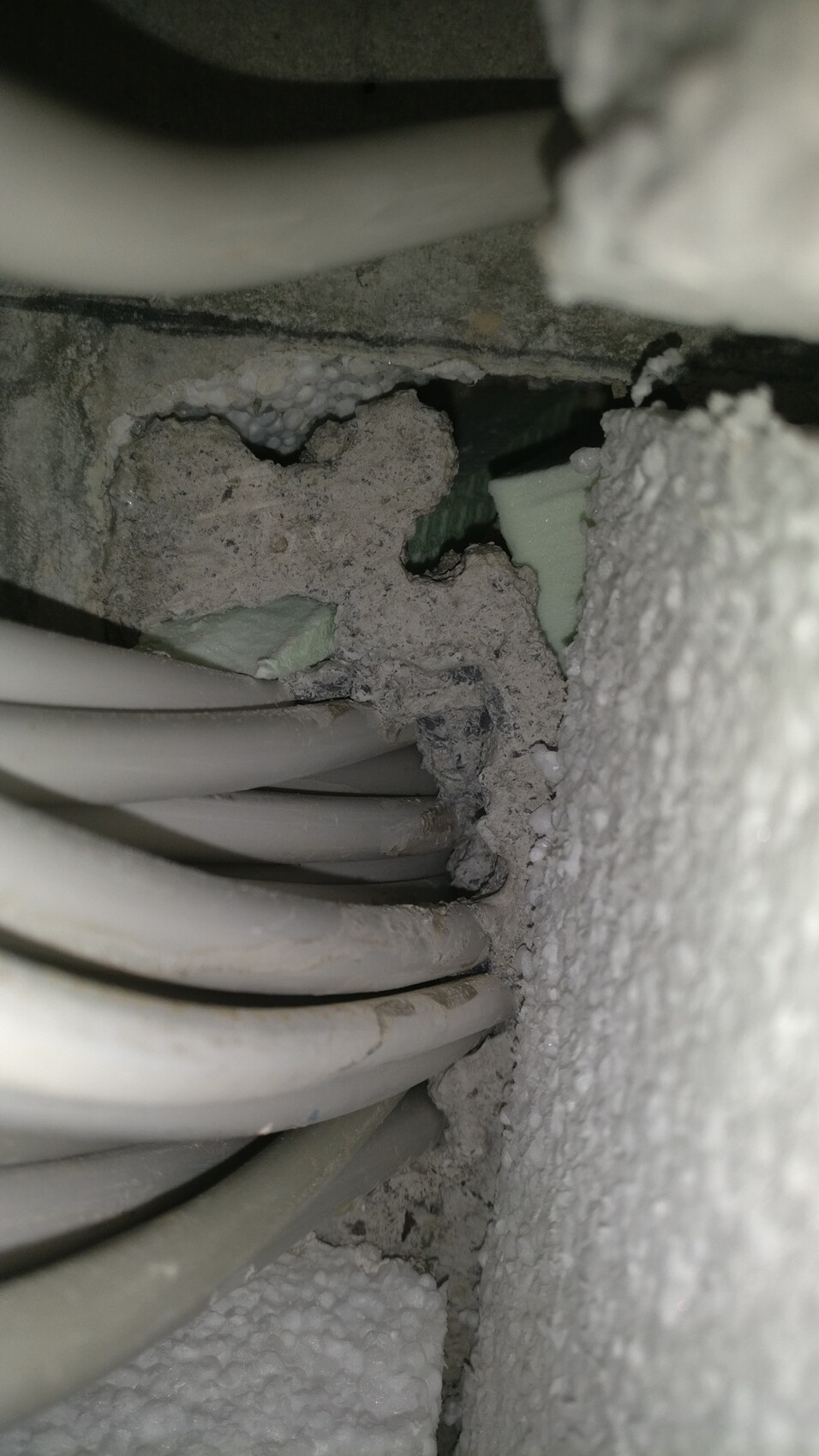
Our house was built in 2014, and as is often the case, unnecessary telephone cables were installed (we bought the house only after completion, so we had no influence during the construction). I would now like to replace the telephone cables with proper network cables, but I was somewhat surprised by how the cables come out of the ceiling in the basement.
I am curious whether this already counts as a defect or is still considered acceptable. Apparently, the entire cable bundle (electrical and telephone cables tangled together) was roughly sealed around the hole in the ceiling with filler, so I would first need to chip that away. To be honest, I have no idea what to expect behind it.
What are your thoughts?
Thanks for any feedback and best regards,
Jens
H
HilfeHilfe23 Aug 2018 16:40hm
V
vaplja3ag04 Sep 2018 12:05The question is whether it counts as a hidden defect if you only discover that the cables were improperly installed when trying to replace them.
But the issue resolved itself because the 12-core telephone cable actually works as a gigabit network cable :-). So I didn’t have to replace it after all.
But the issue resolved itself because the 12-core telephone cable actually works as a gigabit network cable :-). So I didn’t have to replace it after all.
vaplja3ag0 schrieb:
The question is whether it counts as a hidden defect if you only realize when trying to replace the cables that they were not installed properly.
But the issue was resolved because the 12-conductor telephone cable actually works as a Gigabit network cable 🙂. So I didn’t have to replace it.Are you absolutely sure? And if so, lucky you...and over what distance exactly?
V
vaplja3ag04 Sep 2018 14:15Domski schrieb:
Completely sure? And if so, lucky you... and over what distance exactly? So far, I have connected three rooms. Living room (ground floor), guest room (1st floor; router is located here – FritzBox 6490), and gallery (2nd floor). The cables come together in the basement and connect to a Cat6 patch panel there. The network outlets and all cables used are at least CAT6.
Initially, I only wanted to connect the living room to the router on the 1st floor, so I just connected both outlets in the basement at the patch panel. The media PC in the living room then showed 100 Mbps, which it fully utilized during speed tests. To also include the gallery and later move the NAS to the basement, I installed a gigabit switch in the basement and connected it to the three outlets on the patch panel. After that, both the media PC in the living room and the workstation in the gallery each showed gigabit speeds.
The speed test from the gallery PC to the NAS on the 1st floor ran consistently at 111 MB/s.
Cable lengths: gallery PC -> outlet: 15 m (50 feet) CAT7, then approximately 15 m (50 feet) telephone cable to the switch. From the switch about 10 m (33 feet) telephone cable to the 1st floor, then 5 m (16 feet) CAT6 to the FritzBox, and about 1 m (3 feet) CAT6 from FritzBox to NAS.
I was quite surprised myself but had previously read that telephone cables often perform better in practice than theory would suggest.
Similar topics