
Hello,
I recently bought a townhouse and am currently planning the renovation.
Just to mention upfront, I am a complete beginner in this area.
On the ground floor (living and dining rooms), there are currently tiles. Since I want the floor to be warm for my children, I am looking for a cost-effective way to achieve this.
Here are some details: The building was constructed in 1986, the living and dining area is about 30m² (323ft²), and below are partly heated basement rooms.
According to the building specifications: "Reinforced concrete ceilings according to structural engineering, vapor barrier, 36/30 insulation, vapor barrier, 4cm (1.6 inch) screed."
For the floor covering, I was considering either PVC-free click-design flooring (because of access to the terrace) or click-lock parquet flooring.
All the suppliers I contacted recommend the milling method.
However, do I really need underfloor heating to avoid having a cold floor for the children?
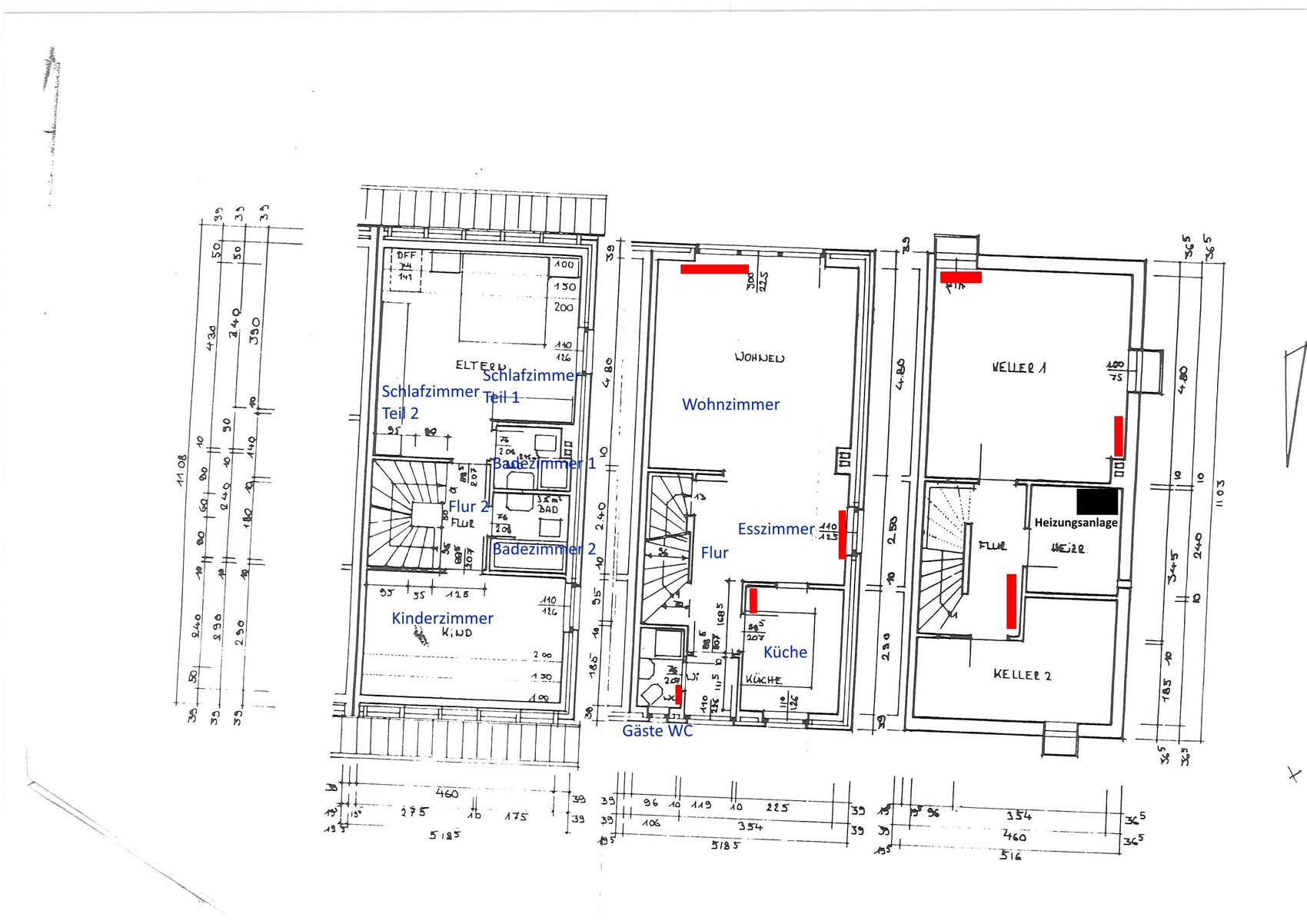
Attached is the floor plan. I have marked the radiators on the ground floor and basement in red in the attached image.
I recently bought a townhouse and am currently planning the renovation.
Just to mention upfront, I am a complete beginner in this area.
On the ground floor (living and dining rooms), there are currently tiles. Since I want the floor to be warm for my children, I am looking for a cost-effective way to achieve this.
Here are some details: The building was constructed in 1986, the living and dining area is about 30m² (323ft²), and below are partly heated basement rooms.
According to the building specifications: "Reinforced concrete ceilings according to structural engineering, vapor barrier, 36/30 insulation, vapor barrier, 4cm (1.6 inch) screed."
For the floor covering, I was considering either PVC-free click-design flooring (because of access to the terrace) or click-lock parquet flooring.
All the suppliers I contacted recommend the milling method.
However, do I really need underfloor heating to avoid having a cold floor for the children?
Attached is the floor plan. I have marked the radiators on the ground floor and basement in red in the attached image.
Try creating a comparison calculation. Which radiators should or need to be replaced?
Completely removing a radiator from a room is, to put it mildly, nonsensical. The room MUST be heated somehow. Even if it’s in the least efficient way, for example, through heat from adjacent rooms.
Fireplace or not, is it actually used? And if so, what kind of wood? If you have to buy wood, you don’t save anything at all and end up with extra work and mess.
Is the central heating system also going to be replaced?
What other work do you plan to do on the house?
Completely removing a radiator from a room is, to put it mildly, nonsensical. The room MUST be heated somehow. Even if it’s in the least efficient way, for example, through heat from adjacent rooms.
Fireplace or not, is it actually used? And if so, what kind of wood? If you have to buy wood, you don’t save anything at all and end up with extra work and mess.
Is the central heating system also going to be replaced?
What other work do you plan to do on the house?
 Kurpfaelzer12 Jul 2019 14:02
A nice, non-cold flooring option is vinyl. We installed click vinyl in the hallway, dining room, and kitchen, with more rooms to follow. It doesn’t feel as cold as tiles. It’s comfortable to walk on with socks. How often you walk barefoot on it also depends on the room temperature.
If you decide to install underfloor heating, a traditional radiator is still recommended because underfloor heating cannot quickly raise the room temperature. In the dining room, we have both underfloor heating and a traditional radiator.
If you decide to install underfloor heating, a traditional radiator is still recommended because underfloor heating cannot quickly raise the room temperature. In the dining room, we have both underfloor heating and a traditional radiator.
Kurpfaelzer12 Jul 2019 14:26It runs for us with the same flow temperature. There is a control valve before the underfloor heating that limits the flow rate, thereby keeping the temperature in check. This was recommended to us when retrofitting.
If you are not at home all day, a constant temperature X is sufficient for me, although it might seem too low in the evening or during an unexpected visit. That’s when the heating kicks in.
If you are not at home all day, a constant temperature X is sufficient for me, although it might seem too low in the evening or during an unexpected visit. That’s when the heating kicks in.
Similar topics