
ᐅ Wardrobe with or without doors? Experiences and long-term reports?
Created on: 2 Jul 2017 11:17
E
EldeaHello everyone,
we are currently planning our bedroom and have a fundamental question: open wardrobe or a model with doors? In our last apartment, we had a free-standing clothes rail; due to two pregnancies, some items remained unworn for over two years and ended up dusty. Since then, I think a closed solution is the more sensible choice, especially for rarely used pieces.
At the moment, we don’t have a controlled ventilation system, but likely will in the future. Is mechanical ventilation (MV) enough to keep an open wardrobe clean, or does a model with fronts provide more reliable protection against dust, light, and odors? For me, the advantages of doors are: less cleaning, a calmer appearance, and some sound dampening. The downside is that an open system allows quicker access to outfits, encourages tidiness, and saves budget. The walk-in option appeals to me visually because it feels light and saves space. A middle ground could be a wardrobe with sliding doors, louvered doors, or even a curtain.
I would be interested in your experiences regarding moisture and mold on exterior walls behind large wardrobes, odors from the kitchen or bathroom, pets, and children’s hands. Which interior layout stays tidy the longest for you: drawers, baskets, closed boxes inside the wardrobe? Does anyone use ventilation grilles or small fans in their wardrobe solution to promote air circulation?
Budget is also a concern for me. Is a custom-made solution worth it compared to a system like Pax, especially in terms of stability, fittings, soft-close mechanisms, and lighting with motion sensors? If doors are chosen: hinged or sliding—how practical are they really for everyday use, also in narrow rooms?
I’m still leaning toward a closed wardrobe but am open to good counterarguments, photos, and care tips. How often do you wipe doors and floors, which cloths work well, and does anyone use anti-static spray?
Thank you for your experiences and also for any long-term reports.
we are currently planning our bedroom and have a fundamental question: open wardrobe or a model with doors? In our last apartment, we had a free-standing clothes rail; due to two pregnancies, some items remained unworn for over two years and ended up dusty. Since then, I think a closed solution is the more sensible choice, especially for rarely used pieces.
At the moment, we don’t have a controlled ventilation system, but likely will in the future. Is mechanical ventilation (MV) enough to keep an open wardrobe clean, or does a model with fronts provide more reliable protection against dust, light, and odors? For me, the advantages of doors are: less cleaning, a calmer appearance, and some sound dampening. The downside is that an open system allows quicker access to outfits, encourages tidiness, and saves budget. The walk-in option appeals to me visually because it feels light and saves space. A middle ground could be a wardrobe with sliding doors, louvered doors, or even a curtain.
I would be interested in your experiences regarding moisture and mold on exterior walls behind large wardrobes, odors from the kitchen or bathroom, pets, and children’s hands. Which interior layout stays tidy the longest for you: drawers, baskets, closed boxes inside the wardrobe? Does anyone use ventilation grilles or small fans in their wardrobe solution to promote air circulation?
Budget is also a concern for me. Is a custom-made solution worth it compared to a system like Pax, especially in terms of stability, fittings, soft-close mechanisms, and lighting with motion sensors? If doors are chosen: hinged or sliding—how practical are they really for everyday use, also in narrow rooms?
I’m still leaning toward a closed wardrobe but am open to good counterarguments, photos, and care tips. How often do you wipe doors and floors, which cloths work well, and does anyone use anti-static spray?
Thank you for your experiences and also for any long-term reports.

Hey, I’m familiar with both options in everyday use and would clearly lean towards doors in your situation. Open shelves look great on the first day, but after a few weeks, they quickly start to look cluttered. With doors, the room feels calmer, and you can simply close them at night when the day has been chaotic.
In practice: don’t place the wardrobe directly against the exterior wall—leave about a hand’s width of air space. Occasionally check the back to see if it feels damp, and if so, move it slightly forward. With a ventilation system, the air quality is generally better, but an open wardrobe still attracts dust, especially on items you rarely use.
Hinged doors are the easiest to manage daily. You have full access at once, and they are quiet, which is a big advantage in the morning or late at night when someone is still sleeping. Sliding doors save space, but you only have access to one side at a time. You only notice that after using them day to day.
Inside, less openness is better. Many drawers and a few closed boxes keep things tidier than endless shelves. Store seasonal items on top, everyday pieces at hand height, and favorite things in a fixed spot you can find blindly. Pets and kids are also a consideration. Doors prevent the cat from making itself comfortable in the wool sweater or a toddler from starting a new stacking challenge every morning.
Odors and light exposure are often underestimated. Doors keep cooking smells out and reduce fading of dark clothes by the window. A small motion-activated light inside the wardrobe is convenient—you can find everything without flooding the room with light.
If you like a compromise, plan a narrow open section for the week’s outfits and close off the rest. This keeps the look calm, gives quick access, and still makes daily life easier.
In practice: don’t place the wardrobe directly against the exterior wall—leave about a hand’s width of air space. Occasionally check the back to see if it feels damp, and if so, move it slightly forward. With a ventilation system, the air quality is generally better, but an open wardrobe still attracts dust, especially on items you rarely use.
Hinged doors are the easiest to manage daily. You have full access at once, and they are quiet, which is a big advantage in the morning or late at night when someone is still sleeping. Sliding doors save space, but you only have access to one side at a time. You only notice that after using them day to day.
Inside, less openness is better. Many drawers and a few closed boxes keep things tidier than endless shelves. Store seasonal items on top, everyday pieces at hand height, and favorite things in a fixed spot you can find blindly. Pets and kids are also a consideration. Doors prevent the cat from making itself comfortable in the wool sweater or a toddler from starting a new stacking challenge every morning.
Odors and light exposure are often underestimated. Doors keep cooking smells out and reduce fading of dark clothes by the window. A small motion-activated light inside the wardrobe is convenient—you can find everything without flooding the room with light.
If you like a compromise, plan a narrow open section for the week’s outfits and close off the rest. This keeps the look calm, gives quick access, and still makes daily life easier.
Yes, dust tends to settle on open shelves over time, even or especially with a ventilation system. But in my old closet, dust also accumulated.
A walk-in closet or dressing room has the advantage that you can see and scan your clothes at a glance.
Having a separate room just for a wardrobe seems somewhat pointless. It’s like having a wallet for your wallet, so to speak.
Regards, Yvonne
A walk-in closet or dressing room has the advantage that you can see and scan your clothes at a glance.
Having a separate room just for a wardrobe seems somewhat pointless. It’s like having a wallet for your wallet, so to speak.
Regards, Yvonne

Hi,
Yvonne’s comparison is a bit off, since a wallet specifically protects against what otherwise lies around everywhere. A mechanical ventilation system reduces moisture and removes odors, but it does not filter out dust caused by textiles. An open system means visible deposits on every surface and edge, while closed fronts slow this down and additionally protect against UV rays, cooking odors, and pet hair. If you want a quick overview, you can create it intentionally with a narrow open section and close off the rest, instead of opening up the entire room.
Moisture on exterior walls remains a building physics issue, regardless of the wardrobe model. Distance from the outside wall, air circulation at the top and bottom, and indoor air humidity between 40 and 55 percent keep the risk under control. A fully sealed back panel directly on a cold wall surface is not ideal; it’s better to allow a surrounding gap or passive ventilation through the base and crown areas. Active fans inside the wardrobe are more of a gimmick, as they tend to draw dust into the unit and cause noise.
For interior organization, order lasts longest when small items go into drawers and only hanging clothes remain openly visible. Deep compartments without divisions inevitably become stacking traps. Knitwear belongs on shelves with a front lip, pants on pull-out racks or clamp hangers, and seasonal items in closed boxes with labels. For lighting, 24-volt LED profiles with door contact switches work better than motion detectors inside the wardrobe; use a color temperature around 3000 Kelvin (5400°F) and high color rendering, otherwise colors look odd in the morning.
A highlight topic: doors. Hinged doors clearly have the advantage for daily use, because you get the full width at once and no floor track that gets dirty. Sliding doors are the solution in very narrow walkways, but then they should run on top with brush seals; otherwise you get dust gaps and rattling noises. Slatted fronts and curtains look airy but hardly filter dust and odors; this is more about appearance than function.
PAX systems work cleanly as long as you stay within standard dimensions and don’t want flush, ceiling-height units. Custom work pays off if you want flush fronts up to the ceiling with a proper shadow gap, consistent 19-millimeter (3/4 inch) carcass sides, solid back panels, and high-quality fittings with a defined cycle count. Soft-close is not a luxury but a noise and wear reducer. If you plan not to have to deal with fittings again in ten years, a carpenter is the better choice.
Maintenance is simple: slightly damp microfiber cloth, wipe dry afterwards, no silicone or antistatic sprays as they create films and attract more dust. Clean fronts every few weeks and interior surfaces seasonally during rearranging. And yes, pets and kids’ fingerprints are an argument for doors—it saves arguments and lint rollers.
Would you share the room data, such as the width of the walkway in front of the wardrobe, ceiling height, location of the exterior wall, whether the ventilation system supplies fresh air to the bedroom, and your budget range for the wardrobe solution? Then it’s possible to decide whether hinged doors are practical or if a well-executed sliding system is the better choice.
Yvonne’s comparison is a bit off, since a wallet specifically protects against what otherwise lies around everywhere. A mechanical ventilation system reduces moisture and removes odors, but it does not filter out dust caused by textiles. An open system means visible deposits on every surface and edge, while closed fronts slow this down and additionally protect against UV rays, cooking odors, and pet hair. If you want a quick overview, you can create it intentionally with a narrow open section and close off the rest, instead of opening up the entire room.
Moisture on exterior walls remains a building physics issue, regardless of the wardrobe model. Distance from the outside wall, air circulation at the top and bottom, and indoor air humidity between 40 and 55 percent keep the risk under control. A fully sealed back panel directly on a cold wall surface is not ideal; it’s better to allow a surrounding gap or passive ventilation through the base and crown areas. Active fans inside the wardrobe are more of a gimmick, as they tend to draw dust into the unit and cause noise.
For interior organization, order lasts longest when small items go into drawers and only hanging clothes remain openly visible. Deep compartments without divisions inevitably become stacking traps. Knitwear belongs on shelves with a front lip, pants on pull-out racks or clamp hangers, and seasonal items in closed boxes with labels. For lighting, 24-volt LED profiles with door contact switches work better than motion detectors inside the wardrobe; use a color temperature around 3000 Kelvin (5400°F) and high color rendering, otherwise colors look odd in the morning.
A highlight topic: doors. Hinged doors clearly have the advantage for daily use, because you get the full width at once and no floor track that gets dirty. Sliding doors are the solution in very narrow walkways, but then they should run on top with brush seals; otherwise you get dust gaps and rattling noises. Slatted fronts and curtains look airy but hardly filter dust and odors; this is more about appearance than function.
PAX systems work cleanly as long as you stay within standard dimensions and don’t want flush, ceiling-height units. Custom work pays off if you want flush fronts up to the ceiling with a proper shadow gap, consistent 19-millimeter (3/4 inch) carcass sides, solid back panels, and high-quality fittings with a defined cycle count. Soft-close is not a luxury but a noise and wear reducer. If you plan not to have to deal with fittings again in ten years, a carpenter is the better choice.
Maintenance is simple: slightly damp microfiber cloth, wipe dry afterwards, no silicone or antistatic sprays as they create films and attract more dust. Clean fronts every few weeks and interior surfaces seasonally during rearranging. And yes, pets and kids’ fingerprints are an argument for doors—it saves arguments and lint rollers.
Would you share the room data, such as the width of the walkway in front of the wardrobe, ceiling height, location of the exterior wall, whether the ventilation system supplies fresh air to the bedroom, and your budget range for the wardrobe solution? Then it’s possible to decide whether hinged doors are practical or if a well-executed sliding system is the better choice.
B
Bieber081513 Jul 2017 00:45Hi,
Open designs feel light, while closed ones feel substantial. A mechanical ventilation system (MVHR) removes moisture and odors from the room but does not keep textile-based dust off surfaces. This is where open systems tend to look tired more quickly. I understand Yvonne’s point—the quick overview is nice, but a walk-in closet isn’t just a gimmick; it acts as a buffer zone for light, sound, and odors. That’s why you accept the fronts.
If you like the walk-in look, design a calm exterior shell and work with lighting inside instead of leaving it open. Matte, closed fronts with clean edge profiles, a minimal door gap, and a brush seal at the top noticeably reduce dust entry. For narrow rooms, a top-hung sliding system makes sense, but only with proper overlap and soft-close; otherwise, you’ll be frustrated reaching on the wrong side. Hinged doors are easier for daily use if you realistically have at least 80cm (31.5 inches) of free movement space in front. Glass fronts only if UV protection is guaranteed—otherwise, in a year, you’ll notice two shades of black on the stack.
Mold behind large cabinets doesn’t form because of the doors in front but because the wall surface remains too cold and the air doesn’t circulate there. A few centimeters of gap, a recessed plinth, and a non-fully-adhered back panel are key. A small hygrometer and an infrared thermometer behind the cabinet quickly dispel concerns. Active fans built into the carcass may seem clever on paper but tend to collect dust and create noise in practice. Passive air circulation is more reliable.
The interior stays tidy longer if the reachable height consists of drawers and hanging garments are clearly separated. Knitwear should be stored folded, pants on pull-out racks or clamp hangers, seasonal items in labeled closed boxes; otherwise, you’ll be reorganizing the same three piles every week. Pay attention to reasonable segment widths; anything wider than about one meter (3.3 feet) tends to hang and wobble. Cabinet lighting should use 24 volts, have a good color rendering index, and door-contact switches. Motion sensors inside the cabinet react to everything except when you’re actually standing in front of them.
About PAX and custom sizes: If you can live with standard heights and a visible ceiling trim, you get solid functionality for the price. When aiming for ceiling flush, minimal joints, and acoustic quietness, a solid carcass, sturdy back panel, and high-quality fittings come into their own. Soft-close is not a luxury but reduces noise and wear. Fingerprints are best avoided with matte, lightly textured surfaces rather than any cleaning routine.
Pets and kids’ hands are ultimately a practical argument for fronts. Doors already solve two problems before the first coffee in the morning.
Can you say how wide the walkway in front of the cabinet will be, where the MVHR supply air is located in the room, and how the windows are oriented? This will determine whether hinged doors work comfortably or a well-designed sliding solution is really necessary.
Open designs feel light, while closed ones feel substantial. A mechanical ventilation system (MVHR) removes moisture and odors from the room but does not keep textile-based dust off surfaces. This is where open systems tend to look tired more quickly. I understand Yvonne’s point—the quick overview is nice, but a walk-in closet isn’t just a gimmick; it acts as a buffer zone for light, sound, and odors. That’s why you accept the fronts.
If you like the walk-in look, design a calm exterior shell and work with lighting inside instead of leaving it open. Matte, closed fronts with clean edge profiles, a minimal door gap, and a brush seal at the top noticeably reduce dust entry. For narrow rooms, a top-hung sliding system makes sense, but only with proper overlap and soft-close; otherwise, you’ll be frustrated reaching on the wrong side. Hinged doors are easier for daily use if you realistically have at least 80cm (31.5 inches) of free movement space in front. Glass fronts only if UV protection is guaranteed—otherwise, in a year, you’ll notice two shades of black on the stack.
Mold behind large cabinets doesn’t form because of the doors in front but because the wall surface remains too cold and the air doesn’t circulate there. A few centimeters of gap, a recessed plinth, and a non-fully-adhered back panel are key. A small hygrometer and an infrared thermometer behind the cabinet quickly dispel concerns. Active fans built into the carcass may seem clever on paper but tend to collect dust and create noise in practice. Passive air circulation is more reliable.
The interior stays tidy longer if the reachable height consists of drawers and hanging garments are clearly separated. Knitwear should be stored folded, pants on pull-out racks or clamp hangers, seasonal items in labeled closed boxes; otherwise, you’ll be reorganizing the same three piles every week. Pay attention to reasonable segment widths; anything wider than about one meter (3.3 feet) tends to hang and wobble. Cabinet lighting should use 24 volts, have a good color rendering index, and door-contact switches. Motion sensors inside the cabinet react to everything except when you’re actually standing in front of them.
About PAX and custom sizes: If you can live with standard heights and a visible ceiling trim, you get solid functionality for the price. When aiming for ceiling flush, minimal joints, and acoustic quietness, a solid carcass, sturdy back panel, and high-quality fittings come into their own. Soft-close is not a luxury but reduces noise and wear. Fingerprints are best avoided with matte, lightly textured surfaces rather than any cleaning routine.
Pets and kids’ hands are ultimately a practical argument for fronts. Doors already solve two problems before the first coffee in the morning.
Can you say how wide the walkway in front of the cabinet will be, where the MVHR supply air is located in the room, and how the windows are oriented? This will determine whether hinged doors work comfortably or a well-designed sliding solution is really necessary.
D
daniels8730 Jul 2017 00:44We have a "walk-in" closet with 4m (13 feet) of Pax units. We’ve been living in the house for 8 months, and the dust buildup is quite manageable.
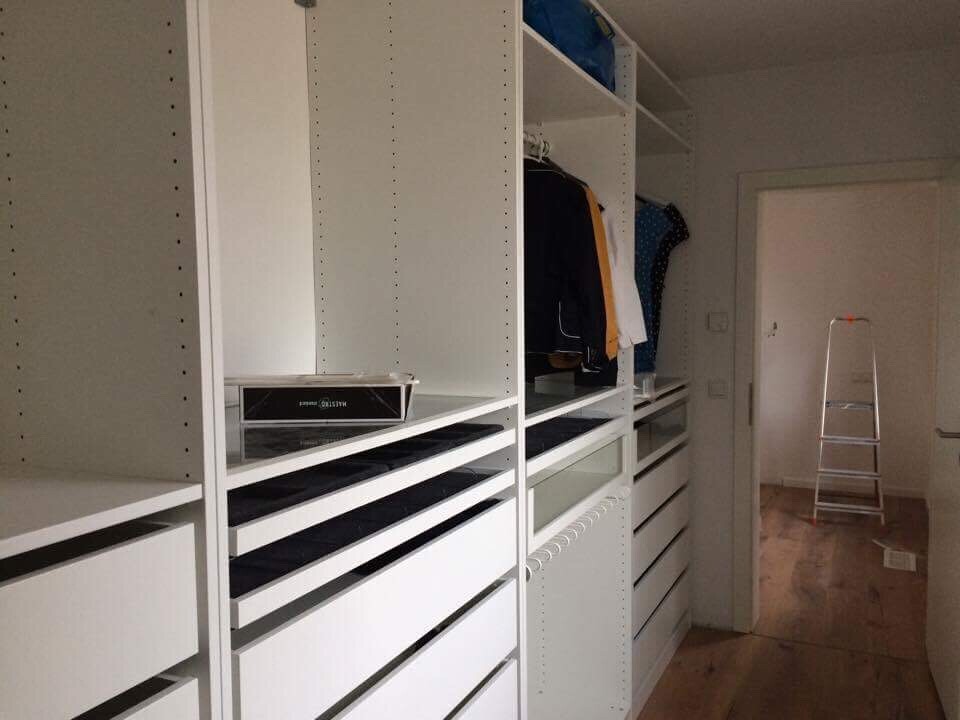
This was right after assembly.
I would have integrated the closet into the bedroom, but my wife didn’t want that. In hindsight, I’m glad we didn’t – it leaves more space, and the bedroom remains just a bedroom.
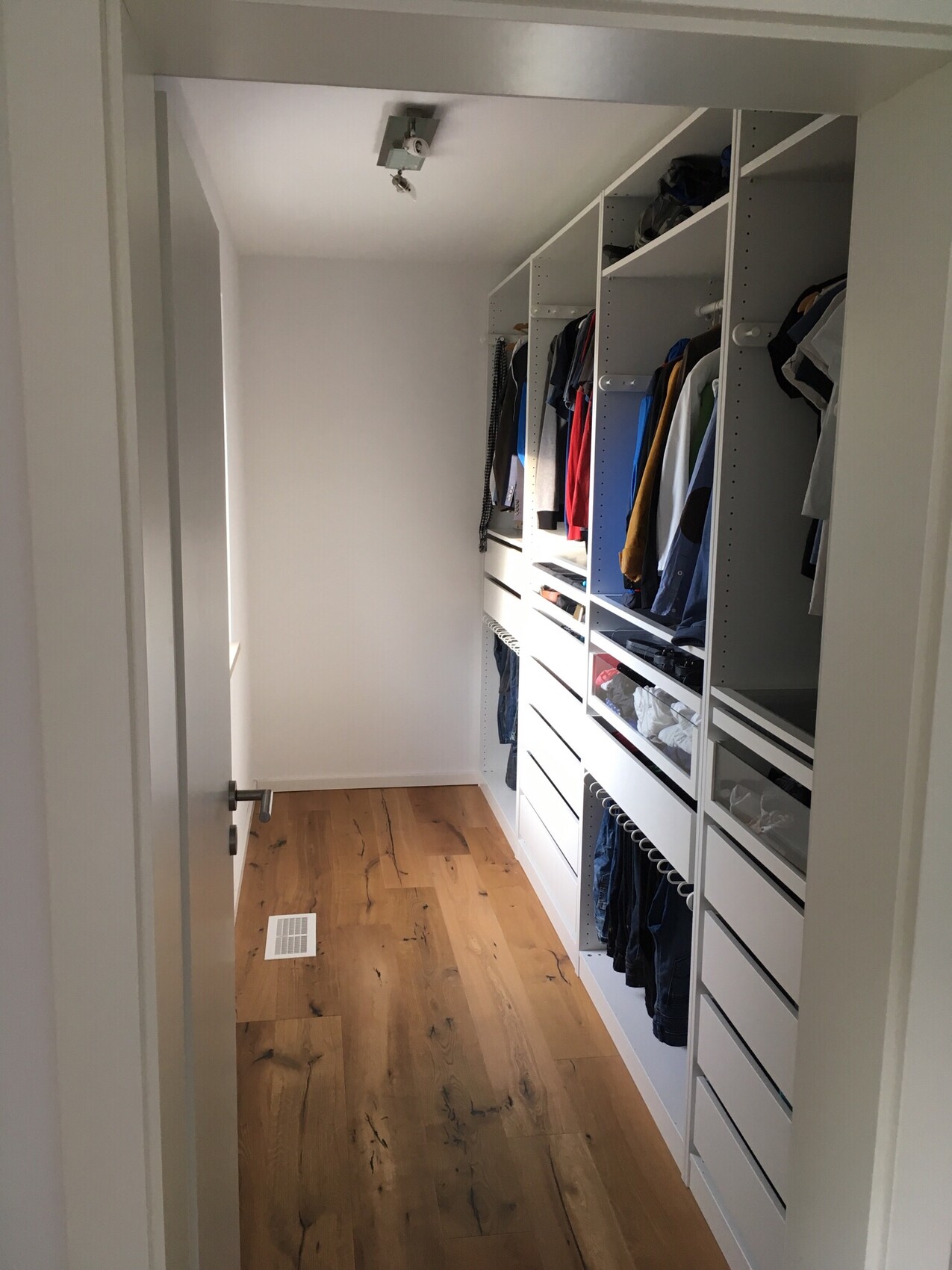
This was right after assembly.
I would have integrated the closet into the bedroom, but my wife didn’t want that. In hindsight, I’m glad we didn’t – it leaves more space, and the bedroom remains just a bedroom.
Similar topics