
ᐅ Wall penetration for heat pump in a timber frame exterior wall
Created on: 8 Jul 2024 10:12
B
BarnhouseB
Barnhouse8 Jul 2024 10:12Hello,
Are there special wall sleeves for timber frame walls? I need to run cables for a heat pump through the exterior wall, a diameter of 50-60mm (2-2.4 inches) would be sufficient. I am especially interested in which sealant I can use to properly seal everything.
Best regards
Jens
Are there special wall sleeves for timber frame walls? I need to run cables for a heat pump through the exterior wall, a diameter of 50-60mm (2-2.4 inches) would be sufficient. I am especially interested in which sealant I can use to properly seal everything.
Best regards
Jens
Depending on the wall construction, you need to properly seal both sides, meaning the airtight layer on the inside at the vapor retarder plus moisture-proofing on the outside (I assume this is under the external thermal insulation composite system, ETICS).
You can do everything with Siga Rissan tape, but there are also prefabricated sealing collars that, in my opinion, work better, for example from the company Eisedicht. They have several versions depending on the type of substrate and how you want to finish the penetration, especially on the exterior.
These are much easier to integrate with existing waterproofing and surface finishes.
You can do everything with Siga Rissan tape, but there are also prefabricated sealing collars that, in my opinion, work better, for example from the company Eisedicht. They have several versions depending on the type of substrate and how you want to finish the penetration, especially on the exterior.
These are much easier to integrate with existing waterproofing and surface finishes.
B
Barnhouse8 Jul 2024 19:53Primarily, there are two insulated copper pipes that need to go through the wall, plus one electrical cable. My question is, what type of pipe should I use to pass through the wall—just a standard PVC drain pipe (HT pipe)—and how do I seal the gap around the pipe inside the wall?
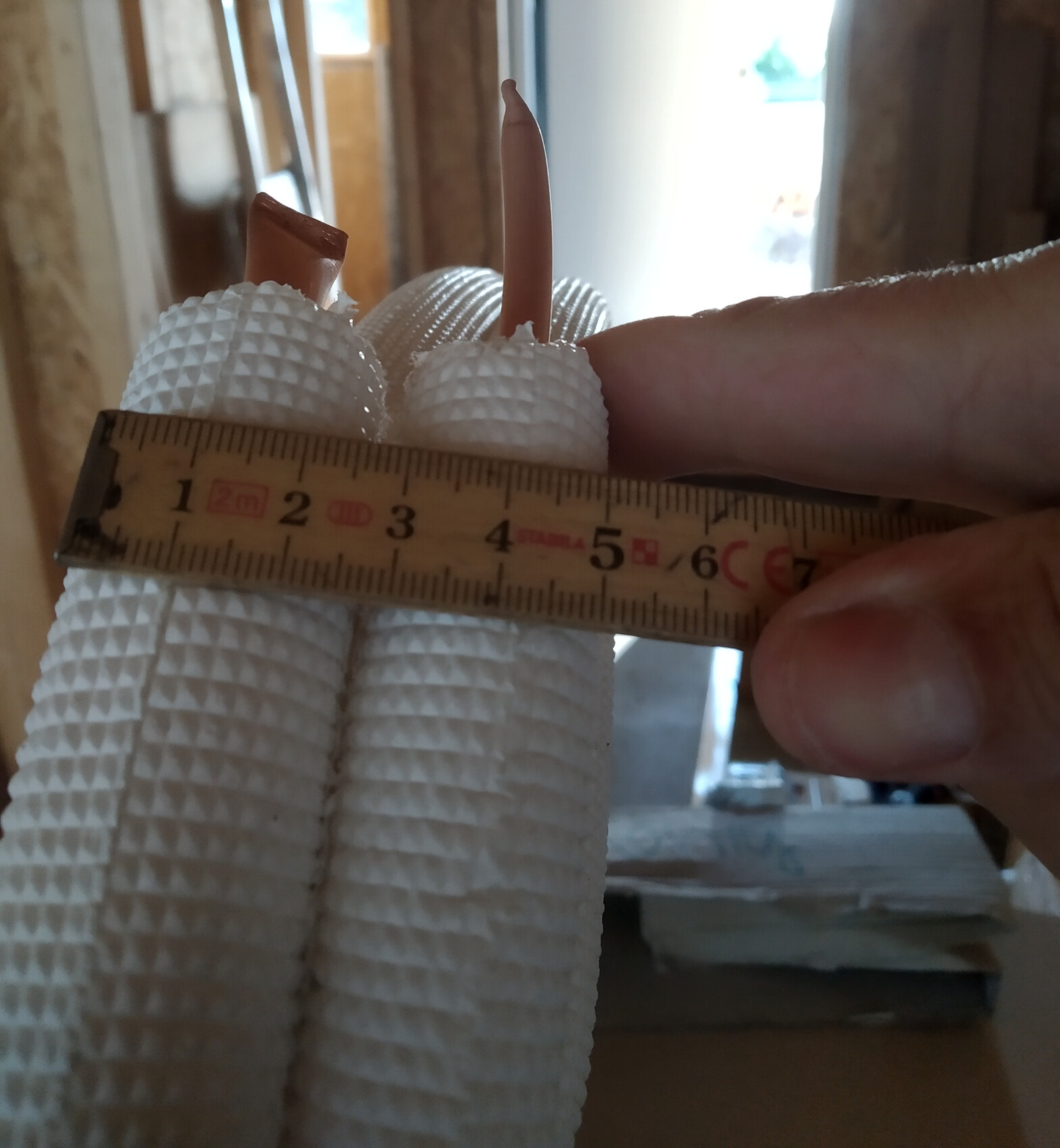
The question is why you want to have an additional pipe – then you face the challenge of sealing both the connection point where the external pipe penetrates the wall (which can be done using sleeves as described above) and the interior side. For the latter, ring seals are generally used, which can accommodate different cable or pipe diameters while providing a reliable seal. Since these are almost always designed for core drill holes or pipe sleeves, it’s better to use a KG2000 pipe as a penetration to better withstand the pressure exerted by the seal – there are some manufacturers who approve this configuration.
Basically, you can also run the 2 pipes and 1 cable separately and seal them as described earlier. This is quite easy with timber stud walls; the OSB boards can be drilled very precisely. This way, you also benefit from having insulation packed between the studs around the cable space, instead of a somewhat larger diameter as with pipe penetrations, which usually remain empty inside.
The only advantage of the pipe solution that I can think of immediately is that, theoretically, you can later install other connections through it, meaning it is accessible for future modifications.
Basically, you can also run the 2 pipes and 1 cable separately and seal them as described earlier. This is quite easy with timber stud walls; the OSB boards can be drilled very precisely. This way, you also benefit from having insulation packed between the studs around the cable space, instead of a somewhat larger diameter as with pipe penetrations, which usually remain empty inside.
The only advantage of the pipe solution that I can think of immediately is that, theoretically, you can later install other connections through it, meaning it is accessible for future modifications.
Similar topics