
Hello,
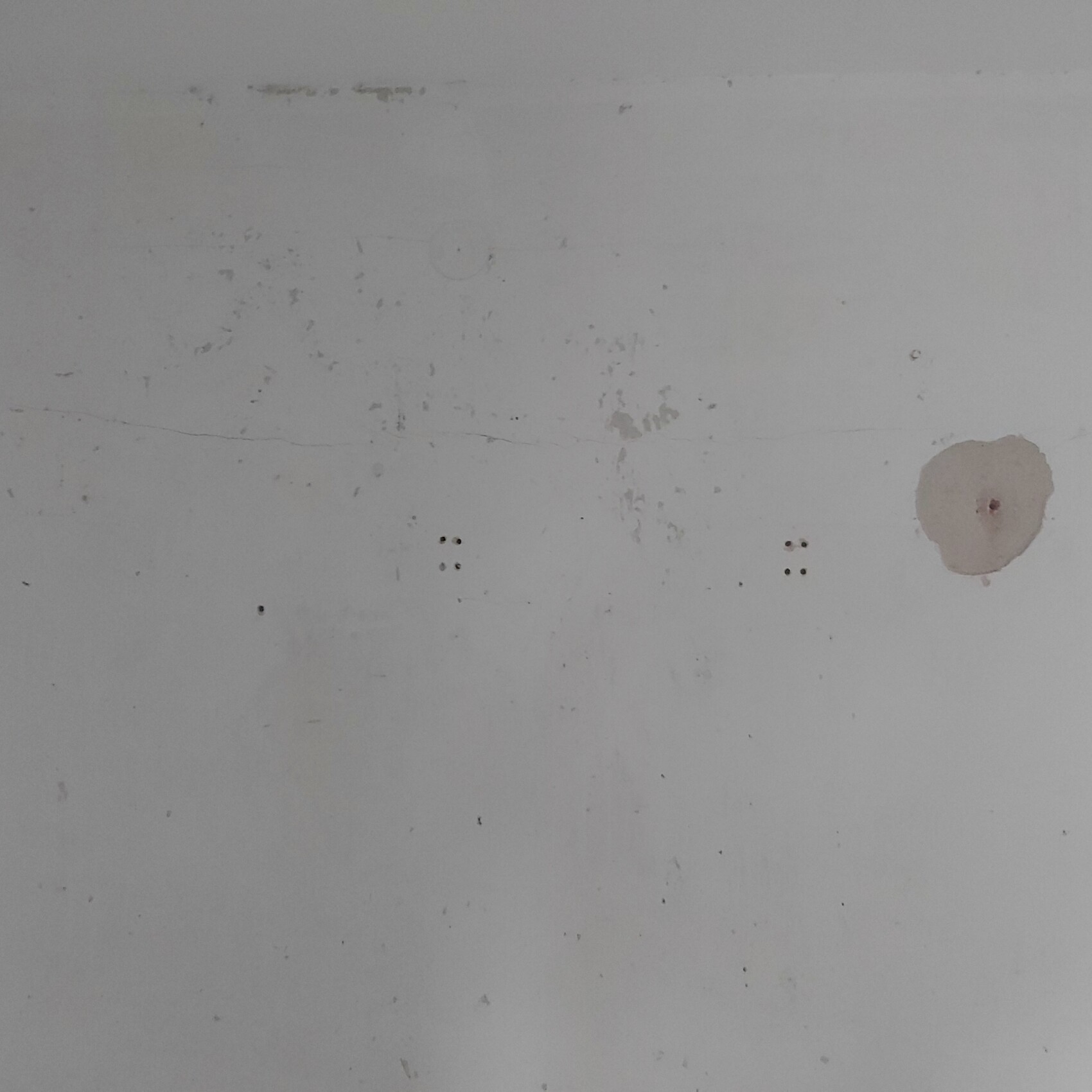
I removed the textured wallpaper from an apartment built in the 1970s. Underneath, there is a single-layer gypsum plaster that has cracks and holes in some areas.
I initially didn’t want to install wallpaper again, so I discussed with the plasterer about embedding a reinforcing mesh and then applying filler to create a smooth, paint-ready surface.
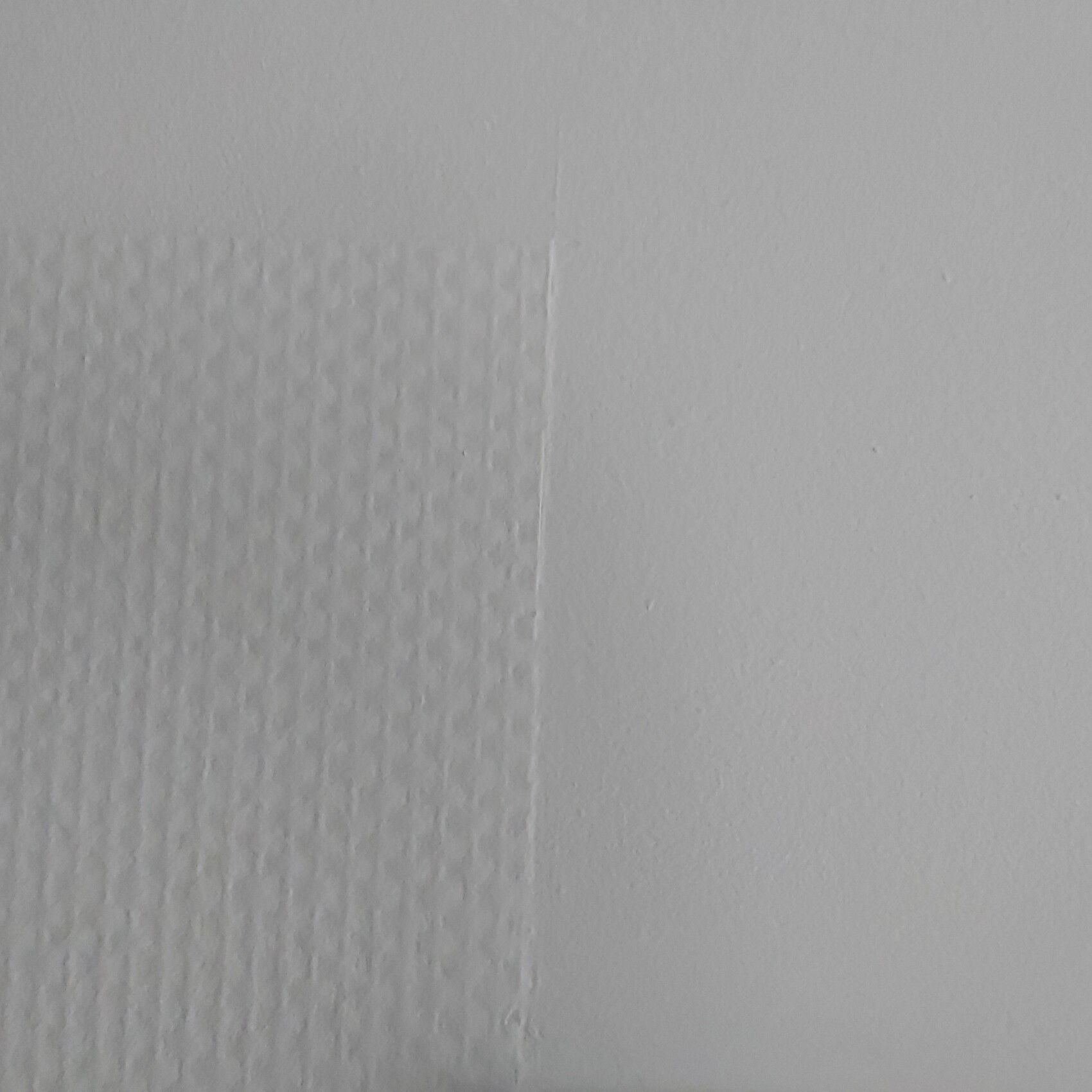
However, the cost for this turned out to be higher than expected, so I now want to install wallpaper again, but definitely not textured wallpaper. I saw a wallpaper with a grid-like pattern in a new build that looks nice to me and has some texture (so it’s not completely smooth), where the difference to painted plaster is very minimal in my opinion; see image: wallpaper on the left, painted gypsum plaster on the right.
The condition of the apartment is shown in the following pictures.
How can I achieve the condition shown in the first image?
1. Sand the wall/ceiling, fill holes in the wall, and then wallpaper directly, or
2. Sand the wall/ceiling, apply painting fleece (also known as scrim or wall lining fabric), and then wallpaper?
For option 2, I am curious how much the fleece affects the surface under the wallpaper. As shown in the picture, the door frame is a steel frame and is not protruding much. I want to avoid the wall being flush with the door frame afterward. The frame should still stand out slightly.

I removed the textured wallpaper from an apartment built in the 1970s. Underneath, there is a single-layer gypsum plaster that has cracks and holes in some areas.
I initially didn’t want to install wallpaper again, so I discussed with the plasterer about embedding a reinforcing mesh and then applying filler to create a smooth, paint-ready surface.
However, the cost for this turned out to be higher than expected, so I now want to install wallpaper again, but definitely not textured wallpaper. I saw a wallpaper with a grid-like pattern in a new build that looks nice to me and has some texture (so it’s not completely smooth), where the difference to painted plaster is very minimal in my opinion; see image: wallpaper on the left, painted gypsum plaster on the right.
The condition of the apartment is shown in the following pictures.
How can I achieve the condition shown in the first image?
1. Sand the wall/ceiling, fill holes in the wall, and then wallpaper directly, or
2. Sand the wall/ceiling, apply painting fleece (also known as scrim or wall lining fabric), and then wallpaper?
For option 2, I am curious how much the fleece affects the surface under the wallpaper. As shown in the picture, the door frame is a steel frame and is not protruding much. I want to avoid the wall being flush with the door frame afterward. The frame should still stand out slightly.
Hi,
From your photos, it’s quite clear that the old single-layer gypsum plaster is still somewhat stable, but it’s not smooth enough to expect a flat surface without an intermediate layer. This is exactly why the texture seen in the new build looks so uniform: the substrate there was prepared almost flawlessly before the wallpaper was applied. In your case, direct application is possible, but only if you carefully sand, chip out, re-plaster, and eliminate all tension cracks on the wall. Otherwise, you risk every small unevenness showing as shadows once textured wallpaper is applied. Have you checked whether the cracks are only superficial or if they actually extend into the plaster?
Using a painter’s fleece (or reinforcing mesh) has the advantage of mechanically stabilizing the wall, decoupling minor crack movement, and significantly reducing the risk of blistering later on. At the same time, the fleece looks neutral and does not negatively affect the wallpaper texture. The additional effort is manageable, and the result is a much smoother surface. It is important not to apply the fleece “on a whim” but to embed it fully and evenly in adhesive. Even a small air pocket is enough to cause an unattractive fold to appear later.
Option number one really only works if the plaster surface is structurally sound. In your case, several defects are visible that need filling, but combined with old cracks they carry a residual risk. This risk is often underestimated with textured wallpapers because people think the texture will hide everything. That is a misconception. A question for you: Would you prefer a visually harmonious surface, or is keeping costs as low as possible your priority?
If your goal is the condition shown in the first picture, the usual way is to use painter’s fleece. Simply sanding and patching can work, but it often results in a restless surface more frequently than expected. Even a tiny imperfection in the substrate, for example, a slightly uneven skim coat, will later show up as a fine wave. That’s something you’ll regret every time.
Good luck!
From your photos, it’s quite clear that the old single-layer gypsum plaster is still somewhat stable, but it’s not smooth enough to expect a flat surface without an intermediate layer. This is exactly why the texture seen in the new build looks so uniform: the substrate there was prepared almost flawlessly before the wallpaper was applied. In your case, direct application is possible, but only if you carefully sand, chip out, re-plaster, and eliminate all tension cracks on the wall. Otherwise, you risk every small unevenness showing as shadows once textured wallpaper is applied. Have you checked whether the cracks are only superficial or if they actually extend into the plaster?
Using a painter’s fleece (or reinforcing mesh) has the advantage of mechanically stabilizing the wall, decoupling minor crack movement, and significantly reducing the risk of blistering later on. At the same time, the fleece looks neutral and does not negatively affect the wallpaper texture. The additional effort is manageable, and the result is a much smoother surface. It is important not to apply the fleece “on a whim” but to embed it fully and evenly in adhesive. Even a small air pocket is enough to cause an unattractive fold to appear later.
Option number one really only works if the plaster surface is structurally sound. In your case, several defects are visible that need filling, but combined with old cracks they carry a residual risk. This risk is often underestimated with textured wallpapers because people think the texture will hide everything. That is a misconception. A question for you: Would you prefer a visually harmonious surface, or is keeping costs as low as possible your priority?
If your goal is the condition shown in the first picture, the usual way is to use painter’s fleece. Simply sanding and patching can work, but it often results in a restless surface more frequently than expected. Even a tiny imperfection in the substrate, for example, a slightly uneven skim coat, will later show up as a fine wave. That’s something you’ll regret every time.
Good luck!
By how much does the wall thickness increase due to the paintable fleece? I want the door frames to still protrude slightly.
And do the walls need to be sanded before applying the paintable fleece? The wallpaper residue, as shown in the pictures, probably prevents good adhesion of the fleece. Which machine is recommended for this?
And do the walls need to be sanded before applying the paintable fleece? The wallpaper residue, as shown in the pictures, probably prevents good adhesion of the fleece. Which machine is recommended for this?
Hi,
The steel door frames will remain slightly protruding despite the painter’s fleece, as the fleece including adhesive application is usually less than one millimeter thick. Check beforehand whether the frames actually protrude evenly everywhere; small tolerances have little impact.
You should definitely sand them; loose plaster edges, ridges, or old wallpaper residues must be removed, otherwise the fleece will not adhere properly. A light primer afterwards can help.
An orbital sander with 120–150 grit is sufficient, or a sanding block if necessary. It’s better to stabilize sandy plaster beforehand. Consider applying a thin layer of filler to smooth the surface so the fleece lies flat.
Painter’s fleece itself adds very little thickness; the key factor is proper preparation, not the half-millimeter thickness. Don’t apply the adhesive too thickly, as this can create small edges on the frame.
The steel door frames will remain slightly protruding despite the painter’s fleece, as the fleece including adhesive application is usually less than one millimeter thick. Check beforehand whether the frames actually protrude evenly everywhere; small tolerances have little impact.
You should definitely sand them; loose plaster edges, ridges, or old wallpaper residues must be removed, otherwise the fleece will not adhere properly. A light primer afterwards can help.
An orbital sander with 120–150 grit is sufficient, or a sanding block if necessary. It’s better to stabilize sandy plaster beforehand. Consider applying a thin layer of filler to smooth the surface so the fleece lies flat.
Painter’s fleece itself adds very little thickness; the key factor is proper preparation, not the half-millimeter thickness. Don’t apply the adhesive too thickly, as this can create small edges on the frame.
What about health and environmental aspects when comparing the two options: painting fleece/wallpaper versus smooth skim coat with glass fiber fabric applied by the plasterer?
The current gypsum plaster already shows several cracks. According to the plasterer, the reinforcement fabric with glass fiber is supposed to prevent cracks. What are the practical experiences here? Are cracks still likely to occur? With painting fleece/wallpaper, I probably won’t have any problems with cracks.
The current gypsum plaster already shows several cracks. According to the plasterer, the reinforcement fabric with glass fiber is supposed to prevent cracks. What are the practical experiences here? Are cracks still likely to occur? With painting fleece/wallpaper, I probably won’t have any problems with cracks.
N
nordanney18 Nov 2025 14:15erwind2 schrieb:
What about health and environmental aspects when comparing the two options: painter’s fleece/wallpaper versus smooth skim coat with fiberglass mesh applied by the plasterer? Both are essentially the same. Any differences come from the specific materials used, not the method itself.
erwind2 schrieb:
The current gypsum plaster already shows some cracks. According to the plasterer, the reinforcing fabric with fiberglass mesh is supposed to prevent cracks. What is the practical experience here? Are cracks still likely? I assume I won’t have problems with cracks using painter’s fleece or wallpaper. Since the house is quite old, results are expected to be similar with either option.
Similar topics