
ᐅ Wall Opening: Is the Wall Load-Bearing? Do I Need a Structural Engineer?
Created on: 2 Mar 2018 14:04
S
stilkeHello,
I am planning a pass-through window of about 1m x 1m (3 ft 3 in x 3 ft 3 in) from the kitchen to the living room (marked in red).
Unfortunately, I cannot determine if the wall is load-bearing.
Considering the wall thickness of 10cm (4 inches), I don’t think there will be any issues?!?
Who could help me based on the drawing?
Do I definitely need a structural calculation?
What should I consider: installing a lintel, framing, or plastering after making the opening?
Thank you very much for your help.
Best regards,
Jan
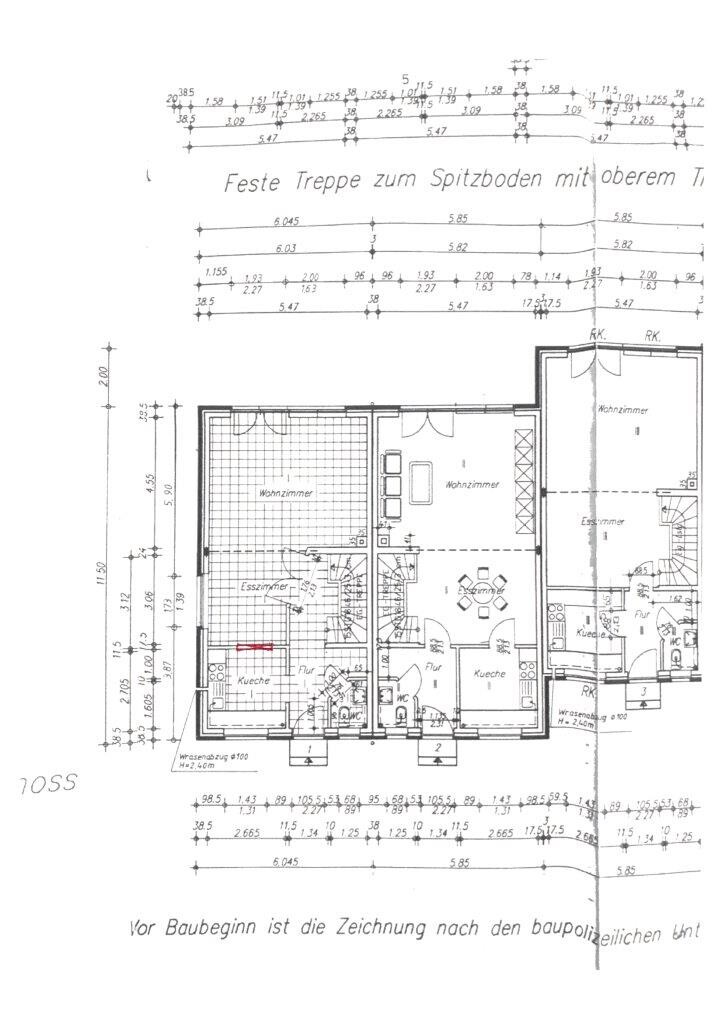
I am planning a pass-through window of about 1m x 1m (3 ft 3 in x 3 ft 3 in) from the kitchen to the living room (marked in red).
Unfortunately, I cannot determine if the wall is load-bearing.
Considering the wall thickness of 10cm (4 inches), I don’t think there will be any issues?!?
Who could help me based on the drawing?
Do I definitely need a structural calculation?
What should I consider: installing a lintel, framing, or plastering after making the opening?
Thank you very much for your help.
Best regards,
Jan

Do you have a plan of the attic?
Preliminary conclusion: According to the plan, there is no load-bearing wall. However, I cannot tell you what has actually been done or if anything else has collapsed onto it, so I recommend consulting a structural engineer. Anything else would be highly negligent.
But honestly, installing an H-beam now shouldn’t be a problem — one day’s work and around 400 euros including plastering materials, etc.
Preliminary conclusion: According to the plan, there is no load-bearing wall. However, I cannot tell you what has actually been done or if anything else has collapsed onto it, so I recommend consulting a structural engineer. Anything else would be highly negligent.
But honestly, installing an H-beam now shouldn’t be a problem — one day’s work and around 400 euros including plastering materials, etc.
It would also be helpful to know the year of construction and the type of material used in the wall where the opening is planned.
Drywall partitions are rarely load-bearing regardless of thickness, but calcium silicate bricks can be load-bearing starting at 11.5 cm (4.5 inches), while other materials typically become load-bearing only from 17.5 cm (7 inches) thickness. At 10 cm (4 inches) including plaster, it is likely that 7.5 cm (3 inch) bricks were used, so this is generally uncritical.
If you want to be safe: support both sides and install a small 7.5 cm (3 inch) concrete lintel. This does not require much additional effort and ensures safety. A structural engineer preparing a report for this size of opening would probably cost more than the mason.
For DIY: (after supporting) cut both sides 50 mm (2 inches) deep with a wall chaser equipped with dust extraction and then knock down the section. Cut out the corners for the lintel at the same time. This creates the least mess and is the fastest method. Check carefully beforehand to ensure there are no cables or pipes there. This is especially important in kitchens, where wiring can sometimes be installed in unconventional ways that do not follow typical installation zones.
EDIT: Just checked the plans. It says 11.5 cm (4.5 inch) wall. If it is calcium silicate brick this wall can be load-bearing, but does not have to be. Since there is no wall above, it would only support the wooden ceiling joists (if any). For calcium silicate brick, to be safe, remove two bricks above the opening first, support through the wall there, and then cut out the opening.
Drywall partitions are rarely load-bearing regardless of thickness, but calcium silicate bricks can be load-bearing starting at 11.5 cm (4.5 inches), while other materials typically become load-bearing only from 17.5 cm (7 inches) thickness. At 10 cm (4 inches) including plaster, it is likely that 7.5 cm (3 inch) bricks were used, so this is generally uncritical.
If you want to be safe: support both sides and install a small 7.5 cm (3 inch) concrete lintel. This does not require much additional effort and ensures safety. A structural engineer preparing a report for this size of opening would probably cost more than the mason.
For DIY: (after supporting) cut both sides 50 mm (2 inches) deep with a wall chaser equipped with dust extraction and then knock down the section. Cut out the corners for the lintel at the same time. This creates the least mess and is the fastest method. Check carefully beforehand to ensure there are no cables or pipes there. This is especially important in kitchens, where wiring can sometimes be installed in unconventional ways that do not follow typical installation zones.
EDIT: Just checked the plans. It says 11.5 cm (4.5 inch) wall. If it is calcium silicate brick this wall can be load-bearing, but does not have to be. Since there is no wall above, it would only support the wooden ceiling joists (if any). For calcium silicate brick, to be safe, remove two bricks above the opening first, support through the wall there, and then cut out the opening.
Similar topics