
Hello,
we are moving walls in a room to create two separate rooms from a larger space.
For the new room, we need to install a door. The door should have a clear opening width of 73.5cm (29 inches) and a height of 198.5cm (78 inches). There was carpet installed before. The screed has underfloor heating.
We plan to lay a tiled floor. Since the rooms no longer exactly match the heating circuits, we might also install a 4mm (0.16 inch) uncoupling membrane. The rough opening for the door in the structural shell is 205cm (81 inches). Since the screed is already in place but the tiles will raise the floor height, I have assumed a door opening height of 203cm (80 inches).
We have chosen a lintel block made of aerated concrete for a non-load-bearing pumice block wall. Its dimensions are 150cm x 11.4cm x 12.4cm (59 inches x 4.5 inches x 4.9 inches). We would cut it down to 110cm (43 inches) because the available space for the door is limited. On one side, the lintel will likely cross cables. We will probably need to cut a groove into the lintel to pass the existing cables through. This might not be fully compliant, but the lintel is located in a non-load-bearing wall here.
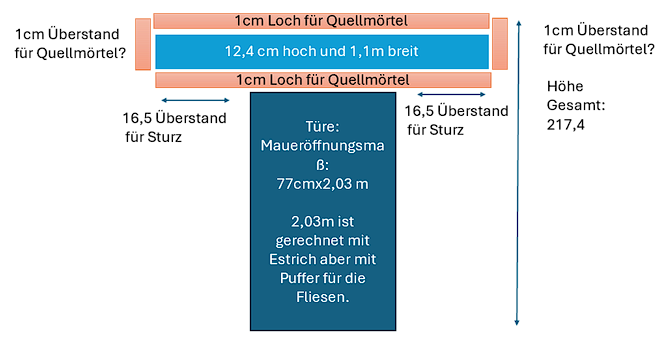
Accounting for the room for expansive mortar (1cm (0.4 inch) at top and bottom) + 12.4cm (4.9 inches) for the lintel block + 203cm (80 inches) results in a total height of 217.4cm (85.5 inches). For the width of a door, a rough wall opening of 76cm (30 inches) is usually assumed. Since we will cut the opening ourselves with an angle grinder and then knock it out, I would opt for a width of 77cm (30.3 inches) here. This would provide a 1cm (0.4 inch) margin for cutting inaccuracies. Thus, I have planned a door opening of 77cm x 217.4cm (30.3 inches x 85.5 inches).
At the height of 203cm (80 inches), there is the overhang for the lintel block (110cm (43 inches) total width - 77cm (30.3 inches) door width = 16.5cm (6.5 inches) overhang for the lintel block on each side). Additionally, I would add 1cm (0.4 inch) on each side for the expansive mortar. This results in an overhang of 17.5cm (6.9 inches) per side.
I have tried to represent the opening schematically with these dimensions: the expansive mortar is orange, the door is dark blue, and the lintel block is light blue.
Are the dimensions chosen suitable? How can all doors on the same floor be installed at exactly the same height? Is there a trick for this? The door frame height for the existing doors is 204.4cm (80.5 inches) measured from the screed, and the gap between the screed and door frame is 5mm (0.2 inch). The door leaf on the old doors is 198.5cm (78 inches) high. The distance between the door leaf and screed is 1cm (0.4 inch).
Is it possible to simply remove and then reinstall the door frame on an existing door? That way, we could check the top height of the wall opening on the existing doors.
Thank you for your answers.
we are moving walls in a room to create two separate rooms from a larger space.
For the new room, we need to install a door. The door should have a clear opening width of 73.5cm (29 inches) and a height of 198.5cm (78 inches). There was carpet installed before. The screed has underfloor heating.
We plan to lay a tiled floor. Since the rooms no longer exactly match the heating circuits, we might also install a 4mm (0.16 inch) uncoupling membrane. The rough opening for the door in the structural shell is 205cm (81 inches). Since the screed is already in place but the tiles will raise the floor height, I have assumed a door opening height of 203cm (80 inches).
We have chosen a lintel block made of aerated concrete for a non-load-bearing pumice block wall. Its dimensions are 150cm x 11.4cm x 12.4cm (59 inches x 4.5 inches x 4.9 inches). We would cut it down to 110cm (43 inches) because the available space for the door is limited. On one side, the lintel will likely cross cables. We will probably need to cut a groove into the lintel to pass the existing cables through. This might not be fully compliant, but the lintel is located in a non-load-bearing wall here.
Accounting for the room for expansive mortar (1cm (0.4 inch) at top and bottom) + 12.4cm (4.9 inches) for the lintel block + 203cm (80 inches) results in a total height of 217.4cm (85.5 inches). For the width of a door, a rough wall opening of 76cm (30 inches) is usually assumed. Since we will cut the opening ourselves with an angle grinder and then knock it out, I would opt for a width of 77cm (30.3 inches) here. This would provide a 1cm (0.4 inch) margin for cutting inaccuracies. Thus, I have planned a door opening of 77cm x 217.4cm (30.3 inches x 85.5 inches).
At the height of 203cm (80 inches), there is the overhang for the lintel block (110cm (43 inches) total width - 77cm (30.3 inches) door width = 16.5cm (6.5 inches) overhang for the lintel block on each side). Additionally, I would add 1cm (0.4 inch) on each side for the expansive mortar. This results in an overhang of 17.5cm (6.9 inches) per side.
I have tried to represent the opening schematically with these dimensions: the expansive mortar is orange, the door is dark blue, and the lintel block is light blue.
Are the dimensions chosen suitable? How can all doors on the same floor be installed at exactly the same height? Is there a trick for this? The door frame height for the existing doors is 204.4cm (80.5 inches) measured from the screed, and the gap between the screed and door frame is 5mm (0.2 inch). The door leaf on the old doors is 198.5cm (78 inches) high. The distance between the door leaf and screed is 1cm (0.4 inch).
Is it possible to simply remove and then reinstall the door frame on an existing door? That way, we could check the top height of the wall opening on the existing doors.
Thank you for your answers.
T
Teimo198814 Feb 2026 10:34It depends on what type of existing doors you have. If they are from this millennium, you should be able to remove the trim. Usually, they are simply clipped in.
At first glance, your calculation seems reasonable, although I only skimmed the measurements and didn’t double-check them.
I’ve done something similar, but it was a load-bearing wall. However, after installing the floor structure, my lintel ended up being too low, and when fitting the door, I had to shorten both the frame and the door leaf by 1 cm (0.4 inches). No one noticed. I had a carpenter available who trimmed the door with his tools to avoid splintering, etc.
At first glance, your calculation seems reasonable, although I only skimmed the measurements and didn’t double-check them.
I’ve done something similar, but it was a load-bearing wall. However, after installing the floor structure, my lintel ended up being too low, and when fitting the door, I had to shorten both the frame and the door leaf by 1 cm (0.4 inches). No one noticed. I had a carpenter available who trimmed the door with his tools to avoid splintering, etc.

I find it very unwise that you separate this discussion from your thread https://www.hausbau-forum.de/threads/umbau-eines-stockwerks-neue-tuere-und-mauerabriss.s0c8i3/#b2d0t7, even though from the perspective of "we are interfering with the structural integrity of the house, but what excites us most about the project is the risk of doing it without an architect," it is somewhat consistent.
Regarding the topic "lintel above the door": you only really need a supporting lintel if you want to build up masonry above the door (in my opinion, unnecessarily).
You should plan the adjustment of the electrical wiring with a certified electrician.
https://www.instagram.com/11antgmxde/
https://www.linkedin.com/company/bauen-jetzt/
Regarding the topic "lintel above the door": you only really need a supporting lintel if you want to build up masonry above the door (in my opinion, unnecessarily).
You should plan the adjustment of the electrical wiring with a certified electrician.
https://www.instagram.com/11antgmxde/
https://www.linkedin.com/company/bauen-jetzt/
Similar topics