
Hello everyone,
My husband and I attended a home exhibition today featuring a local timber house builder (Schleswig-Holstein) and there we learned about the Vestaxx window heating system.
Is there anyone here who has experience with the Vestaxx window heating?
At first, it sounds unusual to have the heating integrated into the windows. For the triple-glazed windows, a nanotechnology-based, invisible layer is applied to the inner surface of the innermost pane, which warms the glass up to 40 degrees Celsius (104°F) via infrared and heats the room. The warmth actually felt very comfortable, and the windows were completely cold on the outside (today’s temperature was below 10 degrees Celsius (50°F)). Allegedly, the Vestaxx window heating transfers 92% of its heat to the room, and the Technical University of Berlin has tested this Vestaxx window heating system and rated it positively. It appears to have been on the market only recently.
Overall, I find this quite interesting. It is significantly cheaper than other heating systems, allows individual control of each room, and unlike underfloor heating, it is very responsive.
Of course, this only makes sense in a low-energy house (the timber builder mainly constructs 40+ standard homes), as the system runs on electricity. In that case, the Vestaxx window heating is said to consume very little power.
This is my impression from the expo; of course, they want to sell the system.
What are your experiences with Vestaxx? Have you heard of this system before? Could it be an alternative to conventional heating? Does it have a future?
My husband and I attended a home exhibition today featuring a local timber house builder (Schleswig-Holstein) and there we learned about the Vestaxx window heating system.
Is there anyone here who has experience with the Vestaxx window heating?
At first, it sounds unusual to have the heating integrated into the windows. For the triple-glazed windows, a nanotechnology-based, invisible layer is applied to the inner surface of the innermost pane, which warms the glass up to 40 degrees Celsius (104°F) via infrared and heats the room. The warmth actually felt very comfortable, and the windows were completely cold on the outside (today’s temperature was below 10 degrees Celsius (50°F)). Allegedly, the Vestaxx window heating transfers 92% of its heat to the room, and the Technical University of Berlin has tested this Vestaxx window heating system and rated it positively. It appears to have been on the market only recently.
Overall, I find this quite interesting. It is significantly cheaper than other heating systems, allows individual control of each room, and unlike underfloor heating, it is very responsive.
Of course, this only makes sense in a low-energy house (the timber builder mainly constructs 40+ standard homes), as the system runs on electricity. In that case, the Vestaxx window heating is said to consume very little power.
This is my impression from the expo; of course, they want to sell the system.
What are your experiences with Vestaxx? Have you heard of this system before? Could it be an alternative to conventional heating? Does it have a future?
S
SaniererNRW12310 Oct 2022 08:47chand1986 schrieb:
I’ll play devil’s advocate and say: Maintenance, repairs, and replacement for the heat pump are missing here. However, this remains manageable over the service life – disconnecting the old heat pump from the pipes (in the example of a monoblock unit even possible on site) and installing a new one. This involves a workload of generously more than half a day plus the cost of a new monoblock unit. Assuming a small monoblock based on the heating load, the total cost including inflation in 10–15 years will still be well below €10,000. Maintenance will be just as intensive as for the domestic hot water heat pump – so it’s more or less equal for both cases. The domestic hot water heat pump will also need to be replaced eventually.

kati1337 schrieb:
I also find the claim "the other system fails, ours doesn’t" quite bold. 😉 I did some research on this topic. The “inventor” of the system apparently comes from thin-film photovoltaic module development and has experience with sputtering and heating float glass (yes, correct, not tempered glass) with metal without causing the expected stress cracks.
But despite the embedded (if I sputter a surface, is that considered embedded?) metals, glass can still break or the only a few micrometers thin coating can develop interruptions due to expansion and contraction (which was also an argument for a possible defect of the underfloor heating pipes). Reliable data have so far been withheld from me. Whether this is due to lack of information or intentional, I don’t know. But they might still be published. 😉
V
Vestaxx GmbH10 Oct 2022 15:51kati1337 schrieb:
What is wrong with the calculation:
Both heating systems individually have: initial costs, ongoing maintenance costs, operational costs, and a service life.
Based on that, you can create a total cost calculation and comparison—independent of a photovoltaic system.
The lower purchase price of the electric panel heating is already taken into account within the initial costs.
If the system does not pass this comparison, then it simply does not pass.
I cannot and should not include a photovoltaic system in this calculation. And if I do, then I should include photovoltaic for BOTH systems—both the costs and the savings effects—or for NEITHER.
Creating a comparison between a heat pump system VS an electric panel heating system with photovoltaic is gaslighting, a naïve calculation, marketing nonsense—call it what you want. In any case, the comparison is flawed. Okay—first of all: the electric panels HAVE NO maintenance costs. And basically, nothing can break because nothing moves. But let’s set that aside.
You can compare heating systems—or better said—heat generators including distribution. In that comparison, every direct electric heating system loses. I have written this several times, and it is clear to anyone without further calculations. COP 0.95 vs COP 4 or 5. Does the comparison make sense? For you and others, yes; but for people planning to build new and interested in heating, no.
Price is what makes the difference. If you get a heat pump for 40,000 € (forty thousand euros), then you can still use the remaining budget for our glazing and the waste water heat pump, and even afford a photovoltaic system. That photovoltaic system will then reduce your household electricity costs.
Of course, you can compare both SYSTEMS and add photovoltaic to the heat pump—and then please add the same system for the other heating option as well. Only then is it a fair comparison.
And why is THAT comparison not naïve? It’s also strange that every client (and the energy consultants and professors) understand me immediately. They never say “… this can’t be calculated like that …”.
Now just imagine you want to build new and have a limited budget. But you need a heating system. Oil and gas are ruled out. The heat pump including underfloor heating costs 40,000 € (forty thousand euros). Then a crazy person comes around and says: For that money, you get direct electric heating from us, and with the difference, you can afford a waste water heat pump and a large photovoltaic system.
Which is more economical?
A heat pump saves around 3,000 kWh (kilowatt-hours) of annual heating energy demand in a new build house, about 2,000 kWh (kilowatt-hours) annually. Over 20 years, that is 40,000 kWh (kilowatt-hours). The user only needs to buy about 1,000 kWh (kilowatt-hours) per year (see your example). That is very good.
With direct electric heating, the user needs to buy 3,000 kWh (kilowatt-hours) annually, so that is 100,000 kWh (kilowatt-hours) over 20 years. That’s rather bad. But the photovoltaic system generates a total of 240,000 kWh (kilowatt-hours) of free electricity in that period. So it is more economical.
If you add the photovoltaic system you want for the heat pump to the photovoltaic system of the direct electric heating, you can compare them again, but the difference will not change.
Or simply put:
The customer has only 40,000 € (forty thousand euros) available and wants to pay as little as possible annually for their entire energy. Which system is better?
V
Vestaxx GmbH10 Oct 2022 16:00Tolentino schrieb:
Because it is fundamentally inaccurate from a financial science perspective.
You are arguing that saved costs equal a lower investment. Whether the difference is invested in photovoltaics, ETFs, or simply spent on consumption would require a separate financial analysis.
It is not a single system; it would only be considered one if, for example, the inner pane contained the heating element and the outer one a photoactive cell that is still transparent enough to fulfill the main window function.
The fact that it is not technologically a single system makes it marketing. I am comparing two systems that have exactly the same costs and looking at the outcome.
And from a financial science perspective, that is fundamentally inaccurate. Sorry, but to put it bluntly, it is completely wrong.
Why must the system — in order to be financially correct — produce electricity on the outer pane (which in turn is completely uneconomical)?
R
RotorMotor10 Oct 2022 16:18Vestaxx GmbH schrieb:
And actually, nothing can break because nothing moves. But whatever. Ah, so only things that move can break—obviously! Surprised no one else has thought of that yet! I’ll have to explain that to my SSD, which failed just a few days ago!
Vestaxx GmbH schrieb:
You can compare heating systems—or better said—heat generators, including distribution. Every electric direct heating system loses in such comparisons. I’ve already said this several times, and it’s clear to anyone WITHOUT further calculation. COP 0.95 vs. COP 4 or 5. Does the comparison make sense? For you and others, yes; for people planning to build and interested in heating systems, no. Yes, exactly right, comparing heating systems only makes sense if you add photovoltaics to one and not to the other. Otherwise, it would be totally unfair to expect the heaters alone to be efficient.
Vestaxx GmbH schrieb:
Price makes the difference. If you can get a heat pump for €40,000, then you can spend the remaining money on our glasses and the BWWP and still afford photovoltaics. And that photovoltaics then further reduces your home electricity costs. Yes, that finally makes perfect sense after the hundredth time I’ve read it—because, of course, banks and loans haven’t been invented yet, and so photovoltaics plus heat pump are absolutely impossible.
Vestaxx GmbH schrieb:
Of course, you can compare both SYSTEMS and add photovoltaics to the heat pump—but then please add the same system on top of the other heating option as well. Only then is it a fair comparison. Scroll up and read.
Vestaxx GmbH schrieb:
So why is THAT comparison not a simplistic crude calculation? It’s also strange that every customer (and energy consultants and professors) understands me immediately. None of them say “… you can’t calculate it like that …”. What was that saying—“not every misleading comparison is a fair one”? Show our arguments and calculations to the energy consultants and professors. Even if it’s not their field, hopefully they can understand it.
Vestaxx GmbH schrieb:
The customer only has €40,000 left and wants to pay as little as possible annually for all their energy needs. Which system is better? Again, just scroll up a bit or go back a few pages and read/recalculate. Spoiler: in that example, Vestaxx was over €30,000 more expensive.
V
Vestaxx GmbH10 Oct 2022 16:32Tolentino schrieb:
Because it is fundamentally inaccurate from a financial perspective.
You argue that saved costs equal lower investment. Whether the difference is invested in photovoltaics, ETFs, or simply spent on consumption should be evaluated separately from a financial standpoint.
It’s simply not a single integrated system; it would only be considered that if the inner pane included the heating element and the outer one was a photoactive cell that still remained transparent to fulfill the main window function.
Since it is not technologically one system, it is just marketing. I am comparing two systems with exactly the same costs and looking at the outcome.
From a financial perspective, that is fundamentally inaccurate. Sorry, but that is simply wrong.
Why must the system – to be financially correct – produce electricity on the outer pane (which is completely uneconomical)?
OWLer schrieb:
First, we have been talking here all along about your cost-effectiveness calculation Vestaxx vs. heat pump. I am honestly not willing to read a page of continuous text but want to see clear tables. Second, we are talking about spreadsheets like Excel, Open Office, etc. Nobody here wants to see your software, but only well-prepared cost-effectiveness calculations comparing window heating systems versus heat pumps with current seasonal performance factors of 4–5.
Actually, I do want to see that. See above.
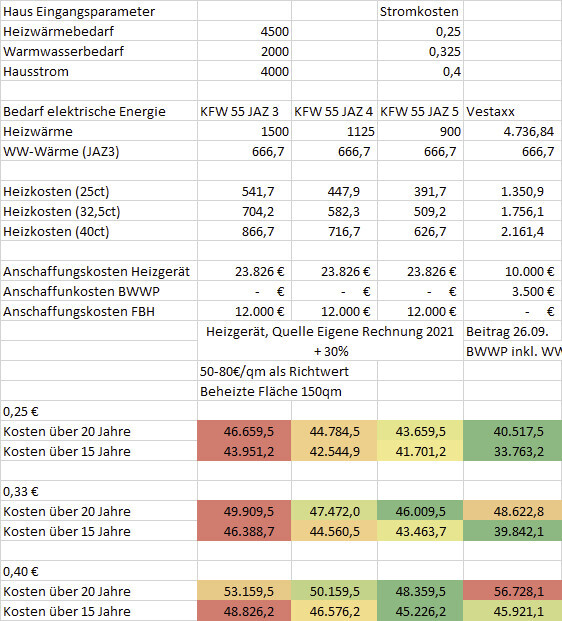
I already broke it down before. Here is the old excerpt:
CO2e for German steel assumed to be about 2.5kg per kilogram, PE floor heating pipe 17x2 with 2kg CO2e. Production overhead estimated at a flat 25%.
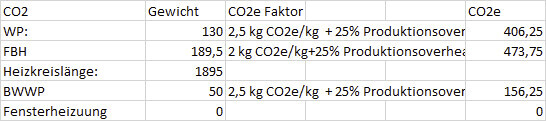
Copper pipes and heat exchangers are actually significant CO2 emitters as well. Add another 100kg there. Fortunately, aluminum is light. The few valves and heating circuit distributors don’t have much impact.
Of course, the CO2e of the German electricity grid mix is problematic. Before the war, there were ambitious targets, but now, with still East German lignite power plants running, I have strong doubts. I simply assume our government will reach the <25% of 1990 target only about 10 years later, in 2040.
In the respective columns then electricity consumption per year*CO2e/kWh.
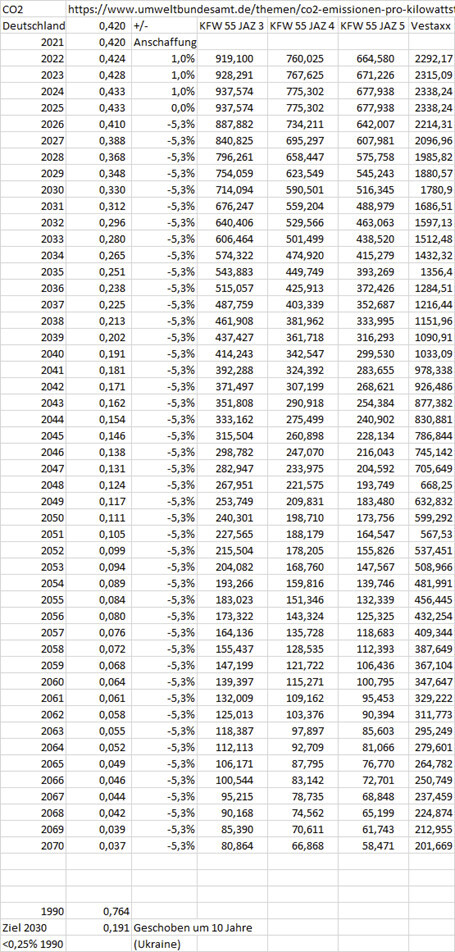
Summing those over the evaluation period looks like this:

Of course, you must also consider Scope 3 downstream emissions, not just cradle to gate.
Infrared is, even here on the forum, the go-to solution, for example, in bathrooms for supplementary heating when the heating surface isn’t large enough. But that’s not the issue here. You wrote “business case” and I read “business case” – if you mean cost-effectiveness calculation, then please write that too. -> Fine.
I don’t know what the outcome is with ETFs (risk and opportunity = speculation).
Consumption is also fine. I know the money is gone, and I enjoyed it a little.
For photovoltaics, I know exactly what comes out over the lifetime. -> certainty.
Now to your table. Fine – you don’t like reading continuous text (with numbers and formulas), and I don’t like random tables where I have to figure out the formulas. Everyone has their preferences – no problem.
The first mistake is using a fixed seasonal performance factor of 3 for the exhaust air heat pump. It is definitely higher – but that’s fine.
Your table is great – thanks for that. It clearly shows that the seasonal performance factor matters, and with a factor of 5, we break even after about 15 years. Unfortunately, maintenance costs are missing – zero in our case, but the heat pump? €200 (about $215) annually? Not sure.
What you have calculated so far is what happens after 15 (or 20) years if the customer uses the saved money to pay the electricity bill. Another very important factor is electricity price increases.
And again – I know it’s annoying – the assumption that the customer is smart and chooses certainty.
By investing the saved investment costs in a photovoltaic system, the customer does exactly that. Photovoltaics are good – we all agree on that here.
But then we have to discard your table and create a new one that takes this into account.
With a large photovoltaic system, the customer becomes largely independent of the surely rising electricity prices.
That’s what motivates people.
CO2 consideration – thanks for the table – but only looking at CO2 during production and then leaving things out again isn’t helpful. Also, way too many numbers – sorry!
Put differently: The material for the heating system of an entire house fits easily in one hand.
For water-based systems, you already need a strong forklift. Does that make sense?
“… Of course, you must also consider Scope 3 downstream emissions, not just cradle to gate …”
Who, among normal people interested in window heating systems here, understands such a sentence?
Write clear, understandable language, or just leave it out.
Similar topics