
Hello everyone,
My husband and I attended a home exhibition today featuring a local timber house builder (Schleswig-Holstein) and there we learned about the Vestaxx window heating system.
Is there anyone here who has experience with the Vestaxx window heating?
At first, it sounds unusual to have the heating integrated into the windows. For the triple-glazed windows, a nanotechnology-based, invisible layer is applied to the inner surface of the innermost pane, which warms the glass up to 40 degrees Celsius (104°F) via infrared and heats the room. The warmth actually felt very comfortable, and the windows were completely cold on the outside (today’s temperature was below 10 degrees Celsius (50°F)). Allegedly, the Vestaxx window heating transfers 92% of its heat to the room, and the Technical University of Berlin has tested this Vestaxx window heating system and rated it positively. It appears to have been on the market only recently.
Overall, I find this quite interesting. It is significantly cheaper than other heating systems, allows individual control of each room, and unlike underfloor heating, it is very responsive.
Of course, this only makes sense in a low-energy house (the timber builder mainly constructs 40+ standard homes), as the system runs on electricity. In that case, the Vestaxx window heating is said to consume very little power.
This is my impression from the expo; of course, they want to sell the system.
What are your experiences with Vestaxx? Have you heard of this system before? Could it be an alternative to conventional heating? Does it have a future?
My husband and I attended a home exhibition today featuring a local timber house builder (Schleswig-Holstein) and there we learned about the Vestaxx window heating system.
Is there anyone here who has experience with the Vestaxx window heating?
At first, it sounds unusual to have the heating integrated into the windows. For the triple-glazed windows, a nanotechnology-based, invisible layer is applied to the inner surface of the innermost pane, which warms the glass up to 40 degrees Celsius (104°F) via infrared and heats the room. The warmth actually felt very comfortable, and the windows were completely cold on the outside (today’s temperature was below 10 degrees Celsius (50°F)). Allegedly, the Vestaxx window heating transfers 92% of its heat to the room, and the Technical University of Berlin has tested this Vestaxx window heating system and rated it positively. It appears to have been on the market only recently.
Overall, I find this quite interesting. It is significantly cheaper than other heating systems, allows individual control of each room, and unlike underfloor heating, it is very responsive.
Of course, this only makes sense in a low-energy house (the timber builder mainly constructs 40+ standard homes), as the system runs on electricity. In that case, the Vestaxx window heating is said to consume very little power.
This is my impression from the expo; of course, they want to sell the system.
What are your experiences with Vestaxx? Have you heard of this system before? Could it be an alternative to conventional heating? Does it have a future?
W
WilderSueden5 Oct 2022 21:14Vestaxx GmbH schrieb:
Depending on the insulation, the wall temperature is about 19°C (66°F) and the glass temperature is 18°C (64°F) – of course, this depends on the outside temperatures and indoor air temperature. This makes the argument that the window is the coldest/warmest spot somewhat irrelevant. By the way, taking measurements right now doesn’t make much sense since we are still in the construction phase (see profile picture 😉 ), and the results wouldn’t be reliable.
Vestaxx GmbH schrieb:
What you don’t consider is that electricity for the house (around 3,000–4,000 kWh) must be purchased year-round, and the heat pump doesn’t contribute anything to that. Yes, the heat pump may save about 3,000 kWh annually – but the photovoltaic system produces roughly five times that amount per year, with a large share used directly. Calculate it yourself and you’ll be amazed! Or are you worried you might miscalculate? 😉 If you read my posts carefully, you’ll see that photovoltaic is a given for us, as is the battery, both nicely subsidized by the KfW for 40+ years. Photovoltaics only pay off if you don’t pay the current sky-high prices (or if electricity gets even more expensive). But that says nothing about any specific heating system. As I said, you could also use air heating. Or install infrared heating everywhere yourself. You need to sell your product against this competition, less so against the heat pump.
Vestaxx GmbH schrieb:
We don’t sell heating as such, but a window heating system combined with photovoltaic and a ground-source heat pump. You sell the window heating, but you market the photovoltaic system. I’d also like to remind you that this thread now ranks quite high on Google.
S
stjoob_at6 Oct 2022 11:31RotorMotor schrieb:
I just don’t understand how anyone can say heat pump OR photovoltaic.
Photovoltaics should simply always be installed first, and then one can decide whether to heat with an air-to-water heat pump, ground-to-water heat pump, direct electric heating, etc. Unless you don’t have enough money to afford everything.
I can only imagine this system working well in very well-insulated buildings or extensions, tiny houses, or modular homes (where a water-based system usually isn’t feasible).
Couldn’t someone run a cost-effectiveness calculation comparing electric panel heating (€10,000) vs. heat pump (€40,000), and electric panel heating with photovoltaics (€40,000) vs. heat pump with photovoltaics (€70,000)? If you have €30,000 available to cover higher energy costs, where is the break-even point?
C
Christian 656 Oct 2022 13:12Max, Uwe, and Svenja Mustermann inherited a large family property as well as €500,000 in cash each.
Unfortunately, their father specified in his will that the cash payout is conditional: each of them must build their own house on the property for exactly this amount; otherwise, they won’t receive the money.
To save on architect and structural engineer fees, they all decided to build the exact same house three times.
The exact same flat-roofed building with 120 sqm (1,292 sq ft) of living space and a volume of 10 x 15 x 3 m (33 x 49 x 10 ft).
They all chose the same wall and ceiling construction, as well as windows with the same U-value.
The energy consultant calculates an average U-value of 0.3 and a building envelope area of 450 sqm (4,844 sq ft).
Max is the heat pump expert and, like the others, has €40,000 available for heating provision.
He opts for an air-to-water heat pump with a COP of 4.2 and pays €9,000 for underfloor heating and €24,600 for the heat pump including all ancillary costs. A total of €40,000 gross.
Uwe installs a window-area heating system for €15,000 and a 12 kWp photovoltaic system for €25,000.
Svenja thinks both are nonsense and installs the same heating technology as Max but takes an additional loan of €9,000 and also installs a 4.5 kWp photovoltaic system.
After one year, they all sit in the garden and put their accounts on the table.
During the 4 cold months (almost always around 0°C (32°F), like the others), Max needs heating energy calculated as: 450 sqm x 0.3 W/sqm x k x 25k x 10h heating time = 33.7 kWh. Since at 0°C (32°F) the heat pump’s COP drops to 2, he has to buy 17 kWh of electricity per day. That is 17 kWh x €0.30/kWh x 120 days = €612 heating energy cost.
Uwe needs twice the electrical energy, so 34 kWh/day, but his 12 kWp photovoltaic system operates at 60% efficiency during these months with 6 hours of sunlight, producing 43 kWh per day. As he cannot store energy, he directly uses 6 h x 3.4 kW/h = 20.4 kWh from the PV system and feeds the excess 20.6 kWh into the grid, earning €0.08/kWh = €1.64/day.
Unfortunately, he must buy the missing 13.4 kWh at the expensive rate of €0.30/kWh, which is €4.02/day minus the feed-in compensation of €1.64/day = €2.38/day.
This results in €2.38/day x 120 days = €285.60 heating energy costs for these 4 months.
Svenja has her own calculation:
She also needs 17 kWh/day for the heat pump like Max but produces only 16.2 kWh/day (= 2.7 kW/h) with the smaller photovoltaic system.
This allows her to run the heat pump during 6 sunlight hours and feed in an excess 1 kW/h during those 6 hours, earning a compensation of €0.48.
Unfortunately, she must buy the missing 4 h x 1.7 kW = 6.8 kWh at €0.30/kWh, which totals €2.04/day.
She only paid €187.20 for heating energy during these 4 months, plus €9,000 x 3.5% interest = €315/year for the loan.
During the rest of the year, the balance shifts increasingly in favor of the “larger photovoltaic system.”
I will skip the calculations with hot water.
Regards, Christian
Unfortunately, their father specified in his will that the cash payout is conditional: each of them must build their own house on the property for exactly this amount; otherwise, they won’t receive the money.
To save on architect and structural engineer fees, they all decided to build the exact same house three times.
The exact same flat-roofed building with 120 sqm (1,292 sq ft) of living space and a volume of 10 x 15 x 3 m (33 x 49 x 10 ft).
They all chose the same wall and ceiling construction, as well as windows with the same U-value.
The energy consultant calculates an average U-value of 0.3 and a building envelope area of 450 sqm (4,844 sq ft).
Max is the heat pump expert and, like the others, has €40,000 available for heating provision.
He opts for an air-to-water heat pump with a COP of 4.2 and pays €9,000 for underfloor heating and €24,600 for the heat pump including all ancillary costs. A total of €40,000 gross.
Uwe installs a window-area heating system for €15,000 and a 12 kWp photovoltaic system for €25,000.
Svenja thinks both are nonsense and installs the same heating technology as Max but takes an additional loan of €9,000 and also installs a 4.5 kWp photovoltaic system.
After one year, they all sit in the garden and put their accounts on the table.
During the 4 cold months (almost always around 0°C (32°F), like the others), Max needs heating energy calculated as: 450 sqm x 0.3 W/sqm x k x 25k x 10h heating time = 33.7 kWh. Since at 0°C (32°F) the heat pump’s COP drops to 2, he has to buy 17 kWh of electricity per day. That is 17 kWh x €0.30/kWh x 120 days = €612 heating energy cost.
Uwe needs twice the electrical energy, so 34 kWh/day, but his 12 kWp photovoltaic system operates at 60% efficiency during these months with 6 hours of sunlight, producing 43 kWh per day. As he cannot store energy, he directly uses 6 h x 3.4 kW/h = 20.4 kWh from the PV system and feeds the excess 20.6 kWh into the grid, earning €0.08/kWh = €1.64/day.
Unfortunately, he must buy the missing 13.4 kWh at the expensive rate of €0.30/kWh, which is €4.02/day minus the feed-in compensation of €1.64/day = €2.38/day.
This results in €2.38/day x 120 days = €285.60 heating energy costs for these 4 months.
Svenja has her own calculation:
She also needs 17 kWh/day for the heat pump like Max but produces only 16.2 kWh/day (= 2.7 kW/h) with the smaller photovoltaic system.
This allows her to run the heat pump during 6 sunlight hours and feed in an excess 1 kW/h during those 6 hours, earning a compensation of €0.48.
Unfortunately, she must buy the missing 4 h x 1.7 kW = 6.8 kWh at €0.30/kWh, which totals €2.04/day.
She only paid €187.20 for heating energy during these 4 months, plus €9,000 x 3.5% interest = €315/year for the loan.
During the rest of the year, the balance shifts increasingly in favor of the “larger photovoltaic system.”
I will skip the calculations with hot water.
Regards, Christian
W
WilderSueden6 Oct 2022 13:39I’m not even sure where to start with this... at a COP of 2 in the new building throughout the entire winter? Assuming every day stays at 0°C (32°F) for four months straight? That the photovoltaic system produces the daily average every day? That sunshine and high heating demand tend not to correlate well? That Max is the only one with hot water because the others were too stingy to buy the necessary equipment? That Max also benefits from a COP well above 1 for hot water? That 43 kWh per day in winter is more than optimistic, even for southern Germany?
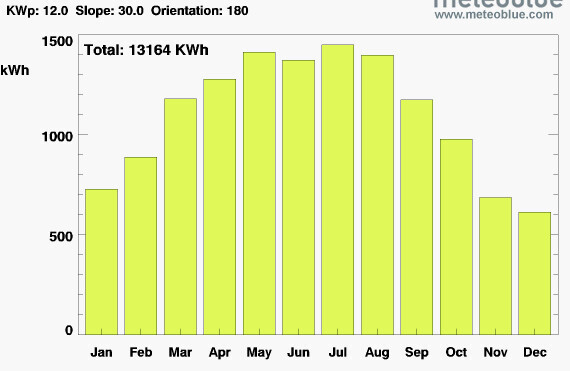
And what’s the point of all the fuss about the building envelope when you can simply set an energy demand per area, choosing between 25 kWh/m² (EH40) and 45 kWh/m² (Building Energy Act)? That results in a heating demand between 3000 kWh and 5400 kWh.
And what’s the point of all the fuss about the building envelope when you can simply set an energy demand per area, choosing between 25 kWh/m² (EH40) and 45 kWh/m² (Building Energy Act)? That results in a heating demand between 3000 kWh and 5400 kWh.
C
Christian 656 Oct 2022 13:56I don’t know where to stop.
Then calculate with a delta k of 15 degrees and an average COP of 3.
That fits a bit better, doesn’t it?
Then calculate with a delta k of 15 degrees and an average COP of 3.
That fits a bit better, doesn’t it?
C
Christian 656 Oct 2022 13:58And only with an average yield of 24 kWh/day.
Similar topics