
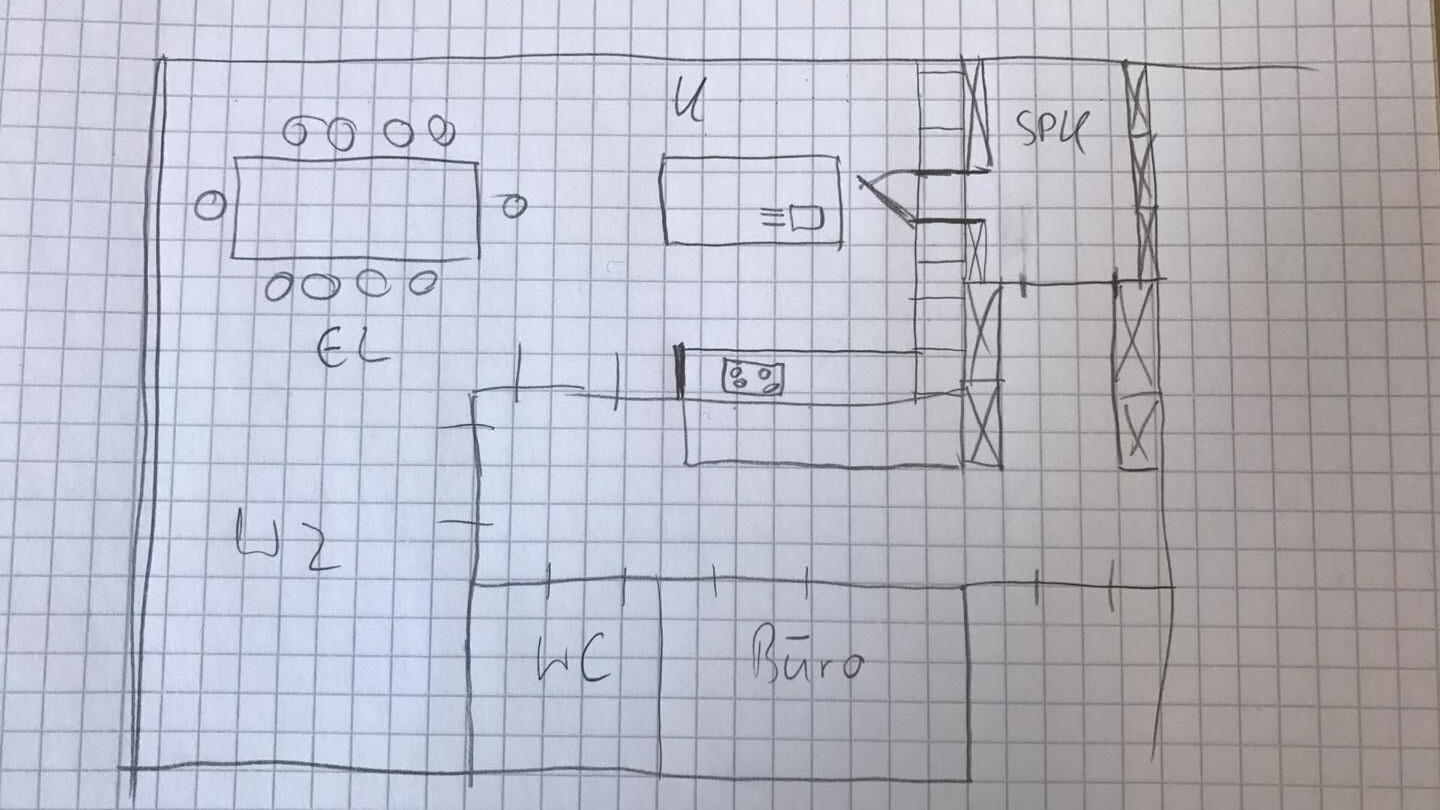
Hello, today I had to wait for an hour and only had my notebook with me... so I just doodled a bit.
This is my very first draft of the ground floor, and it probably still has quite a few mistakes.
What I’m curious about is whether there are any major errors here (for example, the staircase?).
North is at the bottom right.
One square represents half a meter (0.5 m / 20 inches).
This is my very first draft of the ground floor, and it probably still has quite a few mistakes.
What I’m curious about is whether there are any major errors here (for example, the staircase?).
North is at the bottom right.
One square represents half a meter (0.5 m / 20 inches).
M
MIA_SAN_MIA__22 Jun 2017 13:42Basically, this is just some experimenting for now, I agree with you on that. It’s more like a brainstorming session. As it stands, it won’t be an architect but a structural engineer who will eventually create a detailed plan from my drawings.
j.bautsch schrieb:
My idea:
just roughly sketched, of course improvable, but it shows the alternative room layout at first glanceI just wanted to add that I really like it, but you’ve also played the expensive card: The floor plan works because it’s quite a large footprint. Additional floors without setbacks will be just as large... money money money
MIA_SAN_MIA__ schrieb:
Basically, this is just a bit of experimentation, I agree with you.
It’s kind of a brainstorming process. As it looks now, it won’t be an architect but a structural engineer who will eventually create a detailed plan based on my drawings.
I wouldn’t do that.
M
MIA_SAN_MIA__22 Jun 2017 14:38Baufie schrieb:
I wouldn’t do that. What exactly?
J
j.bautsch22 Jun 2017 14:38It depends a bit on what you want to store in your pantry. If it’s just, like with nordlys, dry goods and a few beverages, I agree with the suggested dimensions. However, if you want to include a second refrigerator or freezer, the situation changes significantly. The same applies if you want it large enough to walk into.
If you want to have an appliance inside and be able to walk in, you need to consider the depth of the appliances and allow a comfortable passage width as the room’s width. For most freestanding appliances, this means about 1.5 m (5 feet) wide (0.7 m (28 inches) for the appliance + 0.8 m (31 inches) for the walkway, but everyone has to decide what feels sufficient). The length then depends on your storage needs.
The best approach is to list each room you want individually, then think about what you want to put in each and how much space that requires (sometimes the internet can help with this). This way, you can gradually determine the minimum size and/or shape your rooms should have. That’s how I proceeded, at least.
When building a house, it’s perfectly fine to plan the walls around the furniture, but in a rental apartment, that’s usually not possible—you generally have to work with what’s already there. Of course, you should also plan so that a different furnishing layout could be possible without having to alter the walls, but this approach gives you a good sense of how much space each room needs for its function.
If you want to have an appliance inside and be able to walk in, you need to consider the depth of the appliances and allow a comfortable passage width as the room’s width. For most freestanding appliances, this means about 1.5 m (5 feet) wide (0.7 m (28 inches) for the appliance + 0.8 m (31 inches) for the walkway, but everyone has to decide what feels sufficient). The length then depends on your storage needs.
The best approach is to list each room you want individually, then think about what you want to put in each and how much space that requires (sometimes the internet can help with this). This way, you can gradually determine the minimum size and/or shape your rooms should have. That’s how I proceeded, at least.
When building a house, it’s perfectly fine to plan the walls around the furniture, but in a rental apartment, that’s usually not possible—you generally have to work with what’s already there. Of course, you should also plan so that a different furnishing layout could be possible without having to alter the walls, but this approach gives you a good sense of how much space each room needs for its function.
Similar topics