
Hello,
I’m currently reaching the limits of my planning regarding the installation shaft for the controlled residential ventilation ductwork. I did not expect that my general contractor would want to divert a section of the hallway for this purpose, specifically a drywall shaft measuring 80cm x 20cm (31.5 inches x 7.9 inches) — please see the attachment. This would cause a loss of space in an already tight area and create an unsightly section of wall in the hallway.
The same applies to the kitchen, where a drywall shaft of 70cm x 20cm (27.6 inches x 7.9 inches) is planned for the bathroom installations. How can this be optimally resolved? I would be very grateful for any suggestions or ideas!
Thank you!
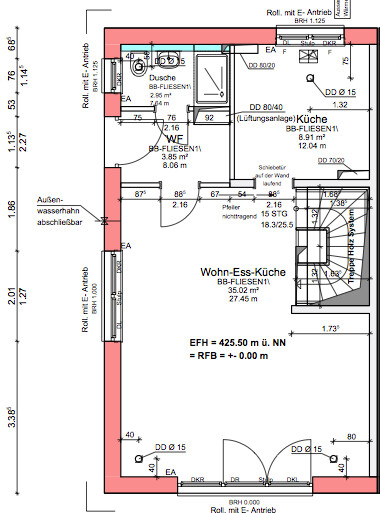
I’m currently reaching the limits of my planning regarding the installation shaft for the controlled residential ventilation ductwork. I did not expect that my general contractor would want to divert a section of the hallway for this purpose, specifically a drywall shaft measuring 80cm x 20cm (31.5 inches x 7.9 inches) — please see the attachment. This would cause a loss of space in an already tight area and create an unsightly section of wall in the hallway.
The same applies to the kitchen, where a drywall shaft of 70cm x 20cm (27.6 inches x 7.9 inches) is planned for the bathroom installations. How can this be optimally resolved? I would be very grateful for any suggestions or ideas!
Thank you!
B
Bieber08158 Mar 2017 06:53You would need to see the overall picture (the complete design plan) for that. Ideally, you would try to work with a single shaft and then distribute it horizontally on each floor.
What does the planner say?
What does the planner say?
The planner and manufacturer is also Zehnder Q350. Originally, the duct was planned along the wall next to the shower on the ground floor, but unfortunately, there is not enough space for a duct there as it is too small.
The plan is to create a ceiling opening with dimensions of 80cm x 20cm (31.5 inches x 7.9 inches) from the upper floor to the ground floor and then to the basement. The question now is where and how to place it optimally in the room.
Does it have to be 80cm x 40cm (31.5 inches x 15.7 inches), or could, for example, 100cm x 20cm (39.4 inches x 7.9 inches) be used to realize a narrower duct?
How have you solved this in your projects, and what is the standard practice in terms of technical requirements?
The plan is to create a ceiling opening with dimensions of 80cm x 20cm (31.5 inches x 7.9 inches) from the upper floor to the ground floor and then to the basement. The question now is where and how to place it optimally in the room.
Does it have to be 80cm x 40cm (31.5 inches x 15.7 inches), or could, for example, 100cm x 20cm (39.4 inches x 7.9 inches) be used to realize a narrower duct?
How have you solved this in your projects, and what is the standard practice in terms of technical requirements?
I consider the space taken up by one or two shafts to be negligible compared to the total living area. Half a square meter for 50 square meters (about 5.4 square feet for 538 square feet) is just 1%.
You should simply let the professional handle it and accept it—there are far more important issues in house construction that can really cause headaches.
Besides, the place where it is planned seems to be a good spot: the niche used as a wardrobe space is not noticeably reduced.
Best regards in brief
You should simply let the professional handle it and accept it—there are far more important issues in house construction that can really cause headaches.
Besides, the place where it is planned seems to be a good spot: the niche used as a wardrobe space is not noticeably reduced.
Best regards in brief
Similar topics