
Hello forum
Here are the key points:
Multi-family house. Built in 1961. Converted attic. Thermal insulation. Above-rafter insulation.
The roof is dry and the roof tiles are old but still watertight.
Now I have received quotes from different roofers mentioning vapor barrier and vapor retarder.
It is not completely clear to me why these are necessary.
I have read that a vapor retarder or vapor barrier is supposed to minimize or prevent moisture entering the thermal insulation.
My question is:
Moisture can also come from the outside air into the thermal insulation.
There are days in winter or summer when the relative humidity is very high.
This humidity also gets into the thermal insulation.
Or am I mistaken?
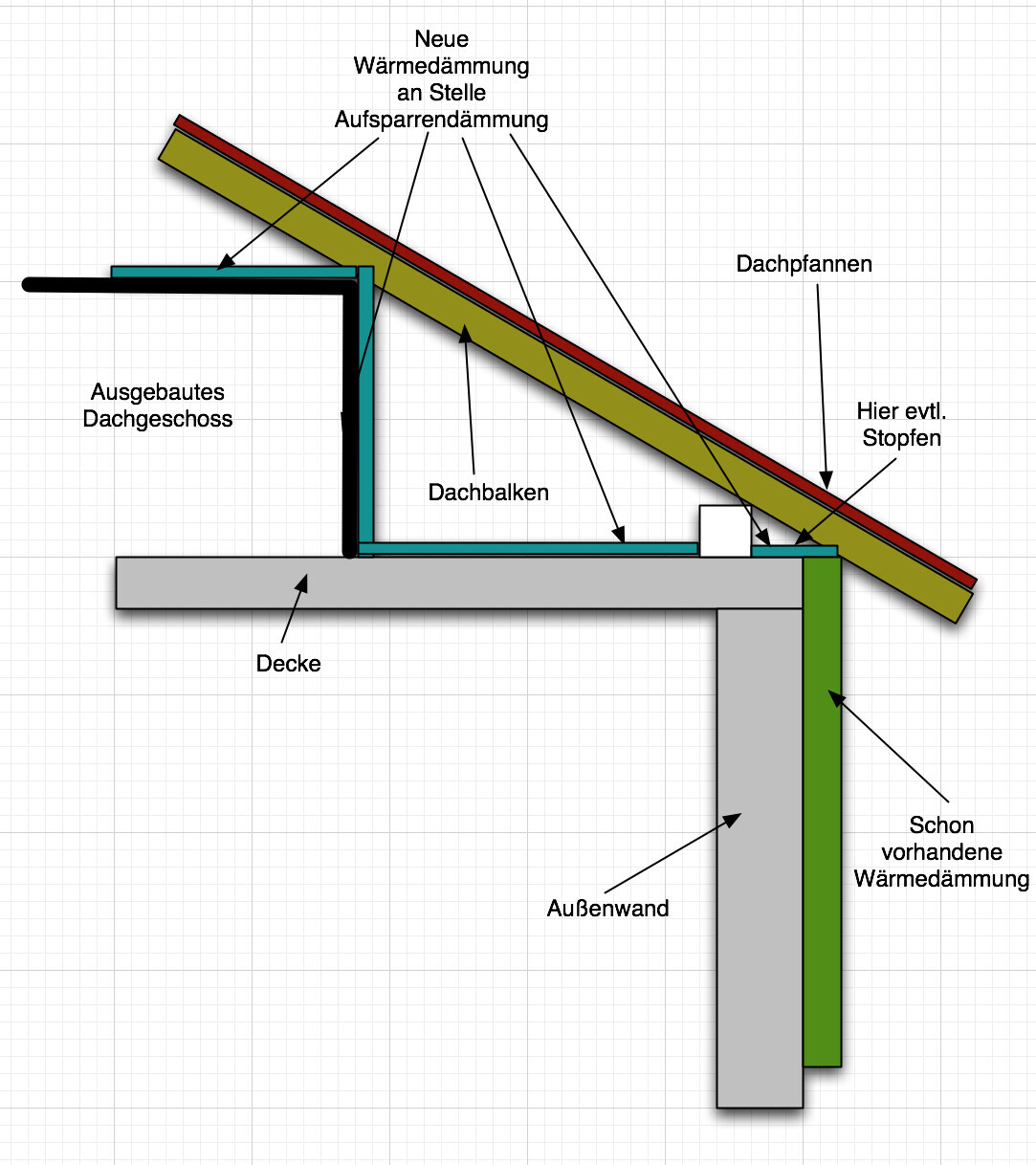
An alternative—which would also be cheaper than above-rafter insulation—would be to insert insulation mats into the space between the roof and attic.
See sketch.
Thank you very much for your feedback.
Jochen
Here are the key points:
Multi-family house. Built in 1961. Converted attic. Thermal insulation. Above-rafter insulation.
The roof is dry and the roof tiles are old but still watertight.
Now I have received quotes from different roofers mentioning vapor barrier and vapor retarder.
It is not completely clear to me why these are necessary.
I have read that a vapor retarder or vapor barrier is supposed to minimize or prevent moisture entering the thermal insulation.
My question is:
Moisture can also come from the outside air into the thermal insulation.
There are days in winter or summer when the relative humidity is very high.
This humidity also gets into the thermal insulation.
Or am I mistaken?
An alternative—which would also be cheaper than above-rafter insulation—would be to insert insulation mats into the space between the roof and attic.
See sketch.
Thank you very much for your feedback.
Jochen
Knallkörper schrieb:
Hello Jochen,
the applied thermal insulation must be able to dry if it is exposed to moisture from "below." Warm, moist air rises from the living space into the insulation. You mean warm, moist air rises through the ceilings/walls of the upper attic apartments into the roof space.
I believe the ceilings/walls were installed with drywall panels around 1961–1962.
Jochen
K
Knallkörper23 Sep 2016 20:04Exactly. Because of the material and joints. Can’t you insulate the roof slope? Is it no longer accessible there?
Knallkörper schrieb:
Exactly. Because of the material and joints. Can’t you insulate the roof slope? Can you no longer access that area? Which roof slope do you mean?
Jochen
K
Knallkörper23 Sep 2016 22:37Actually all of them. Especially those above the converted attic. So, why is cavity insulation between rafters not possible?
Knallkörper schrieb:
Actually all of them. Especially those above the converted attic. So, why is insulation between the rafters not possible? I learned that even with insulation between the rafters, a vapor barrier or vapor retarder should be installed on the underside of the entire insulation. How is that supposed to be done in the sloped areas?
Jochen
Similar topics